Drawing a HO Scale Union Pacific Water Tender Part 2

In my last post I shared with you the designs for my HO Scale Union Pacific auxiliary excursion train water tenders; you can find that post here.  Since then the test print has arrived and in this post I’ll show how it came out and the few improvements I have made.

As shown below the kits arrived from Shapeways with the Frosted Detail parts in a transparent form covered in the waxy residue left over from the print process.

HO Tender Kit Raw

I cleaned the parts using Goo Gone to break down the wax, however with this kit being HO it is considerably larger than my normal N Scale parts so a bigger container was needed.  An ice cream tub works very well for this as the lid can be sealed; the Goo Gone will evaporate if it is in an open container.  And I can strongly recommend honey flavour!

Goo Gone Ice Cream Tub

Only the parts printed in FD needed to put in the Goo Gone, the White Strong & Flexible material does not print in the same way and has no waxy residue.

After the cleaning process the FD parts turned opaque and the detail could now be seen as shown below.
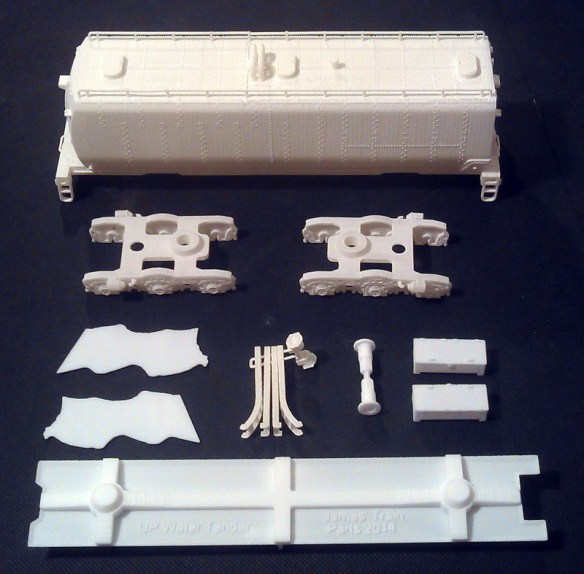
HO Tender Kit

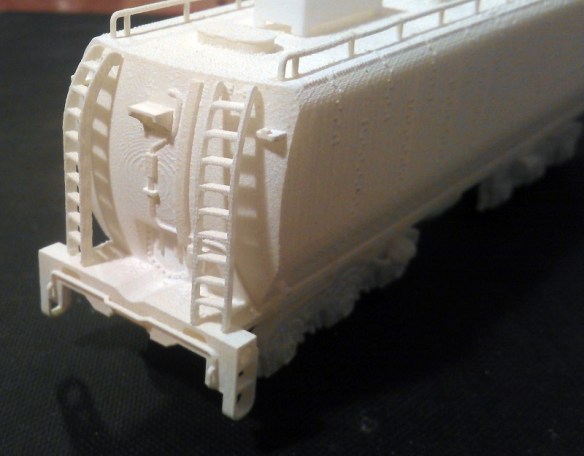
This is my first print in the FD material and it came out a little bit coarser than the Frosted Ultra Detail.  This particular model also had a lot more wax build up than I am used to which left a lot of powder on the model from the wax residue, and this needed scrubbing off with a toothbrush.  In the photos below you can still see a lot of the powder around the detail.

HO Tender Detail 1 HO Tender Detail 2 HO Tender Detail 3 HO Tender Detail 4 HO Tender Detail 5

Below you can see the trucks have powder in the holes, clogging the detail.
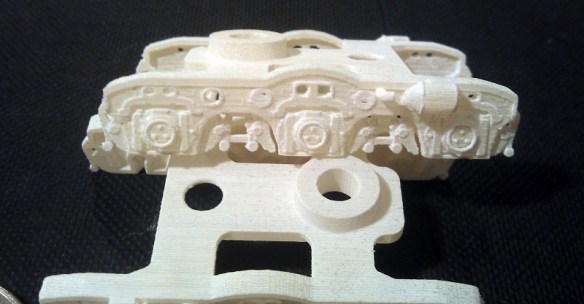
HO Tender Truck Detail 1

Most of it was easily removed using a toothpick and a toothbrush but there is still more to remove.HO Tender Truck Detail 2

The trucks have been designed to be used with Proto 2000 Wheels as shown below but the distance between the truck side frames is a little too tight so for the test print I have had to use plastic wheel sets from some old box cars.  This has now been corrected in the 3D model as well as the gap you can see between the air cylinder and the pipe.  I have ordered a test print of the new trucks for this model to check the Proto 2000 Wheels work.
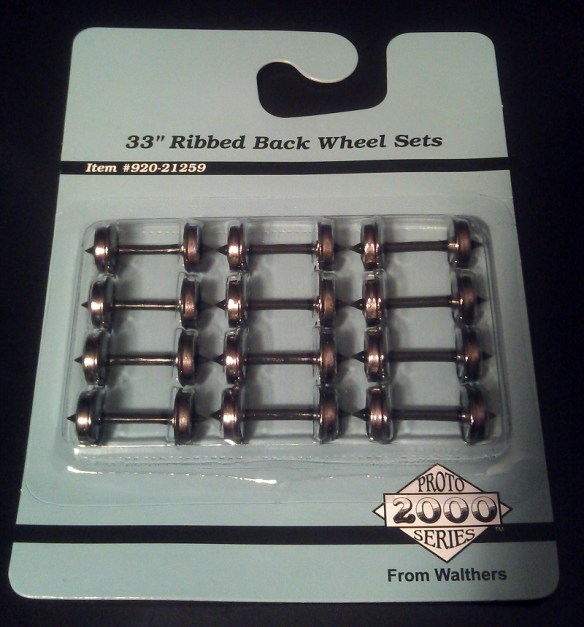
HO Tender Wheelsets

As with the N Scale kit the ladders are tied together on a ring which also has the head lamps attached to it, as shown below.

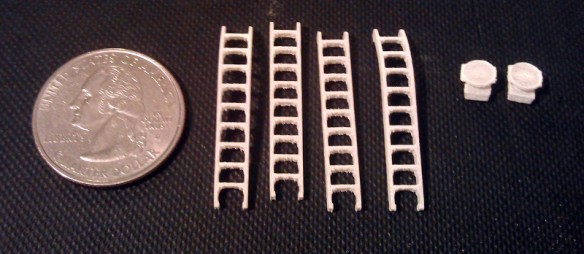
HO Tender Ladder Detail 1 HO Tender Ladder Detail 2

The chassis, tool boxes, flag plates and truck bolsters were all printed in WS&F and all came out well.  The bolster pins are fixed together to help reduce the number of small parts and can easily be cut apart.  HO Tender WS&F Parts

The holes in the chassis for the pins needed to be very slightly drilled out to allow the pins to be a good fit.

HO Tender Chassis  TrucksThe detail on the tool boxes came out very well in the WS&F, it had the level of detail necessary for this part.
HO Tender WS&F Tool Boxes

The chassis fitted into the shell a little too tightly so I have also altered the shell in the 3D model at one end to make for a better fit.
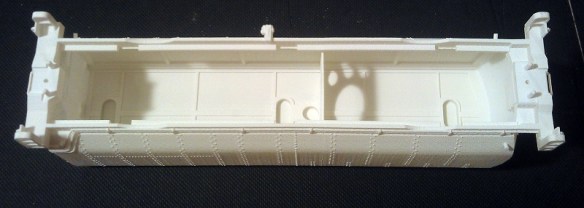
HO Tender Under Side 1

The chassis only fits in one way as each end has a different shape which fits around the coupling connection mounts.
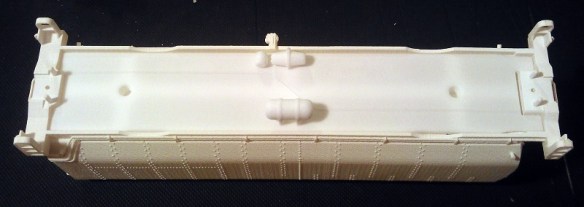
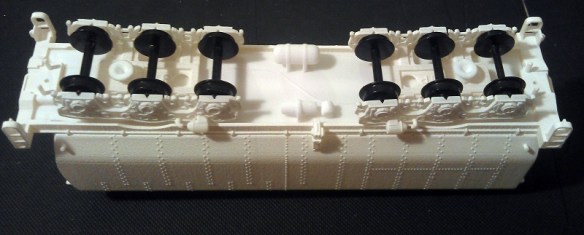
HO Tender Under Side 2 HO Tender Under Side 3Each end of the shell has two pegs to mount a Kadee coupler; I have used No.5 couplers.

HO Tender Coupling 1 HO Tender Coupling 2

The tender still needs some more checking over before I am happy to release it and I also want to check that the new trucks work with the Proto 2000 wheel sets but I think it is just about there.
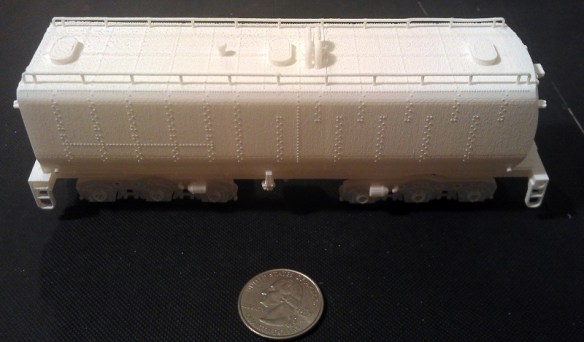
HO Tender Test Print 1 HO Tender Test Print 2

As I have already said in the previous post the cost of printing in the FUD material led me to test print in the FD material to make the model more wallet-friendly. Having assessed the overall finish of the FD test print the finish is a bit rougher than the FUD so when I do release the tenders for sale I will make them available in both materials to give you the choice.

In a later post I will show you what the FD HO tender looks like painted in the UP colors.

Drawing a HO Scale Union Pacific Water Tender

Back in February 2014 I showed you the drawings and designs for my N scale Union Pacific auxiliary excursion train water tenders. You can find the first post here.  These proved to be very popular and it soon became apparent that modelers in other scales would also like to have the 3D printed model.  In this post I will show you some of the things I have done to turn the N scale model into a HO model.

Below is a pair of the N Scale tenders, as currently run by UP with their heritage fleet.  Some of the details were omitted from the print due to them being simply too small to print and, as is often the case with N Scale, some details needed to be made larger than real life.  A good example of this are the steps at each end and the ladders.UP Water Tenders 1One of the most noticeable details missing from the print were the handrails running along the top.  Several customers have added their own, as shown below on Mark Peterson’s Tenders.

UP Water Tender 4 (Mark Peterson)

UP Water Tender 5 (Mark Peterson)

With the HO kit I wanted to add the missing details in and also improve the scale of the chunkier parts.  HO being at a scale of 1:87 is just about twice the size of N scale which is 1:160.  This means that everything will be, just about, twice the size and therefore the detail will be more defined. However this also introduces another issue.  Re-scaling an N scale model to HO will not simply make it twice the price.

The 3D printers charge by volume of material used or cubic capacity in cm3 to produce the print, plus a fixed charge per print.  So for example, if you had a 1 meter square cube (roughly 3 foot square) it would have a cubic capacity of 1m3 or 1,000,000cm3. If this was printed at 1:160 it would have a cubic capacity of 0.2439cm3.  But if you printed the same cube at 1:87 it would have a cubic capacity of 1.5161cm3 which is significantly higher.

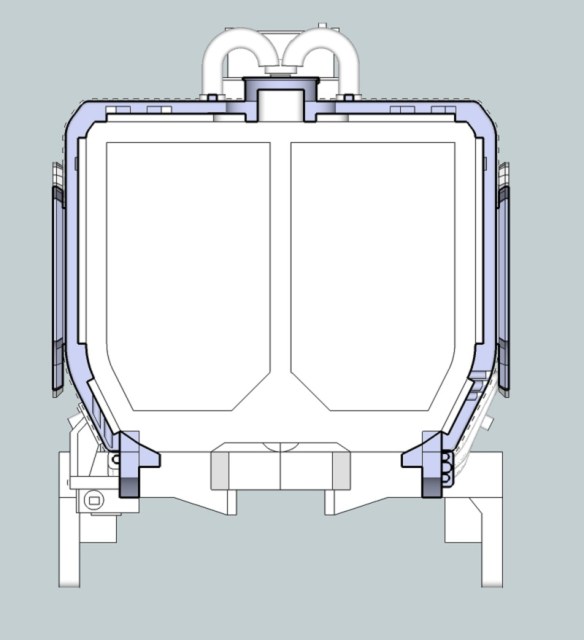
To overcome this there are a few things we can do.  The first thing is to look at the thickness of the parts as these are now all twice the thickness they need to be to print. The 3D printers specify the minimum wall thicknesses which they can print for all their materials.  My N scale water tenders were designed to print in Shapeways Frosted Ultra Detail (FUD) material which has a minimum unsupported wall thickness of 0.6mm.  Details such as the end steps and ladders will be reduced in thickness anyway to remove the chunky look I mentioned earlier, but the biggest difference is made in the large side panels and roof section.  By reducing these thicknesses it greatly reduces the cubic capacity of material in the model.  Below is a section though the N Scale water tender, you can see the thickness of the walls in light blue on the sides and top of the main shell.

UP Water Tender 2007-Present N Inside

After re scaling and adjusting the wall thickness for HO the section looks like this;

UP Water Tender 2007-Present HO InsideThe second thing we can do is look at printing in other materials.  The FUD material is one of the more expensive plastic materials due to the high level of detail that is achievable.  Shapeways also offer a Frosted Detail (FD) material.  This is printed in the same way but the level of detail is slightly less.  FUD can print detail which is embossed or engraved in the parts as small as 0.1mm (0.0039″).  FD can print detail which is embossed or engraved in the parts as small as 0.2mm (0.0078″).  This difference doesn’t sound a lot but in N Scale it is equivalent to 27.2mm (1.07″) and therefore using it for N scale is not practical.
However as we will basically printing an N Scale model at twice the size, printing in the FD material would make sense as the difference in detail will not come into play.  The FD material is cheaper than the FUD which also brings the cost per cubic capacity down.

The third thing we can do is to look at parts of the model which don’t have any detail, such as the chassis, which are required structurally but not cosmetically.  These can be printed in very cheap materials such as Shapeways White Strong & Flexable (WS&F).  WS&F is almost two and half times cheaper than FUD and even though parts in WS&F need to be thicker than in FUD they are still significantly cheaper.

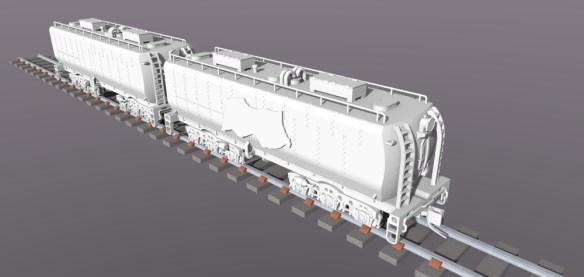
So for the HO Scale UP Water Tender the main body, ladders and trucks will be printed in FD and the chassis, truck bolster pins, tool boxes and flag plates will be printed in WS&F.  I have included the top handrails as part of the main body print.  The ladders are still separately applied details which makes painting easier as they are Harbour Mist gray and not Armor yellow.  Below is a rendering of how they will look.

UP Water Tender 2007-Present HO

The test print has been successfully printed by Shapeways and is due to be delivered to me this week. In a later post I will cover more in-depth details such as couplings and the wheel sets I have used for this model and how they fit, and I will also share with you how the test print came out.

Upcoming NMRA (BR) Convention and New Prints Around the Corner

This weeks post is fairly short as I have been very busy getting several new print designs underway, not just because most of my current projects are finished, but because this year I will be giving a Clinic on 3D printing at the National Model Railroad Association (British Region) Convention. The convention is on the 17th to the 19th of October and will be held in Bournemouth, England, at the The Carrington House Hotel, here is a link.

The clinic is titled ‘How 3D printing works and how it can help you’ so I will be demonstrating what can be done with 3D printing and showing off some of my designs in various stages of the process.

I will post up a little nearer the time as to what day and time my Clinic will be and I look forward to meeting anybody that wants to learn more about 3D printing or simply wants to see my models in the flesh, or in this case plastic!

I also have a few new items currently being printed, actually as I type this post, which I will be sharing with you over the coming weeks. These include repair kits for small steamers, detail parts for Gas Turbines, some new locomotive shells and a few surprises.

The first large print that I am looking forward too is also my first HO scale model kit as well as my first test print in Shapeways Frosted Detail material.  This will be my Union Pacific Water Tenders, Jim Adams and Joe Jordan, which should be ready soon.  These will have parts printed in several different materials to reduce cost but I will cover this model in more depth in a later post.  For now here is a screen shot taken from my 3D model.

UP Water Tender 2007-Present HO

A little later this year these tenders will also be available in TT Scale and O Scale.  My Baldwin DT6-6-2000 will also be coming out in TT and HO Scales.

For N Scale I am currently finishing my Baldwin RT624 locomotive shell and will shortly be starting the big ALCO Century 855, which coincidently I announced I was doing at last years NMRA (BR) convention so I guess its time I pulled my finger out.

For those of you that will not be able to attend the convention I will be taking a lot of photos and videos of the layouts and displays to share with you, as this year neither of my clubs will be bringing a layout to run I will have more time to enjoy the convention.

Running Trains at The Bearwood Group’s Running Meet

This weekend I was at the Bearwood Group’s running meet with the Poole & District Model Railway Society’s N-trak layout.  The Bearwood Group is predominantly a HO club and had two very nice layouts on display which I was hoping to photograph to share with you, but as usually happens when you get the opportunity to indulge in your passion, I spent just about all my time running trains and talking to fellow modelers about various 3D printed items!  But I do have some photos and videos to share with you from the N-trak layout.

The layout consists of a large industrial section with plenty of switching at the front, as shown below, and a large yard at the rear, also shown below.  The layout was reviewed in more depth in my post about the Bournemouth N-Trak convention which you can find here.

P&DMRS N-Trak Frount 9-8-2014 P&DMRS N-Trak Tard 9-8-2014

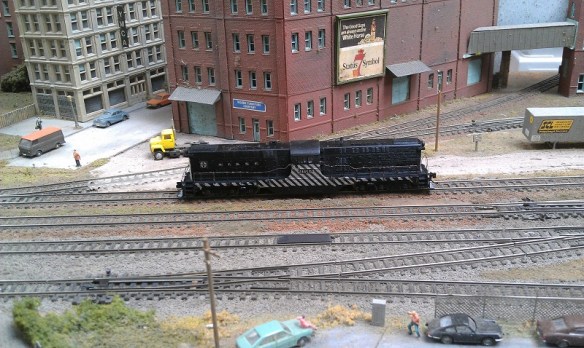
Looking at the yard image above you can see my EMD DD35 paired up with a brass 8500HP gas turbine at the bottom left of the shot.

Not knowing if there would be a set theme or time period I brought a variety of stock to run, and as it turned out it was an open session, so I started with early steam, as you can see below, from my Sierra Railroad fleet.

Sierra 28 Berwood 9-8-2014

There was a lot of interest in my new model, the Baldwin DT6-6-2000, of which I had two running on the layout;  ATSF no. 2601 and no. 2602.  2602 has the new etched brass Additions handrails and is also equiped with DCC sound.

DT6-6-2000 ATSF 2601 & 2602 Bearwood 9-8-2014

Both units trundled around the switching yards at the front of the layout and looked fantastic stopping to pose for some photos.

DT6-6-2000 ATSF 2602 1 Bearwood 9-8-2014

DT6-6-2000 ATSF 2602 2 Bearwood 9-8-2014 DT6-6-2000 ATSF 2602 3 Bearwood 9-8-2014 DT6-6-2000 ATSF 2602 4 Bearwood 9-8-2014 DT6-6-2000 ATSF 2602 5 Bearwood 9-8-2014 DT6-6-2000 ATSF 2602 6 Bearwood 9-8-2014

DT6-6-2000 ATSF 2602 7 Sieers 28 Bearwood 9-8-2014

Both ATSF 2601 & 2602 are DCC powered and run very well together creating a very similar scene to many photographs of the real pair working together.

DT6-6-2000 ATSF 2601 & 2602 Bearwood 1 9-8-2014 DT6-6-2000 ATSF 2601 & 2602 Bearwood 2 9-8-2014

Here is a short video of the pair running by.

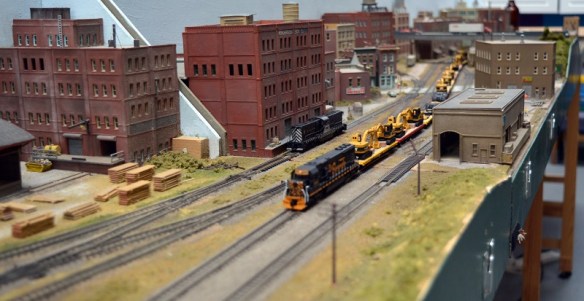
2602 then returned to the front of the layout where it sat noisily idling away as the Rio Grande trundled by with a load of JCB excavators.

DT6-6-2000 2602 & Rio Grande Bearwood 9-8-2014

JCB train Bearwood 9-8-2014

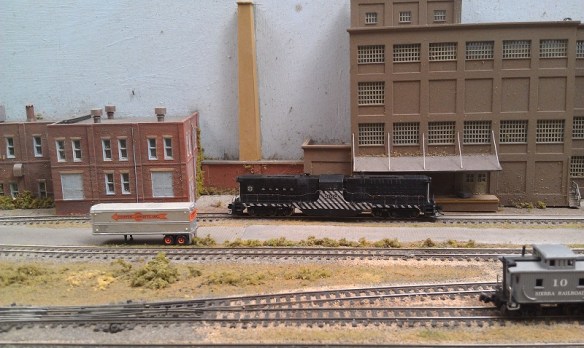
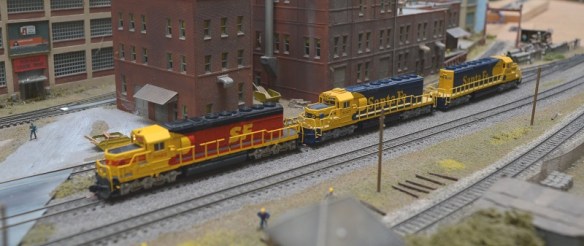
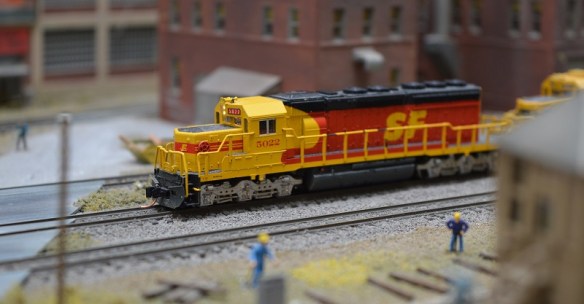
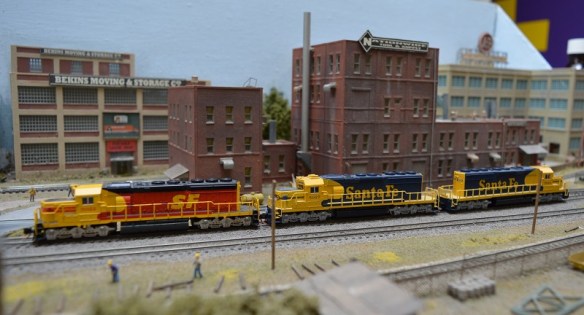
The AT&SF had a good presence at the show as a set of SD40-2 cruised through on their way to pick up a train.

SF SD40-2 Bearcross 9-8-2014

SF SD40-2 1 Bearcross 9-8-2014 SF SD40-2 2 Bearcross 9-8-2014 SF SD40-2 3 Bearcross 9-8-2014

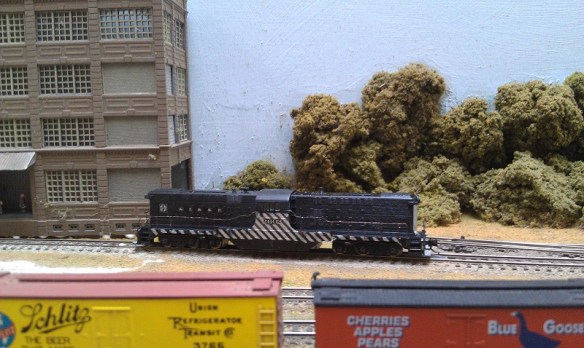
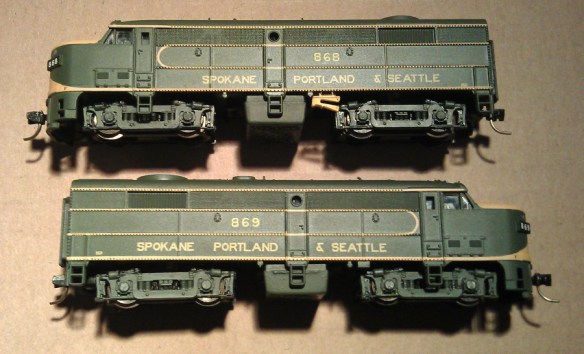
As well as freight we also had a lot of passenger trains running through the layout but the only one I manged to catch on camera was Northern Pacific’s Vista Dome North Coast Limited as is streaked through.  Obviously the NP were having some motive power issues today as the train was powered by a set of Spokane, Portland and Seattle Railway Alco FA2s.  Note the chassis mounted Re-Railers on the last locomotive, you can see one as it passes the gap in the fence.

You can also just make out the tops of the DT6-6-2000 as they ran the other way with another freight transfer.

Then next thing I knew it was time to pack up but it was a very enjoyable day and I’d like to thank Bernie Wood for letting me use some of his photographs here.  The Bearwood Group will be having another running meet in December and hopefully I will get time to photograph their HO layouts to share with you.  There might even be some of my forthcoming HO products running on their layout but that will have to wait for another post.

Discovering the Possibilities of Etched Brass Part 4 – With Sound

A few weeks ago I shared with you the etched brass Additions for my EMD DD35 kit, which you can find here.  This week I wanted to share with you some more work-in-progress pictures, this time with the etched brass Additions for my Baldwin DT6-6-2000 kit as shown below.

DT6-6-2000 Additions Set

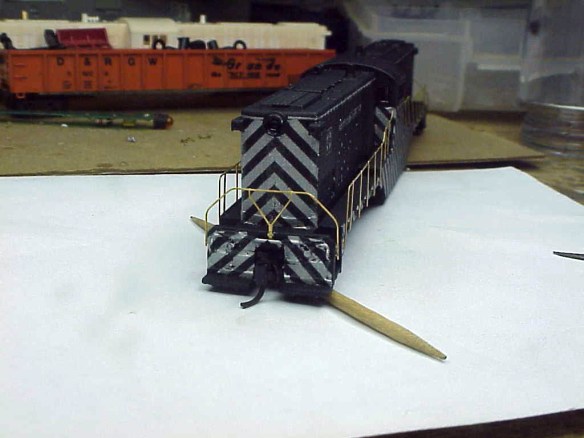
Below is a photo of a DT6-6-2000 using the stock 3D printed handrails.  An interesting point was raised recently by a fellow modeller who also adds a lot of custom etched brass details to his British OO locomotives and rolling stock.  He said that he has stopped putting the details on all of his stock that he takes to shows because after a few trips the brass details start to get damaged through handling so he is limiting it to just the stock he keeps at home.  Because of points like this the 3D printed hand rails will still be provided with the kits should you wish to use them.   DT6-6-2000 Finished 8 As with the DD35 Additions kit the DT6-6-2000’s handrails can cut out of the brass plate with a sharp craft knife and simply glued into place.  Below are some work-in-progress shots taken by Brian Stewart of one of his DT6-6-2000s, the brass stands out well against his black paint work.
DT6-6-2000 WIP(Brian Stewart) 3 DT6-6-2000 WIP(Brian Stewart) 2 DT6-6-2000 WIP(Brian Stewart) 1

The other DT6-6-2000 shell in the background will be the two tone green Baldwin demonstrator engine.  Brian painted the handrails after he installed them as shown below finishing the locomotive ready for use.

DT6-6-2000 WIP(Brian Stewart) 6 DT6-6-2000 WIP(Brian Stewart) 5

The difference between the 3D printed and etched brass handrails is very noticeable and looks very realistic.

These etched brass Additions are made from 8 thou brass and are very thin, this makes them very flexible and also very easy to bend and misshapen by accident.  Now that I and others have had a good chance to work with them I think that the next sets of brass etched Additions, which will be for the Baldwin RT624, will be made from 10 thou brass and the handrails will be about 0.2mm wider.  This doesn’t sound a lot but it will add more rigidity to the handrails without losing the realistic look they achieve.

When working with very thin etched brass details there are a few things that you can do to bolster them.  A simple method is to add several layers of paint, this will round off the brass giving it a thicker look but will not add any strength, plus it may also cover up small etched details.  Another option is to strengthen the rails by adding solder.  Solder takes very well to brass and is the prefered method of joining brass kits together.  The trick with details like handrails is to coat the rear surface of the handrail with flux.  Then when the hot solder is added to the handrail it will run out over the flux evenly thickening up the brass.  This adds a lot of strength to the handrail but can be tricky to do.  Another option also using solder is to dip the parts in a solder bath, then all the surfaces get an even thin coat of solder which greatly increases the strength.  However by simply making my future etched brass Additions out of thicker brass will solve the issue.

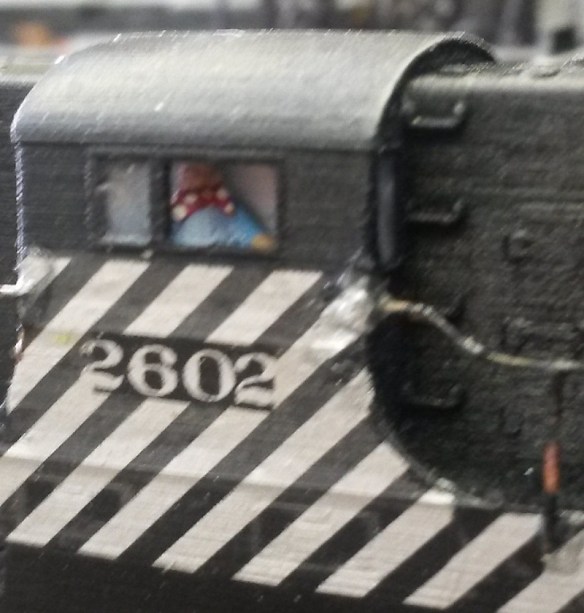
Sometimes having kinks in the handrails can be desirable if you want to make your model look used and tired.  On one of Bob Norris’ DT6-6-2000s he has used a mixture of rust colored paints making the handrails look like they have been soaking up too much of the California sea air.  I particularly like the patterned neckerchief on Burt the driver.

DT6-6-2000 Rusty Rails

DT6-6-2000 Driver

This particular unit also come with sound.  Bob has fitted a Digitrax SDN144A0 DCC sound decoder which is a ‘drop in’ decoder for the donor chassis, an Atlas C-628.  The only changes Bob made was to lengthen the LEDs and change the speaker for a ‘Sugar Cube’ speaker made by Zimo.  This speaker is only 12mm long, 8mm wide and 8mm tall and fits nicely on the chassis where the C-628 cab would have been.  The speaker is much louder than the stock speaker and here is a short video so you can hear it for yourself.

I still have some DT6-6-2000 etched brass Additions left so if you require some for your 3D printed shells please drop me a message using the Contact page.

This coming weekend I will be at the Bearwood Groups running meet with the Poole & District Model Railway Society’s N-trak layout so I will have some photos and videos to share with you from the day and if you are in the area it would be nice to see you.

Getting Back on Track Part 2

Last week I shared with you my design for an N scale Re-Railer which can be added to your locomotives as a detail part.  You can find the post here.  This week I wanted to share with you how the 3D print came out and what it looks like on some of my locomotives.

The design for the print, as pictured below, included the mounting bar and lugs so it could be fixed directly to the locomotive chassis, as was typical on a lot of switching locomotives.

Re-Railers Type 1-3

When the parts arrived they needed cleaning, as do all parts printed in Shapeways Frosted Ultra Detail material.  I did this by using my normal method of soaking the parts in Goo Gone for 24 hours, but before I did this I took some photos.  As shown below, even though the parts are transparent, the detail and shape is visible, although with an average phone camera getting the detail in focus is hard. Re-railer Type 1 Raw FUD 1Once removed from the Goo Gone I let the parts dry for a further 24 hours in which time they turned opaque.  They are still hard to photograph at this stage, not just because they are very small but the brilliant white reflects a lot of the light.
Re-Railers Type 1 - Cleaned

I brush painted the Re-Railers using a basic matt yellow acrylic paint.  To make sure I didn’t put on too much paint and fill all the detail I dipped the brush lightly into the paint then wiped most of it off on the side of the pot before painting the parts.

Yellow Paint

Again getting my camera to focus on such a small part created some issues as you can see below but the detail of the parts really stands out now they have been painted.

Re-Railers Type 1 - Painted

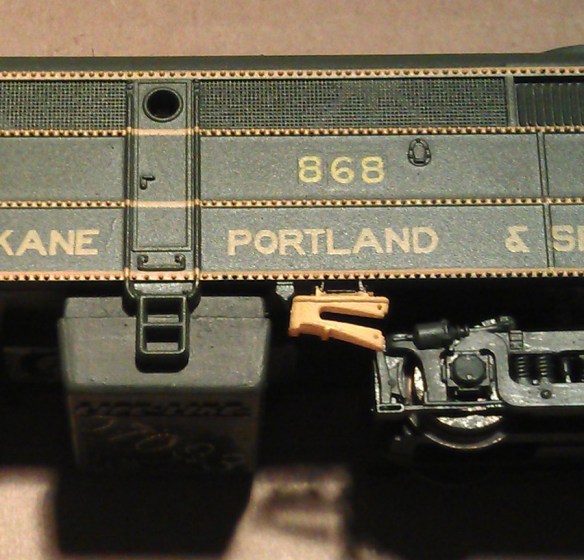
The next step was to fix them to some locomotives.  A good example of these in place on a real locomotive can be seen here and here on Canadian Pacific’s S-3 loco No. 6538.  I don’t have any S-3s on my roster but I do have various other locomotives that I want to super detail and I am starting with my Life Like Spokane, Portland and Seattle FA2s.

FA1 with Type 1 Rerailer

These models don’t have such a large fuel tank as the later FA2s so there is plenty of room for the Re-Railers to hang.  I used a gel super glue to fix it in place and I only glued it to the plastic shell and not to the models chassis, this enables me to remove the shell without damaging the Re-Railer.

FA1 with Type 1 Rerailer - Close Up

The trucks swing freely without knocking the Re-Railer and it doesn’t protrude past the shell so I can still put the locomotive in its original box.

Re-Railers are more commonly found on switching locomotives and for this I often use my GP20, also made by Life Like.  The fuel tank on this locomotive doesn’t give as much room so I have mounted the Re-Railer under the shell at the center of the truck, as shown below.  This also enables the truck to swing freely as the Re-Railer is in line with the truck pivot where it moves the least.

GP20 With Re-Railer

This Re-Railer detail part is currently available in 3 different packs from my Shapeways shop or by clicking on the links below;

A set of 8

A set of 16

A set of 32

The GP20 locomotives also used a different style of Re-Railer which were carried on the side of the trucks; if you look closely at UP No. 475 pictured here you can see them.  I am also designing these truck mounted Re-Railers but that will be for another post.