A Replacement Drive Shaft for an N Scale Bachmann 4-4-0

Since releasing my N Scale MDC/Roundhouse/Athearn 2-8-0 & 2-6-0 drive shaft repair kits back in 2014, which can be found here, I have been asked to produce replacement drive shafts for several other N Scale locos.  One of these is the Bachmann 4-4-0.  So in this post I will share with you the results.

The Bachmann 4-4-0 or ‘American’ has been around since 1979 and for years was the only choice for a ready-to-run model of this locomotive.  The first generation, as pictured below, housed the motor in the tender.  This was then connected via a thick drive shaft to the driving wheels through to the back of the cab.
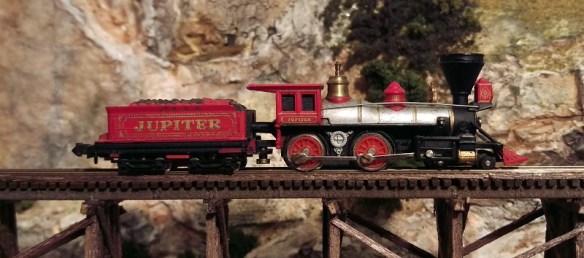
Bachmann 4-4-0 Old Style

The model had several improvements over the years but the one that I’m interested in  was made in 1998 when the drive shaft was changed, leaving the locomotive looking like the one below.
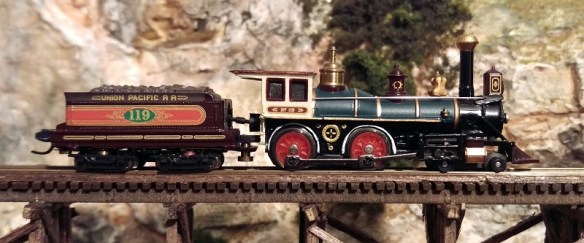
Bachmann 4-4-0 New Style

Together you can see the locomotives are basically the same, the newer one just has finer paint and details.

Bachmann 4-4-0 New & Old Style

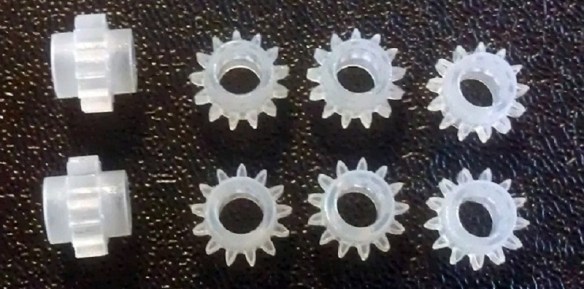
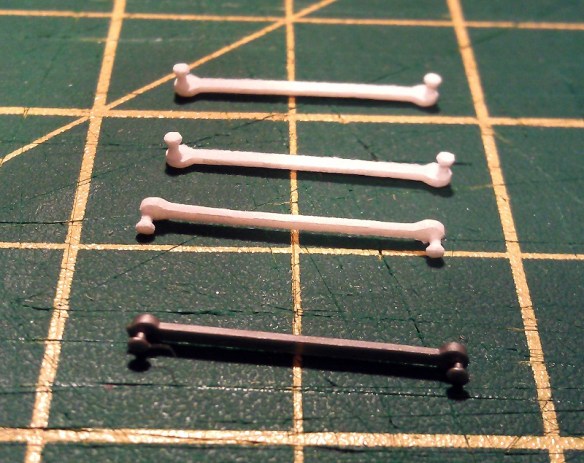
The original locomotive’s drive shaft was a Hex-Cup style, pictured on the left in the image below.  This drive shaft was fairly bulky and dominated a lot of the space between the cab and tender.  On the end of the motor and worm gear inside the locomotive is a hexagonal nut that the ends of the drive shafts fit over.  This arrangement allows the linkage to flex as it goes round curves in the track.  The improvement in 1998 was to replace the bulky Hex-Cup with a Ball-Cup and peg design, as shown on the right.  The ball fits into a cup with slots on ether side.  The ball can rotate in all directions within the cup and the pegs rotate the shaft via the slots.

Bachmann 4-4-0 Drive Shafts

The Ball-Cup and peg design, apart from being much smaller, makes for a smoother motion which improves the performance of the loco.

However, as with all small parts it’s possible to lose these bits when servicing the loco or possibly they could break, particularly with those tiny pegs on the ball and cup connection.

Bachmann do sell replacements parts for the newer style drive shafts but they have been out of stock for a long time. As for the older Hex-Cup shaft it is likely that these are no longer available.

So I have drawn up both drive shafts and made them available on Shapeways.

Bachmann 4-4-0 Drive Shafts Rendering

The larger and earlier Hex-Cup type is available here and can be printed in either Shapeways’ Frosted Ultra Detail or their Frosted Extreme Detail materials.  As usual with these materials they can be used directly out of the bag but they are a white or translucent color.  They can be painted but they will need of be cleaned with a product such as Goo Gone in order to remove any wax residue left over from the print process.  The wax will prevent the paint from drying or adhering to the part.

The smaller Ball-Cup style drive shaft is available here and comes in a pair.  This is because, unlike its predecessor, the Ball-Cup drive shaft is a bit more delicate, particularly around the pegs so just in case the first one gets broken I have supplied a spare.  Again the second generation drive shaft is printable in both FUD and FXD materials from Shapeways.

This Ball-Cup and peg system has become a commonly used drive shaft across a lot of model manufactures but sadly the actual drive shafts are all a bit different; whether it is length or peg diameter the chances of one manufactures drive shaft fitting into an others locomotive is slim.  However if you are in need of a drive shaft for a particular model please let me know through the contacts page and I can draw up the parts and make them available on Shapeways.
Happy New Year and a Look Back at 2015

Happy New Year!

For this week’s post, being the first post in 2016 and because I did it last year, I thought I would take a look back over the 3D printed and metal products, how-tos and exhibitions from 2015.

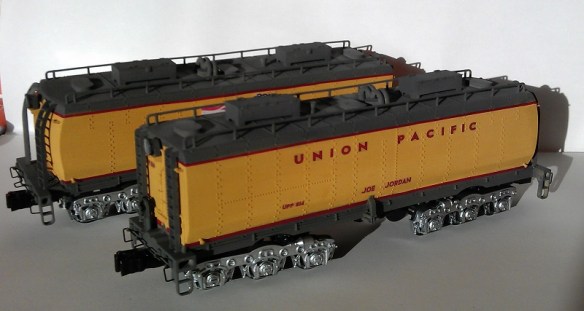
January saw the release of my O scale Union Pacific excursion train tenders.  These had already been released in N Scale and HO but to scale up to O was an interesting challenge.  Both Joe Jordan and Jim Adams were made available and they can be found here.

O Scale Tender Shells Finished 6

These were a lot of fun to work on after all the N Scale models and they looked fantastic.  Only the bodies and detail parts were 3D printed as they ran on Lionel trucks and chassis.  The Lionel parts have plenty of weight, which is very important with O Scale.

The other new release for January was my N Scale dummy chassis for Atlas’ Alco C-628 & C-630 body shells.

Alco C-628 Dummy Chassis Render 3

This chassis was also made available with the option to fit the original circuit board for lighting using a circuit board clip as shown below.

Alco C-628 Dummy Chassis Render 6

This chassis is ideal if you have purchased one of my Baldwin DT6-6-2000 or RT-624 kits and have a spare shell left over from the donor locomotive.  In the line up below only the middle locomotive has a powered chassis, the other two are dummies using my chassis kit.  The kit can be found here.

Alco C-628 Trio - x2 Dummys

In February I released my replacement gears for Rivarossi F9 O Scale locomotives.

Rivarossi F9 Scale Gears Button

These replace the original drive gears on the axles that have a tendency to split.  Below you can see a set that has been fitted to the loco.

Rivarossi F9 (O Scale Gears 6 (Mike Dobson)

The Rivarossi F9 chassis is popular with O Scale modelers and here it is under a GP7 body shell on Mike Dobson’s home layout.  The incline is fairly steep so it’s a good testament to the strength of the gears.  They can be found here.

February also saw the start of my C-855 project which you will be seeing more of very soon.

Alco C-855 WIP Render 5

March brought detail parts such as my replacement N Scale horns and these came in a variety of styles.

Horns Type 3-3 Horns Type 3-2 Horns Type 3-1

These are now available here in several configurations and there will be more coming this year.

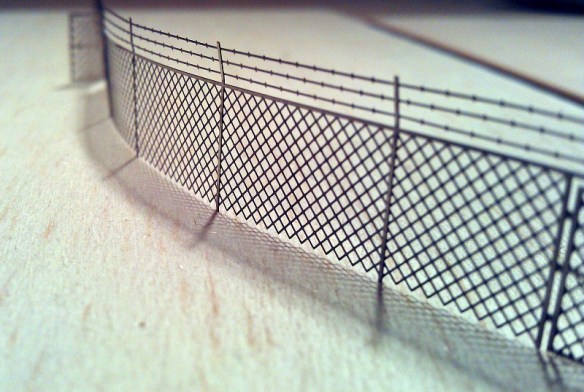
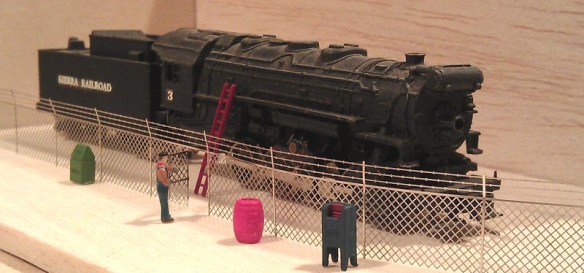
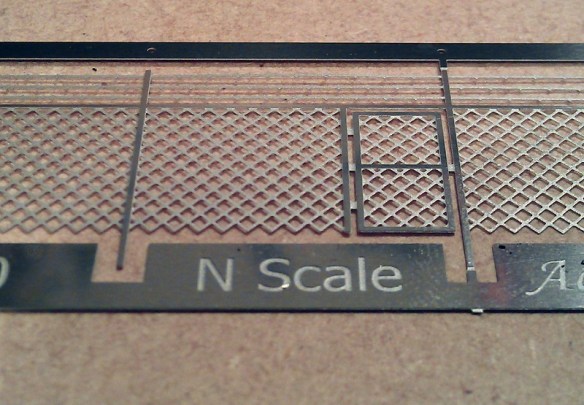
April introduced my N Scale Etched Chain Link Fencing.  The fencing is made from stainless steel sheet and is currently available in three configurations which can be found here.

Chin Link Fence Blog Post 36 Chin Link Fence Button Chin Link Fence Blog Post 4 Chin Link Fence Type 1 Chin Link Fence Type 3

Because of the new fencing and other metal products becoming available I created an Etched Metal Additions page in the shop.

Shapeways also announced their new higher quality 3D printed material FXD.

Shapeways-fxd-email-hero-625x468

This new material has a 16 micron layer thickness which is sharper and finer than the FUD which has a 29 micron thickness.  The FUD is still a fantastic material so, as the FXD is more expensive, I now offer my models, where appropriate, in both materials.

May brought more detail parts such as the replacement eccentric rods for MRC/Rowa N Scale 2-8-4 locomotives.

Berkshire Eccentric Rod Repair 1

These are designed to simply clip in as a direct replacement, as you can see below.

Berkshire Eccentric Rod Repair 3

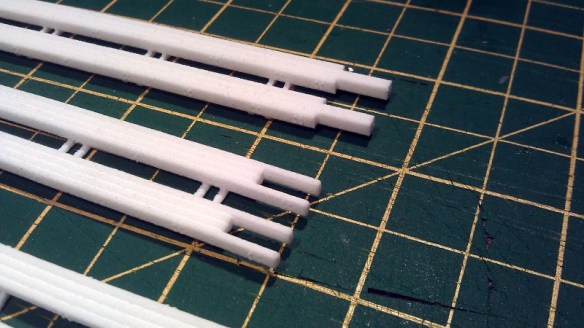
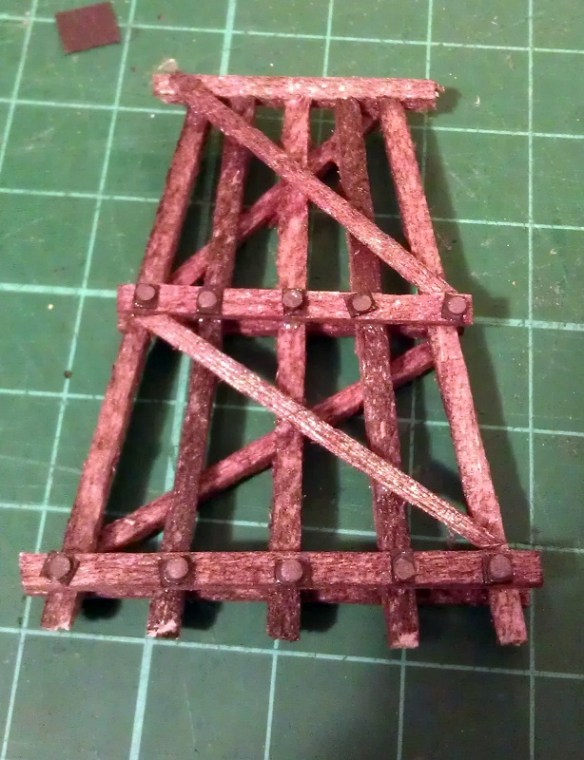
June introduced some more N Scale replacement horns and I started sharing my work on my modular layout sections, beginning with my 3D printed trestle bridge deck.

WS&F Trestle Parts 5 WS&F Trestle Parts 6 WS&F Trestle Parts 9 You can read more about the trestle parts in part 1 here and part 2 here.

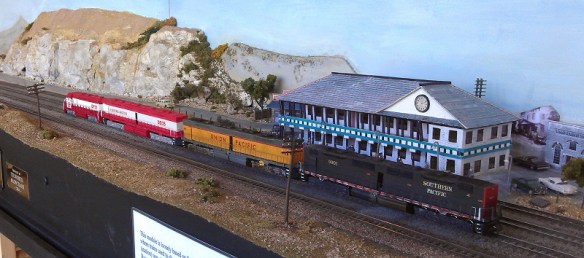
The C-855 project also took a step forward with its metal chassis extension parts.

C-855 Chassis Extenders 1
C-855 Chassis Extenders 9

C-855 Chassis Build 15

You can read more about the chassis extension here and here.

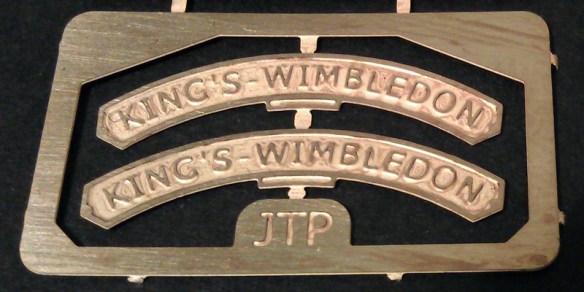
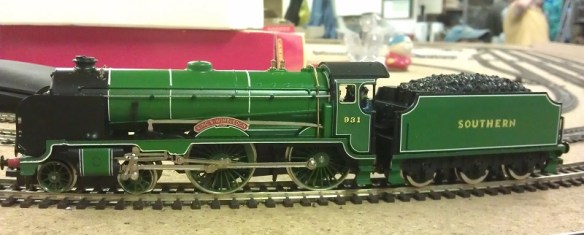
With the summer getting underway, July was a quiet month for new releases, with only a set of etched brass name plates being released for a OO gauge Schools class 4-4-0 locomotive.

New Name Plate New Name Plate 3 New Name Plate 2

The rest of the month was mostly taken up with working on my modular layout getting ready for exhibiting, and I did a how-to on casting your own rocks, which you can read about here.

Rock Moulding From Bark 9

In August I gave some demonstrations including how to create cheap but effect Nut, Bolt & Washer details for trestle bents which you can find here.

NBW Blog Post 16

You can find my how-to on using your rocks to build river & railroad canyons here.

Warsash Canyon Creation 16

And how to paint your rocks which you can find here.

Colouring Rocks 12

And to close out August I released my brass Addition kits for my P42 mirrors and GP7/9 detail parts.

JTP Additions P42 Mirrors

JTP Additions GP7-9

They can both be found in the etched metal Additions page here.

September brought some more replacement parts and this time it was a crank pin for a Minitrix 4-6-2 Britannia.  You can find the part here.

Minitrix Crank Pin 5

Minitrix Crank Pin 8

Minitrix Crank Pin 9

I also did two more demonstrations; one on how to ballast track which you can find here.

BalistingTrack 13

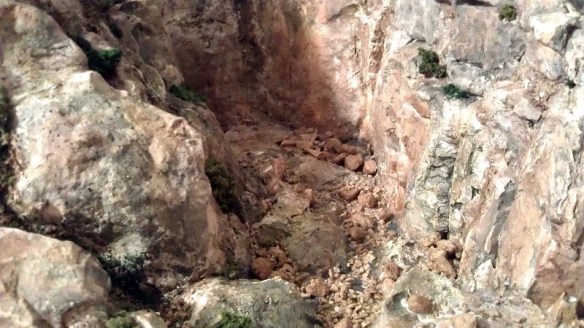
And one on how to make your own Talus and rock fall for river beds which you can find here.

Making Talus 18

November was mostly taken up with exhibition reviews (see towards the end of the post) but I did share with you my new design for 3D printed speaker enclosures which you can read about here.

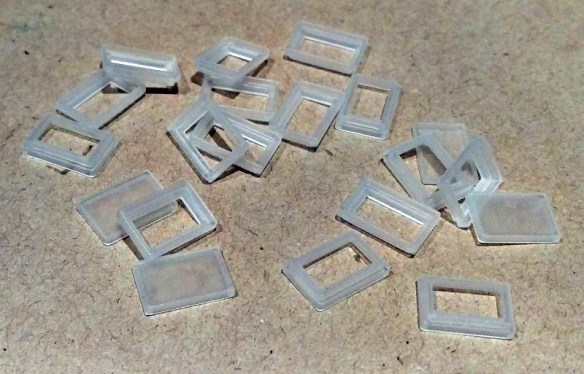
Speaker Enclosure Prts Raw.

These will be available shortly but for now you can see some examples of the working prototype here.

Speaker Enclosure Base plus 2

December is normally a short month for me and I shared with you a how-to on adding resistors to N Scale wheelsets for track detection.

Wheel Set Resistor 12

As well as all the new products and how-tos I also visited a few exhibitions and a home layout and you can find them all below.

Poole & District Model Railway Society’s Exhibition 2015, November 8th

NMRA (BR) Annual Convention 2015 – 23rd to 25th October

Southampton Model Railway Exhibition 2015, January 24th & 25th

David Townend’s Mckinley Railway

And that rounds up 2015, it’s been a good year and I’d like to thank you for your continued support. Here’s to a happy and finely modeled 2016!

My Last Post of 2015

2015 is drawing to a close and I have been spending some time this week catching up on some of my projects over the Christmas break. So this week’s post is simply to remind you about Shapeways 15 days of deals which will be running until the end of the year and to wish you all the best for the New Year.

The start of the New Year will bring the completion of some long awaited projects and the introduction of some new ones, I think it’s going to be a good year.

James

New Gears for an O Scale Rivarossi F9 Revisited

Back in February of 2015 I shared with you my 3D printed replacement gears for the Rivarossi O Gauge F9, you can read the post here.  Since producing the gears we have picked up a few anomalies in the different Rivarossi locomotives, mainly caused by a large manufacturing tolerance, that causes an issue with the gears.  In this post I will be showing you the new updated gears.

Although the 3D printed gears are vertically identical to the original Rivarossi ones they have been coming out at about 0.3mm to 0.5mm larger in diameter than anticipated.  For the majority of the Rivarossi O Gauge F9s that were fitted with the new gears, this had no impact as there was room for this.  But a few seemed to bind up.  The problem was traced to the 3D printed gear teeth hitting the corresponding gears root.  The root is the bottom of the gap between the gear teeth.

To solve this the 3D printed gears teeth where reduced in length by a fraction each reducing the overall diameter of the gear.

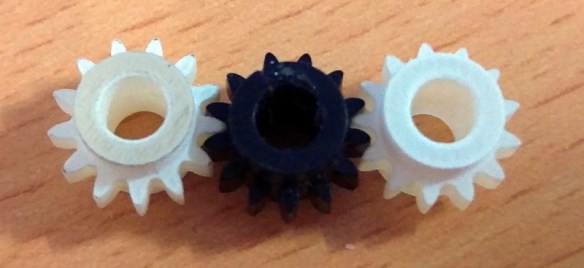
Below is an image with all three gears.  On the left is one of the first run of 3D print gears, in the middle is the original injection molded gear and on the right is the new 3D printed gear.

Rivarossi o Scale Gears 1
Although it is hard to see, as the difference is small, the teeth on the new gear are slightly shorter than on the first run.  This will make the new gears mesh perfectly with all the existing Rivarossi gears even if the drive gear position is a bit out of tolerance thus eliminating the problem that arose with a few models.

All the gear pack in my shop have been updated to the new versions and you can get them here.

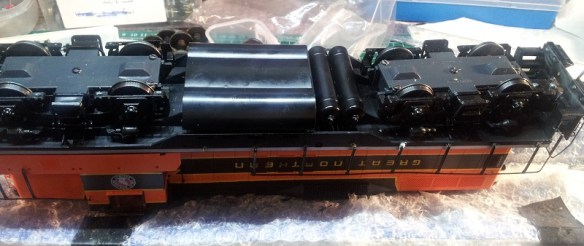
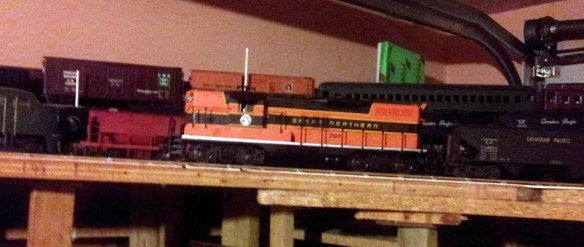
Mike Dobson is the fellow modeler who first asked me to 3D print the gears to repair his locomotives and below you can see the new gears fitted to a chassis under a Great Northern GP7 shell.

Rivarossi F9 (O Scale Gears 6 (Mike Dobson)

As you can see below Mike has several sets of axles already repaired with the new gears ready to be fitted to his locos.

Rivarossi F9 (O Scale Gears 7 (Mike Dobson)

Rivarossi F9 (O Scale Gears 8 (Mike Dobson)

With the locomotive reassembled, it was time for a test run.  Mike storage yard is above his layout in the roof and there is a fair climb up to it.  This is a great test for the gears.

Rivarossi F9 (O Scale Gears 9 (Mike Dobson)

And finally we have a video of his repaired GN GP7 running on Mike’s layout.

And that ‘wraps up’ my last post before Christmas, but not wanting to leave you with out a gift, the nice people at Shapeways are having 15 days of deals to close out 2015, and today’s deal is $10 off all Frosted Detail Plastic orders of $30 or more!  As all the gears and my locomotive shells and detail parts are printed in Frosted Detail Plastics this could be useful.  Simply enter the code FROSTY2015 at the checkout.  This offer ends at 11:59PM Pacific Time on the 21 December 2015.

Happy Christmas

Completing My N Scale DD35 Set

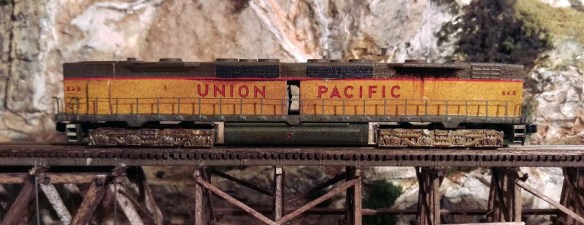
This week’s post is about completing my set of Union Pacific EMD DD35 locomotives and making one of them look like it’s about ready for the scrap man’s torch.

My N Scale DD35 kit comes with 3D printed handrails and although they are strong and fit well, they are a bit on the thick side, as you can see in the image below.  This is one of my early DD35 dummy locomotives.

UP DD35 With 3D Printed Handrails

When running a DD35 along with a Con-Cor U50, as shown in the next image, this is less of a problem as the U50 also has oversized handrails so they work well together.

DD35s and U50

To further improve the DD35 I released an Additions kit of brass handrails and as you can see below they greatly improve the locomotive.

UP DD35 With Brass Handrails

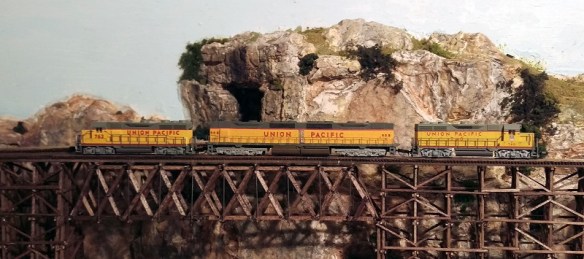
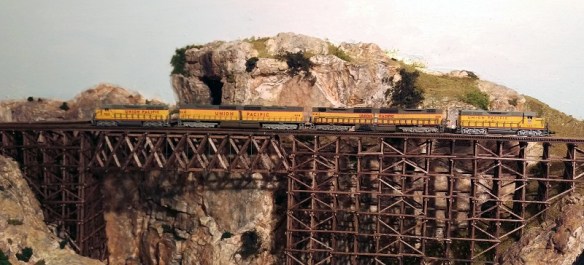
The DD35 above has been painted as if it was a new locomotive and is ideal for running with a pair of GP35s as shown in the following image.

UP DD35 with GP35s Brass Handrails

Ideally another DD35 is needed to complete the set but as you can see from the image below the 3D printed handrails tend to stand out.

UP DD35s with GP35s Plasic & Brass Handrails

Weathering a locomotive always improves the appearance, even if it’s a little soot around the exhaust stack and grills, but to really make a DD35 look like it’s had a hard life you need to go a step further.

The DD35 shell used for the locomotive below was actually a damaged shell.  It had suffered damage which had left the surface very rough and some of the detail had been obliterated.  This made the shell perfect for a heavy weather.

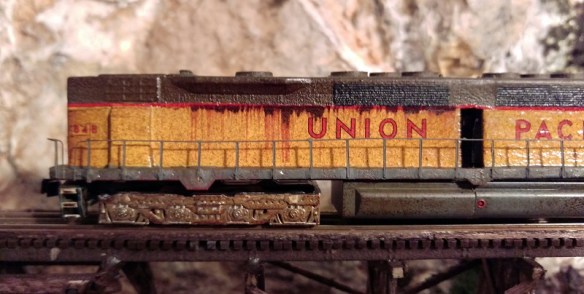
UP DD35 With Brass Handrails & Heavy Weather 1 UP DD35 With Brass Handrails & Heavy Weather 2

Not only has the paint been darkened and discolored but rust streaks have been added along the sides; this has been done with decals.

UP DD35 With Brass Handrails & Heavy Weather 3

Very close up you can still see the roughness of the shell but you have to look for it.  Overall the effect of all the rust and corrosion blends in with the roughness to create a great-looking loco.

UP DD35 With Brass Handrails & Heavy Weather 4

Putting all three DD35s together you can see the differences.

All UP DD35s

I am planning on running both the heavily weathered and clean DD35s together as if one has been refurbished.

UP DD35s Brass Handrails Heavy Weather & New

Although it’s difficult to see, my GP35s are not actually the same.  One is a Phase 2 and a later model so I have one new and old GP35 and one new and old DD35 to complete my set.

UP DD35s & GP35s Brass Handrails Heavy Weather & New 1

My older GP35 Phase 1, on the left, will get some heavy weathering too.  This line up would have produced 15,0000 horse power at the draw bar and even for the long trains we run on our N Scale layout, Solent Summit, that’s a lot.  So only the weathered DD35 is powered and the refurbished one is a dummy locomotive.

All the painting and weathering on these DD35 locomotives was done by Bob Norris who has also painted and decaled Southern Pacific DD35 locomotives.

SP DD35 9902 8

In fact we can offer DD35 locomotives in SP, UP & EMD Demonstrator liveries.

DD35 UP SP Demonstrator

If you wish to read more about my DD35 kit for powered and un-powered models here is a link to their page in the shop and here is a link to their gallery page.  If you are interested in getting a ready-to-run model in any livery, in new or weathered condition, please contact me though the contact page.

Adding N Scale Wheelset Resistors for Circuit Detection

As well as 3D printed models I do a lot with DCC and model railroad wiring.  Recently I have been building computer controlled DCC layout and this adds a whole new level of requirements to the layout such as circuit detection.  In this post I will share with you how I get rolling stock ready for circuit detection on an N Scale DCC layout.

Circuit detection is fundamental to computer control as it tells the computer where trains are on the layout.  It is also useful if you have hidden sidings and you want to know where your trains are.  There are several companies that produce circuit boards for circuit detection and on this layout I have used Digitrax’s BDL168 boards.  The boards work by measuring a resistance across the track; this can be anything from an LED to a DCC chipped locomotive.  So if you have a locomotive in a section connected to a BDL168, even though it’s not moving, the board will detect a resistance and turn on the output for the section.  The output could be connected to a display panel or a computer could pick it up through the Digitrax Loconet system.

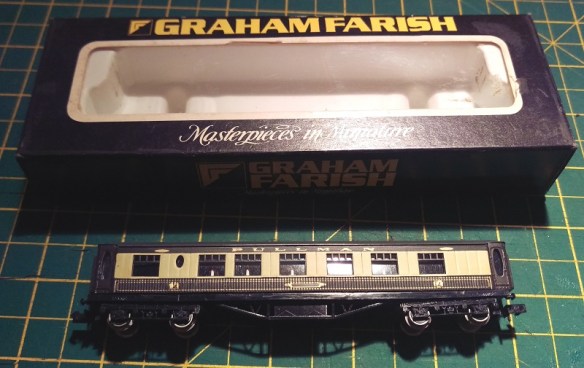
This is fine for locomotives and rolling stock with illumination but what about basic freight cars or wagons?  The computer controlled layout I’m building is a British outline model railway and has a lot of coaches that will all need to be modified so the circuit detection can pick them up.  A lot of the coaches, as shown below, are made by Graham Farish and luckily have metal wheels, obviously plastic wheels sets are no good for circuit detection..

Wheel Set Resistor 1

If you do have rolling stock with plastic wheels you can get replacement wheel sets for just about all ready-to-run stock.  Although metal wheels usually run better you don’t have to change all the wheel sets for metal ones, only the ones you intend to modify.  In fact you only need to modify one wheel set per item of rolling stock.  Because of the length of the coach I am going to modify one wheel set in each truck.  If it was a short wagon I would only do one.  Ideally I would like to modify the two outer wheel sets but as the axle is so close to the coupling box there would be no room.

Wheel Set Resistor 2

Adding lighting to the coach would be one way of creating a resistance across the coach but by far the simplest way is to add a resistor to a wheel set.

Wheel Set Resistor 13

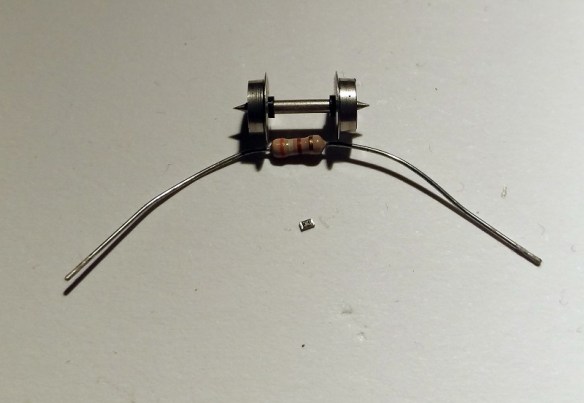
As you can see from the images above with N Scale, and OO/HO, a standard resistor is a bit big and would be very impractical.

To overcome this, tiny resistors called ‘Chip Resistors’ are available, and are also very cheap to buy.

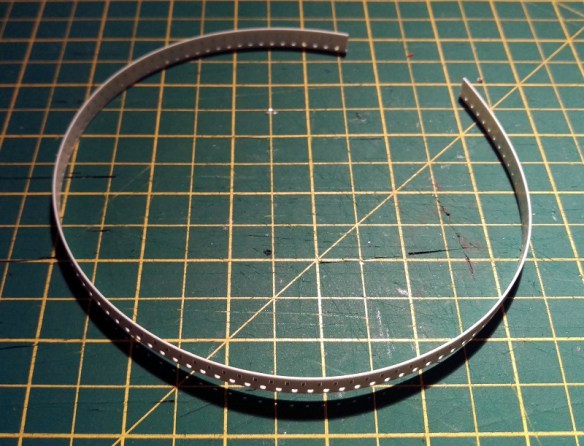
The best size of resistor for this job is a 10K Ohm.  The Ohm rating is the measurement of resistance and it is important to get this correct as the wrong resistor may cause heat which might warm up the wheel set and melt your train.  The chip resistors are usually supplied in strips as shown below.

Wheel Set Resistor 3

Close up you can see the tiny chip resistor, each one is in a pocket in the strip and covered by plastic film.

Wheel Set Resistor 4

Below is a comparison of the strip with an N Scale 3 axle tender truck.

Wheel Set Resistor 5

Once the chip resistor is popped out of the strip you can see just how small it is.

Wheel Set Resistor 6

And immediately you can see the advantage over the traditional resistor.

Wheel Set Resistor 7

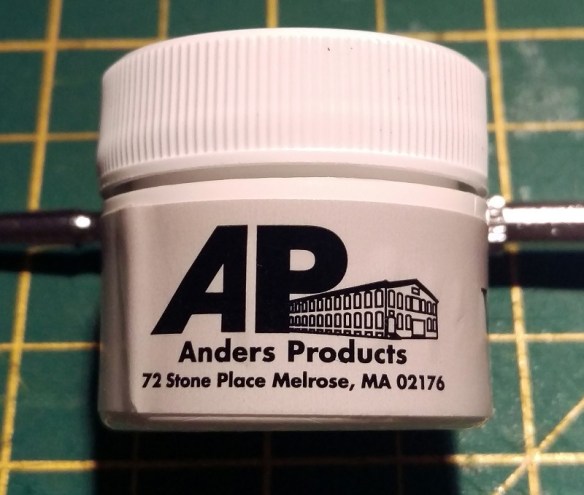
The next issue is how to fix the resistor to the wheel set.  If you attempt to solder it on I guarantee it will go wrong.  The heat from the iron will heat up the wheel set and melt the plastic spacer between the wheel and the axle.  This will cause the wheel to become out of line and wobbly.  It may even cause a direct short across the wheel set.  The other option is to glue the chip into place.  This also has a few problems because if you get glue between the metal contact of the chip and the wheel or axle, the chip will not be able to conduct electricity.  To overcome this I have used Wire Glue made by Anders Products.

Wheel Set Resistor 8 Wheel Set Resistor 9

This is glue that has been designed so once it sets it will conduct electricity.

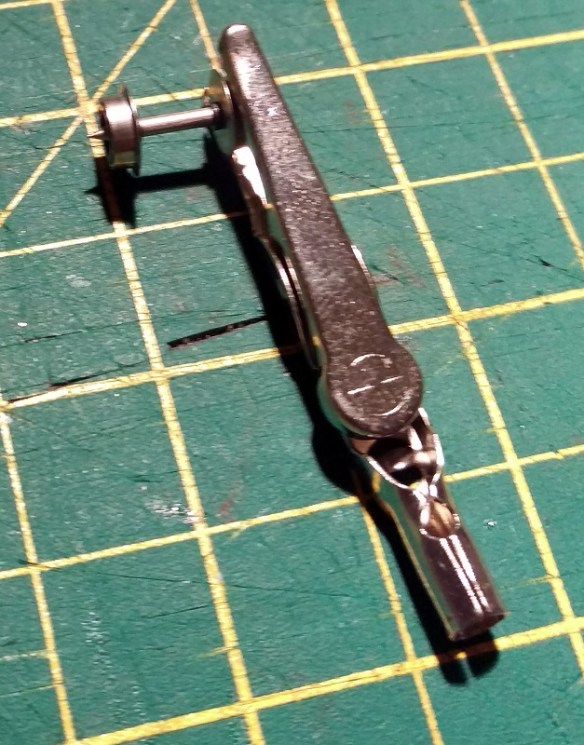
Unlike superglue or CA the wire glue needs time to dry, normally overnight, and that means it needs to be left where it won’t be knocked or moved.  Sitting one of those tiny chips on an axle that rotates is not very practical so I pop out the wheel sets and gently hold one of the wheels so the set can’t roll over.  Make sure what you are using to clamp the wheel set is not too strong as you don’t what to damage the wheel.  I would also recommend checking the wheel centers are correct before gluing the chip in as you won’t be able to move it once the glue has set.

Wheel Set Resistor 10

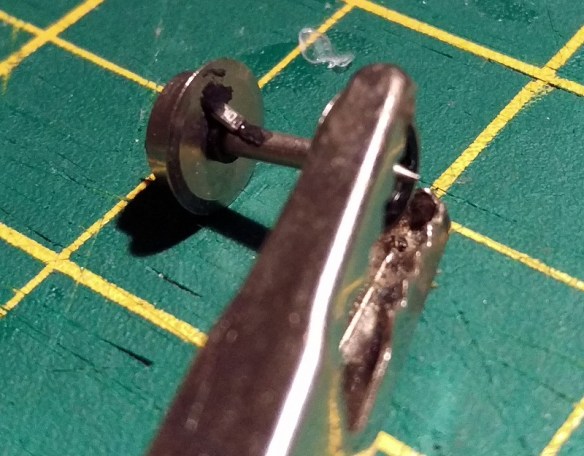
Once you are ready, and have stirred the wire glue, use a tooth pick to put a tiny amount on the axle and the inner face of wheel making sure you don’t bridge the plastic spacer with the glue.  Then using a pair of tweezers position the chip so one end touches the axle and the other touches the inside of the wheel.Wheel Set Resistor 11Once it has dried a little I put a bit more glue over the top to ensure everything makes contact.

Wheel Set Resistor 12

If, like this particular wheel set, both wheels have a plastic spacer you will also need to bridge the other side.  I have done this simply by spreading some of the glue across the spacer from the wheel to the axle.

Once dry you can check the resistance across the wheel set with a multi-meter.

This glue generates a fair amount of resistance itself so it would not be good for main DCC wires etc but for this purpose it does the job nicely.  I also don’t think it’s as strong as most glues so to make sure the chip won’t come off you could also put some superglue or CA over the top once you know it works okay.

Then it is a simple matter of fitting the wheel set back into the truck and the coach is ready for use on any layout and will trigger track detection on layouts with circuit detection.