Specialist Brick Feature For an S&D Signal Box

In this week’s post I have another 3D printed part to share with you.  This time it’s a set of specially shaped bricks for a OO Scale signal box.

The Somerset & Dorset Railway’s terminus station at Bournemouth West had its own signal box, as most stations did.  Sadly the station and signal box are no longer there but a group from the local area are recreating the terminus in OO Scale.  I have already 3D printed an unusual chimney cap for the station building for them, which you can read about here.

The signal box was constructed with a brick base and wooden top which is common for the UK.  However, just to be different, this one had a brick castellated feature around its lower windows.  In the image below, captured from a video taken from a passing train,  you can just make out the feature.

sd-bournemouth-west-signal-box-1

This has proven a very difficult building to find images for, so below is a photo of Carterhouse Junction signal box, take on the 5th April 1988 by Harry Gardner.  It has a similar detail around the bricked up windows.

carterhouse-junction-5th-april-1988-harry-gardner

Luckily a fellow modeller, Frank, has painstakingly gathered enough information to 3D model the signal box and below are some screen shots from his 3D model.
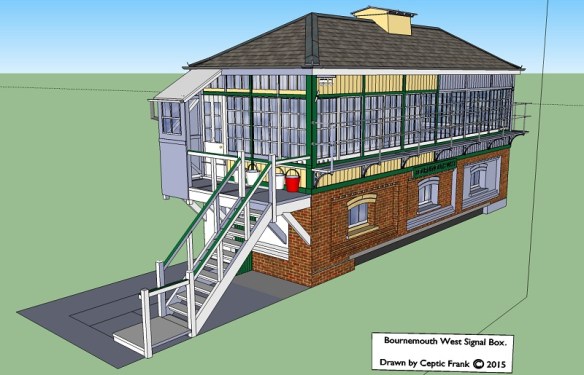
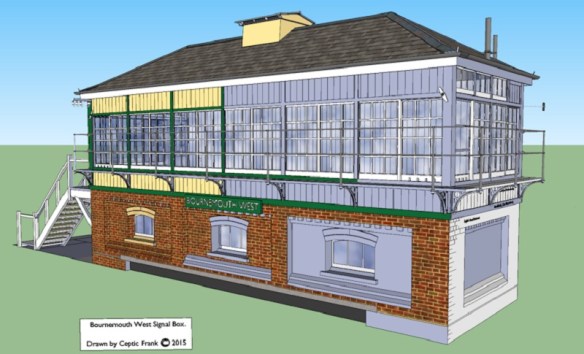
sd-bournemouth-west-signal-box-2 sd-bournemouth-west-signal-box-3 sd-bournemouth-west-signal-box-4

Using measurements from Frank’s computer model the group will scratch build the signal box.  But although Frank’s model has provided them with the information needed to do the scratch build it’s not a suitable file for 3D printing, and to make their lives a bit easier they have asked me to 3D print the brick feature.  As you can see in the image above the bottom feature consists of two sloping sets of bricks.  The top feature has one sloping brick and one alternate brick rotated by 90 degrees to form the brick castellations.

This was a fairly easy geometric shape to draw for 3D printing and as you can see below the two parts will come in strips, each measuring 51mm in length.  Each brick, for 00 Scale, is 1mm wide so this can be 3D printed in Shapeways’ White Strong & Flexible material.

sd-bournemouth-west-signal-box-5

The WS&F will be ideal because the slightly grainy texture will help it look like brick, and this material also absorbs paints, leaving a matt finish, which again helps it to look like brick.
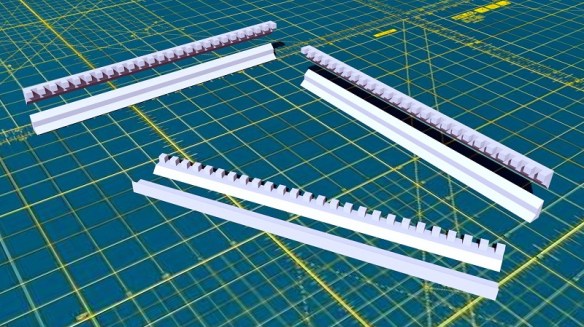
sd-bournemouth-west-signal-box-6

As with everything else I’ve ordered recently, these are still being printed but they are due to be shipped this week. So hopefully I’ll have them shortly and will be able to share them with you in next week’s post, along with the other parts.
A New Tender Drawbar for a Marklin 4-6-2

As promised in last week’s post, this week I have a replacement part for a German steam engine to share with you.

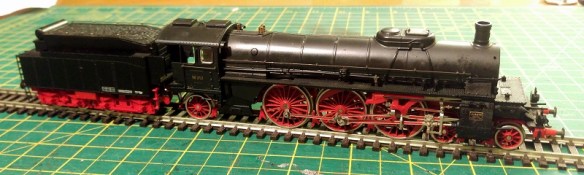
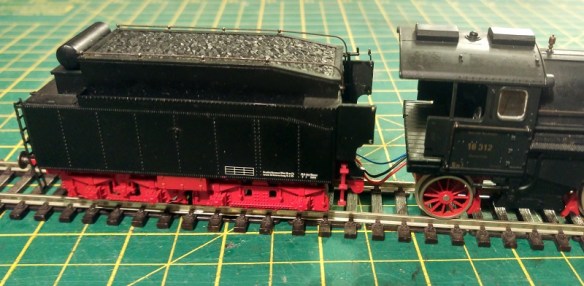
The engine is a Class BR03 4-6-2 built for the DB (Deutsche Bahn – National Railway of Germany). The model is HO scale and made by Marklin.

marklin-4-6-2-tender-drawbar-1

As well as converting this loco to DCC it also needed a few repairs, including a replacement tender drawbar. The tender houses the motor which drives two of the four axles. The locomotive is free-rolling but has a very heavy weight in the boiler. This not only keeps it on the track at speed but also helps with power pickup as the tender wheels all have traction tires.

marklin-4-6-2-tender-drawbar-2

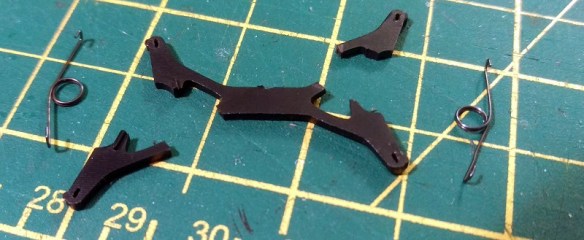
In order to keep the coupling between the locomotive and tender close but smooth Marklin have devised a drawbar which incorporates springs. Below you can see what is left of the original drawbar. The metal springs clip into the slots in the tails and a screw runs through the loop. This system absorbs any bounce, keeping the locomotive running smoothly, and allows great flexibility.

marklin-4-6-2-tender-drawbar-3

However, as you can see below, the drawbar has suffered a lot of damage, which is not fixable by simply gluing it back together as there are bits missing.

marklin-4-6-2-tender-drawbar-4

This is a perfect situation for a 3D printed part and that is exactly what I’m going to do. As this part needs to be strong but detailed, to get the slots on the right place, I’ll be using Shapeways’ Frosted Ultra Detail material, which has proved itself time and time again as being ideal for this sort of job. You may recall back in December of 2015 I used this material for a set of replacement gears in an O scale Rivarossi F9, which you can read about here. The gears needed to be precise and strong, as the forces passing through them had already cracked the original injection moulded gears. The FUD is a hard acrylic material which gives it its strength and as it’s printed to a 29 micron layer thickness, the detail is very precise.

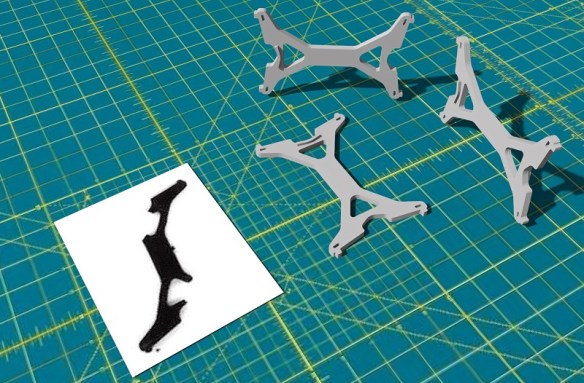
As always it starts with a 3D drawing of the part. Great care was taken to capture all the lumps and bumps on the original so it’ll be a good fit.

marklin-4-6-2-tender-drawbar-5

To ensure the part is the right shape, as well as measuring it, I scanned the original on a photocopier and brought that image into my drawing package. I could then lay the new part over the top as a final check.

marklin-4-6-2-tender-drawbar-6

This drawbar is currently being printed by Shapeways, along with the steps from last week and several other new parts. They are due to arrive in the next two weeks, when they do I will share the fitting of the drawbar with you.

In the meantime next week I have another new 3D printed part to share; this time it’s for a OO scale English signal box.

A Step in the Right Direction

Over the last few weeks I’ve been working my way through several of the projects which have been on my desk for a while; and as promised I’m sharing them with you.  This week’s project is a replacement set of steps for a Hornby OO Stanier 4MT 2-6-4T as shown below.

r2635x-lms-stanier-4mt-2-6-4t-class-4p

The model to be repaired is missing one of its steps from the front, just behind the buffer beam.  The part is a separate plastic piece which is normally glued into the locomotive frame.

hornby-lms-stanier-4mt-2-6-4t-front-step

As there was one still on the locomotive I was able to measure it and draw it up in 3D.

hornby-lms-stanier-4mt-2-6-4t-front-stepThis part will be 3D printed in Shapeways Frosted Ultra Detail material because I wanted the steps to be thin, just like the original.  I also included the bolt detail and the locating nub on the top.  The new 3D printed step can then simply be fitted into the existing fixing.
Once I have test printed the part it will be available as a pair through my Shapeways shop.  It will also fit several other Hornby locomotives as well as being usable for scratch building.

Next week I have a replacement part for a German 4-6-2 to share with you.

Adding a Speaker in a Small Place

Almost a year ago I shared my designs for a 3D printed speaker enclosure which could be built up in sections.  This allowed Zimo speakers to be fitted in even more places.  You can read about it here.  Since then I haven’t had the need for them but just recently I did; and in this week’s post I will share it with you.

Rowa, and later MRC, used to make some wonderful large steam locomotives for N Scale, in particular the 2-8-8-2 Y6b.  When Rivarossi and Con-Cor took over the production they added the 2-8-8-0 EL5 to the lineup.  The EL5 came with a large Vanderbilt tender and it’s one of these I recently added a sound decoder too.

As the shell of this locomotive is full of motor and metal chassis the tender is the obvious place for the decoder and speaker to go.  However, the Con-Cor Vanderbilt tender is a one-piece molding and the body doesn’t separate from the chassis.  To gain access to the inside the back plate has to be removed.  This isthe section between the tender and the locomotive cab just under the coal load.  It’s glued in place but with a gentle bit of pressure it will pop off.  The two metal weights inside the tender will now slide out, giving you full access to the inside.

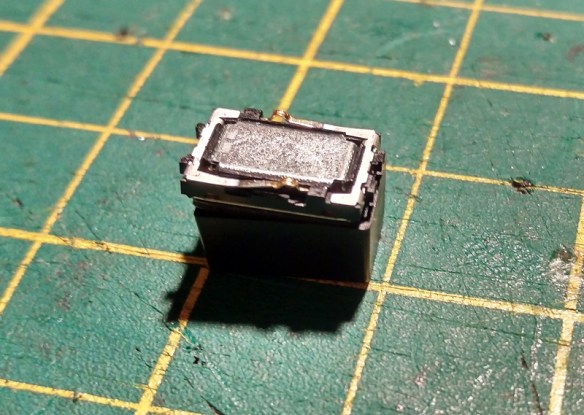
For this DCC install I am using a Digitrax sound decoder with a Zimo speaker, a LS8x12. This speaker gives much better sound than the standard speaker the decoder comes with.

speaker-fitting-1

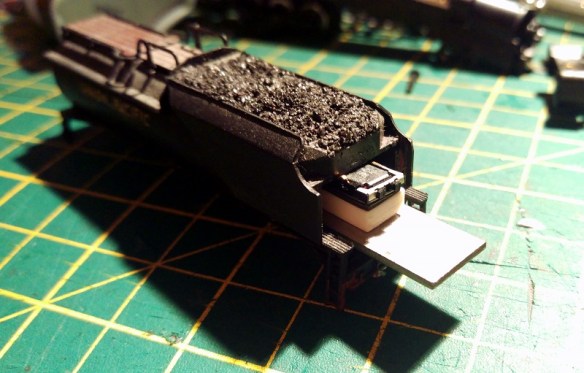
As you can see the speaker comes with a sound box.  This is an injection-molded box with a recessed lip around the top which the speaker fits into.  However the box is fairly deep.  My intention is to fix the decoder and speaker to the upper metal weight and slide it all into the tender, but the speaker will not pass under the coal load.

speaker-fitting-2

speaker-fitting-3

To solve this I’ve used two of my 3D printed speaker enclosure sections to form a smaller speaker box. Three sections will make the enclosure the same height as the original.

speaker-fitting-4

The two parts have been glued together with a spot of superglue.  Before fixing to the metal weight I did a test to see if it fitted.

speaker-fitting-5 speaker-fitting-6

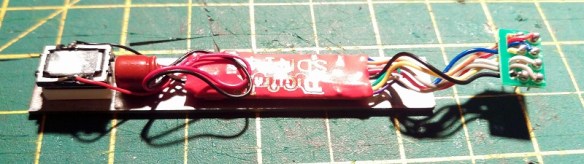
The back of the tender is slightly higher than the space under the coal load so although the speaker just scrapes through it will be just fine once in the right place.  I again used superglue to fix the sections to the weight.  The speaker has a sticky foam fitting which holds it into the new enclosure.  The decoder was also fixed to the weight as well as the capacitor, you can see it between the speaker and decoder.

speaker-fitting-7

This whole assembly then slides into the tender and is prevented from moving by the grooves which hold the weight in place.  The last thing to do is connect up the wires.  For this particular locomotive I cut off the plug and hard-wired it in.  Only four wires need to go to the locomotive, so it made sense.

Once the decoder was tested and renumbered the locomotive was ready for service.

speaker-fitting-8

Well, almost ready for service.  The decoder was recycled from another locomotive and, although the sounds work perfectly, they are the sounds for an Alco PA diesel!  This can easily be corrected by uploading some new sounds using Digitrax’s SoundLoader software which is something I will show you how to do in a later post.

For now the speaker enclosure sections should be available by next week and I will share those with you and maybe a video of the EL5 working a train in all its glory.

Drawing a Dummy Chassis & Trucks for an N Scale Alco C-855 Part 1

As you may have noticed from last week’s post I am getting back into the drawing and I’m trying to wrap up some of the outstanding projects. This week I’ve been working on the dummy chassis and trucks for my N Scale Alco C-855.

This also has the advantage of providing all the parts to make a dummy chassis and trucks for Con-Cor’s U50 and 4500 Gas Turbine locomotive shells. I’m sure there are a few spares knocking about now several have been converted into C-855s.

As with all the dummy chassis kits it’s the trucks that take the time.  This is because this is where all the detail is.  The C-855s, U50s and Turbines all had the same truck designs, in fact the same trucks were recycled through the engines.  The original 4500 Gas Turbines were built under the Alco-GE (General Electric) partnership. Alco went on to build the C-855 and GE the U50. The wheel arrangement is specified as B+B+B+B. This means there are four two-axle trucks with all the axles powered. The first and second trucks are linked with span bolsters, as are the third and fourth. In the image below of a Con-Cor 4500 Gas Turbine, with one of my battery box kits, you can see the truck arrangement.

Gas Turbine Batter Box - Clean 1

The first and fourth truck on the model are the only powered trucks and are connected via a gear tower up into the chassis. The second and third trucks are connected to the first and fourth via a span bolster or draw bar and clip into the battery box.

To draw the truck I normally start with a rough image scaled to the correct size, then using actual dimensions I draw the side frames in 3D.

alco-c-855-dummy-truck-1

Then I assemble the frames to form the truck, ensuring they are correctly spaced for the wheel sets.  Depending on how the truck will be connected to the chassis will depend on the truck construction.  These have a central bolster pin.

alco-c-855-dummy-truck-2

The truck isn’t actually finished yet. I still need to add the span bolster section to join the two trucks together and, as you can see, this will be one of the first or fourth trucks because of the bolster pin.

One of the challenges I have with this design is weight. As the first and fourth truck will be carrying the weight of the loco they will stay on the track but the second and third won’t be carrying weight.  3D printed parts are very light, even with metal wheels, so this will make the trucks bounce about. To solve this I will be looking at a 3D printed stainless steel insert, as with the original Con-Cor truck. This will ensure the truck stays on the track and will help them track around corners.

The chassis is an easier issue. As you can see below it is a fairly simple design.  Because of the size I am planning on printing this in the WS&F material simply to reduce the cost as I did with the EMD DD40AX dummy chassis.

alco-c-855-dummy-chassis-2

As I’ve already drawn the Con-Cor chassis in order to work out the extension parts and correct fittings for the shell, all I had to do was copy the shape. In the image below you can see my model of the C-855 powered chassis next to the dummy.  I have left the same mounting points on the fuel tank allowing the shell to clip directly on and there will be ample room inside to add some weight.  Again this is important as the chassis and shell on their own will be very light.

alco-c-855-dummy-chassis-1

Interestingly these three locomotives differ from regular locomotives in that the couplings and pilots are part of the truck and not the body. Normally a diesel locomotive’s strength is its chassis and the couplings are attached to the end of it. The load of the train is transferred through the chassis and the trucks provide the thrust up through the bolster pins. Most early models of locomotives positioned the couplers on the trucks to make them navigate the un-prototypically tight curves on model railroads. However the locomotives with span bolsters do have the couplings on the trucks and the load of the train is transfered through the trucks. The chassis simply rides in the trucks and provides weight for traction. This means I also have to draw the couplings and pilots on the first and fourth truck.

To make the U50 and Turbine dummy chassis it will simply be a matter of shortening the C-855 chassis and changing the centre section to accept a fuel tank or battery box. Once I have solved the span bolster section and drawn the couplings and pilots I will share the next step with you.

Drawing a Dummy Chassis & Trucks for an N Scale EMD SD50

As promised in last week’s post this week I have another design for a 3D printed product to share with you. This one has been knocking around my drawing board, or laptop, since last year so it’s time I got it finished.

So far I have tried to supply a dummy chassis and trucks for the spare locomotive shells left over from donor locos.  For example, I have made a dummy chassis kit available for the Bachmann DDA40X and the Atlas C-628/630.  These locos are donors for my EMD DD35, Baldwin DT6-6-2000 & Baldwin RT-624.  A dummy kit for the Con-Cor U50/Turbine is on its way.

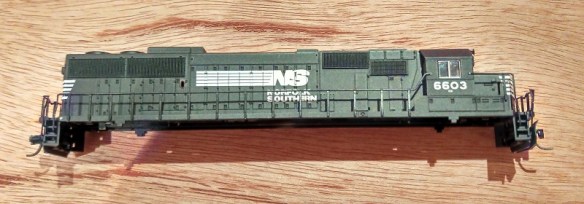
I have also been asked to supply dummy locomotive chassis kits for other shells.  I have several on their way but the first is for an Atlas’ SD50, in particular this Norfolk Southern one.

ns-emd-sd50-dummy-chassis-1

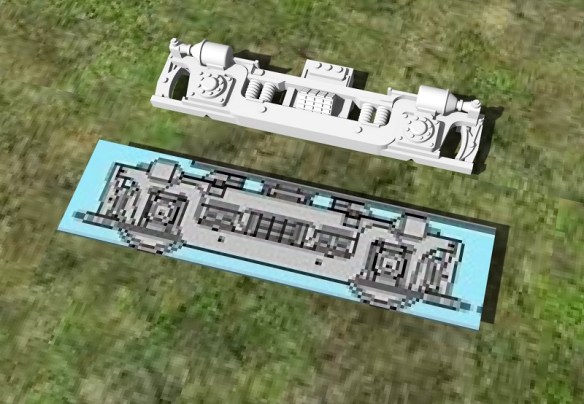
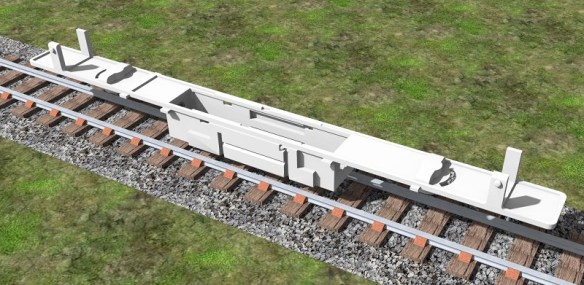
Drawing the actual chassis part is fairly simple, as it will mostly be hidden, so there is very little detail to worry about and I can stretch the one used for the Atlas C-628/630.  The biggest challenge, apart from getting the size right, is to reduce the amount of material used so it’s cheap to print but still strong.  The actual chassis, shown below, is designed to clip into the shell using the same mounting points found on the metal power chassis.  These are on the four upstands. My first design for this system had a solid bar across the top of the upstands,, however this made them too inflexible and it was very hard to get the shell off the chassis.

emd-sd50-dummy-chassis-2

Also any parts that normally protrude into the original chassis have to be accounted for with notches and cut outs.  These are often used as locating lugs designed to get the shell in exactly the right place, which also helps me.

The fuel tank on these Atlas models is a separate injection molded part so the chassis has been designed to receive the tank using the same fixings. Luckily this is simply a longer version of the fixing for the C-628/630 fuel tank so again I can stretch my existing design.

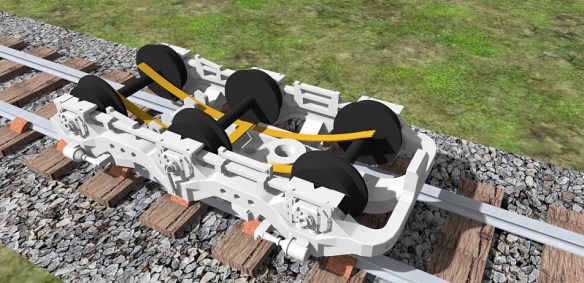
The trucks are the more difficult part because these are on show and there’s normally a lot of detail here.  EMD built their SD50s with two different types of trucks.  The HT-C trucks, which can be identified by the hydraulic shock on the side of the middle axle of each truck, or the earlier Flexicoil trucks.  Only Conrail opted for the Flexicoil trucks so as this model is a Norfolk Southern I have modeled the HT-C style.  Once all the complicated visual parts were complete I had to design a new center section which missed the wheels and held the bolster pin in the right place. The bolster pin is shown below but will be a separate part.

emd-sd50-dummy-chassis-3

As with my previous trucks I have spaced the truck frames to receive 3 Fox Vally 36″ metal wheel sets (FVM3611).  And I have made the same provision for electrical pick-up if required.

emd-sd50-dummy-chassis-4

The axle wipers only make contact with the two outer wheel sets but this is enough to power the original circuit board or a pair of LEDs.  Below is a photo of an actual C-628 dummy truck fitted with the power pickups.  Each truck only picks up power from one rail.

IMAG0603

To use the original lighting board the same clips I used for the C-628/630 can be used as you can below.

Alco C-628 Dummy Chassis Render 12

This fastens around the circuit board and clip into the top of the chassis over the fuel tank void.

emd-sd50-dummy-chassis-5

I have a few more checks to make and then these parts will be ordered for a test print.  When they arrive I will share the results with you before making then available through my shop.