Getting Back on Track Part 2

Last week I shared with you my design for an N scale Re-Railer which can be added to your locomotives as a detail part.  You can find the post here.  This week I wanted to share with you how the 3D print came out and what it looks like on some of my locomotives.

The design for the print, as pictured below, included the mounting bar and lugs so it could be fixed directly to the locomotive chassis, as was typical on a lot of switching locomotives.

Re-Railers Type 1-3

When the parts arrived they needed cleaning, as do all parts printed in Shapeways Frosted Ultra Detail material.  I did this by using my normal method of soaking the parts in Goo Gone for 24 hours, but before I did this I took some photos.  As shown below, even though the parts are transparent, the detail and shape is visible, although with an average phone camera getting the detail in focus is hard. Re-railer Type 1 Raw FUD 1Once removed from the Goo Gone I let the parts dry for a further 24 hours in which time they turned opaque.  They are still hard to photograph at this stage, not just because they are very small but the brilliant white reflects a lot of the light.

Re-Railers Type 1 - Cleaned

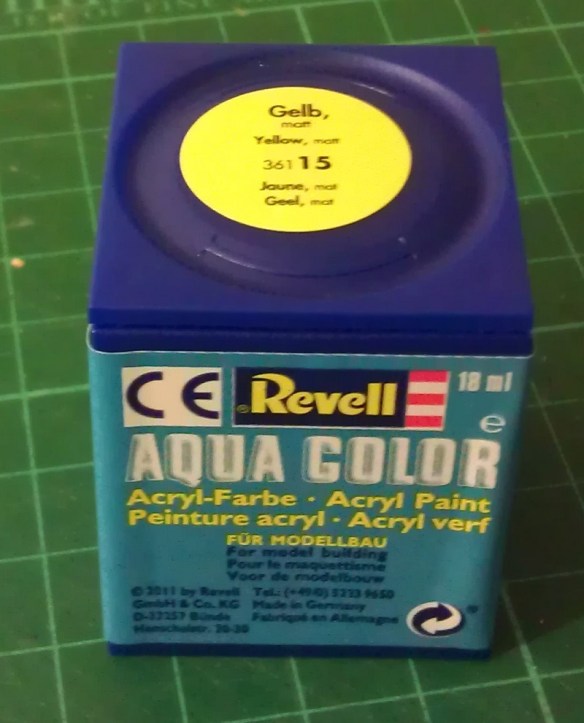
I brush painted the Re-Railers using a basic matt yellow acrylic paint.  To make sure I didn’t put on too much paint and fill all the detail I dipped the brush lightly into the paint then wiped most of it off on the side of the pot before painting the parts.

Yellow Paint

Again getting my camera to focus on such a small part created some issues as you can see below but the detail of the parts really stands out now they have been painted.

Re-Railers Type 1 - Painted

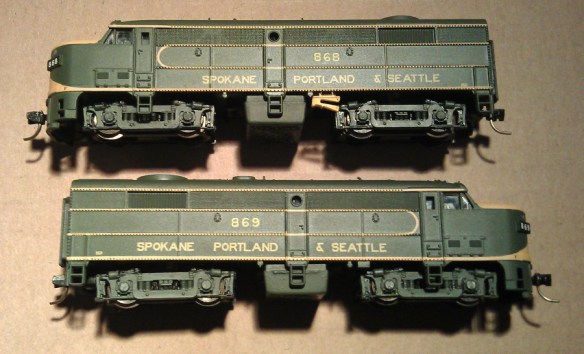
The next step was to fix them to some locomotives.  A good example of these in place on a real locomotive can be seen here and here on Canadian Pacific’s S-3 loco No. 6538.  I don’t have any S-3s on my roster but I do have various other locomotives that I want to super detail and I am starting with my Life Like Spokane, Portland and Seattle FA2s.

FA1 with Type 1 Rerailer

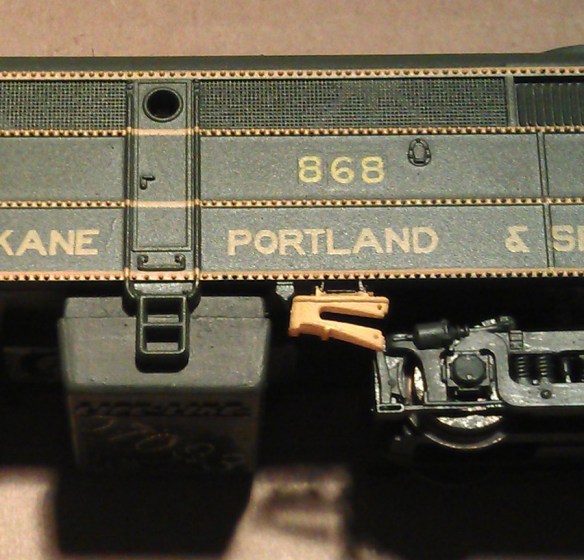
These models don’t have such a large fuel tank as the later FA2s so there is plenty of room for the Re-Railers to hang.  I used a gel super glue to fix it in place and I only glued it to the plastic shell and not to the models chassis, this enables me to remove the shell without damaging the Re-Railer.

FA1 with Type 1 Rerailer - Close Up

The trucks swing freely without knocking the Re-Railer and it doesn’t protrude past the shell so I can still put the locomotive in its original box.

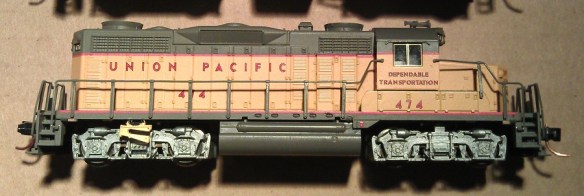
Re-Railers are more commonly found on switching locomotives and for this I often use my GP20, also made by Life Like.  The fuel tank on this locomotive doesn’t give as much room so I have mounted the Re-Railer under the shell at the center of the truck, as shown below.  This also enables the truck to swing freely as the Re-Railer is in line with the truck pivot where it moves the least.

GP20 With Re-Railer

This Re-Railer detail part is currently available in 3 different packs from my Shapeways shop or by clicking on the links below;

A set of 8

A set of 16

A set of 32

The GP20 locomotives also used a different style of Re-Railer which were carried on the side of the trucks; if you look closely at UP No. 475 pictured here you can see them.  I am also designing these truck mounted Re-Railers but that will be for another post.

Discovering the Possibilities of Etched Brass Part 3

Following on from last week’s post, where I showed you the first two sets in my new ‘Additions’ series of etched brass details, I promised to share with you some photos to demonstrate how effective the ‘Additions’ details really are. So in this week’s post I have some of the current work-in-progress photos for you.

So far we have only been working with the EMD DD35 Additions set; the weather here in the UK has been unusually fantastic so we’ve been making the most of it!

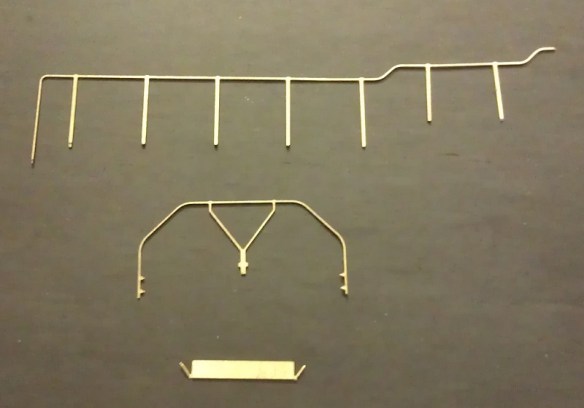
The DD35 set, pictured below, comprises of two long handrails for the sides and four corner handrails that need to be rolled into shape as I showed you in last week’s post.

DD35 Additions Set

DD35 Additions 1

DD35 Additions Parts

Below are some photos of a DD35 using the stock 3D printed handrails which will still be provided with the kits should you wish to use them and I think they work well when using the DD35 with a Con-Cor U50 as the stock handrail sizes match.

DD35 & U50 1

DD35 2

Having already cut out a set of Additions for a DD35 and having a new one under construction it was simply a matter of glueing them on.  They were a good fit using the same mounting locations on the side of the shell as the 3D printed rails and, as you can see below, they look very realistic.  They still need the final coat of paint to finish the model but I think the brass Additions really finish it off nicely.

EMD DD35 With Brass Etched Additions 1 EMD DD35 With Brass Etched Additions 3

EMD DD35 With Brass Etched Additions 5

Once complete I will have some more photos of this model to share with you as well as some of the Baldwin DT6-6-2000 with its brass Additions.

In the meantime, if you would like to purchase one of these brass Additions kits please drop me a message using the Contact page.

Discovering the Possibilities of Etched Brass Part 2

A few weeks ago I shared with you my designs for etched brass handrails and details to improve my Baldwin DT6-6-2000 and EMD DD35 locomotive shells.  These etched brass sets are the first in my ‘Additions’ series which will be available for all my locomotive shells.  Now that the first batch have arrived I wanted to share some of the results with you.

DT6-6-2000 Additions Set

DD35 Additions Set

The sets pictured above are etched from a sheet of 0.2mm or 8 thou brass and this has given me the ability to make handrails the correct actual scale size.  Although the brass is very thin I recommend using a very sharp, if not new blade in a craft knife to cut the parts out because pressure applied to remove them with a blunt blade will distort the parts.

The parts have small tabs which are only half thickness showing you where to cut them out, and making it easer to cut.  Depending on how close to the part you can make the cut it is likely there will be a small bur which can easily be removed by carefully filing the area with a flat needle file.  I found the best way to handle the parts was with a set of tweezers with a flat end.  Even between my fingers I could see the parts had the potential to bend out of shape. Below is one of each part from the DT6-6-2000 set.

DT6-6-2000 Additions Parts

The center leg of the end handrails, shown in the center above, is designed to be bent to form a dog leg as shown below. At the bend line the brass has again been etched to half thickness to mark the bend and make it easer to do.  I used my flat end tweezers to grip the brass at the bend line and pushed it over with my fingers.

DT6-6-2000 Addtions End Handrail

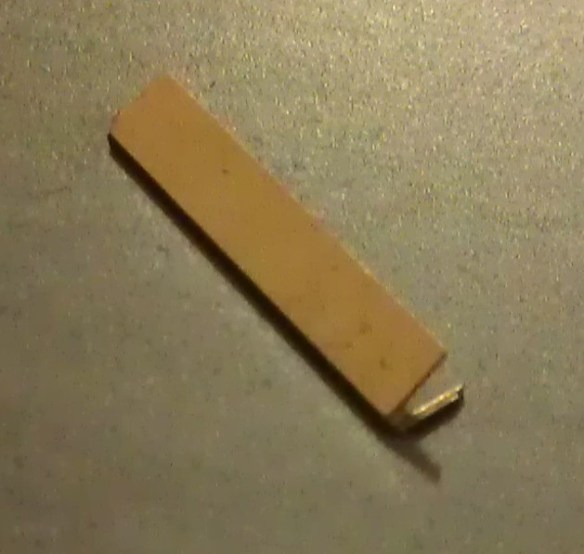
The sun visors for the DT6-6-2000 also have two stay bars that are designed to be bent back as shown below.  This again was done simply with the tweezers and there is an etched section at the bend point.

DT6-6-2000 Addtions Sun Visor

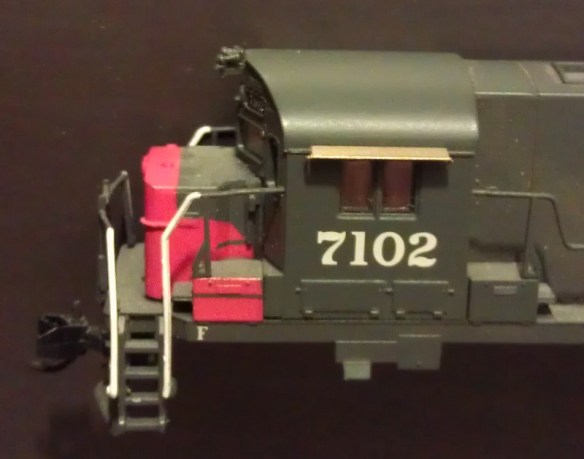
This can then be glued directly above the window as shown below on a different locomotive.

DT6-6-2000 Additions Sun Visor 2

These particular sets only have additional etched details on one side, for example the real DD35 handrail stanchions, as pictured below, are made from a folded plate made into a channel section.

EMD DD35 Handrail stanchion

To accurately model this detail I etched the middle of the stanchion to give a fluted effect as shown in the 3D rendered image and photos below.

DD35 Handrails Additions Close Up Render

DD35 Additions 1

DD35 Additions Close Up 1The small handrail sections shown above are for the ends of the DD35 and there is one for each corner.  Once they have been carefully cut out as shown below, again using the half thickness brass as a guide, they need to be shaped.

DD35 Additions Parts

To shape the end rails I rolled the brass handrail around the handle of a watch mender’s screwdriver handle which had the radius I was looking for.  As you can see from the results below the handrail section is now ready to be fixed to a DD35 Shell.

DD35 Additions End Rail 1 DD35 Additions End Rail 2

The ‘Additions’ series are designed to complement my range of 3D printed locomotive shells, enabling you to model in finer detail to suit your budget, and in a later post I’ll show you how effective the ‘Additions’ details really are.

In the meantime, if you would like to purchase one of these brass Additions kits please drop me a message using the Contact page.


N Scale 2-8-8-2 Y6B & 2-8-8-0 EL5 Replacmet Pilots With Couplers

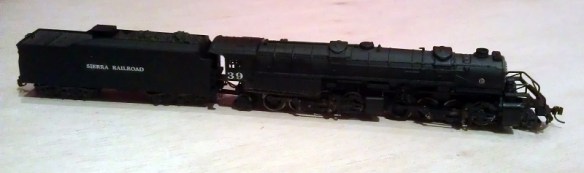
Last week I shared with you how I added a working Micro-trains coupler to the front of a Rowa 2-8-8-2 Y6B as pictured below; you can find the post here.  The only thing left to do was a running test and this week I’m going to share how it went.Rowa Y6b Finished Pilot N 1

Although the 3D printed replacement pilot fitted perfectly, I had some reservations about the Micro-trains body mount coupler hanging down too low underneath the pilot and preventing the lead wheel set from swinging freely.  This could prevent the locomotive navigating tight bends and turnoughts.

So to test this I took a pair of Rowa Y6B locomotives, and some rolling stock, down to a local model railway club, the Poole and District Model Railway Society, based in Poole, Dorset, who kindly let me use their N scale layout.

As well as having a test track setup for all scales the club also has a reasonably sized N scale layout under construction with a fast double mainline section and a single track branch line. All three lines run in loops through the layout and back to a large storage yard at the rear.  The layout is designed for UK prototype operation and the double track mainline has some lovely sweeping curves, but I was more interested in the branch line.  This was because not only did it have a gradient on a curve but also some very tight curves, particularly for large US outline articulated mallet locomotives, and as the intention was to test the pilot coupling this seemed ideal. Here are the pair working up the grade and around the first curve.


We had to have a couple of goes at this, not because the locomotive struggled but being big US steamers and wider than UK trains the cylinders on the front of the locomotives caught the platform and the guys at the club had to do a quick bit of sanding so the train could get past.


The two locomotives I used for the test run have different makes of DCC decoders installed.  The lead locomotive, DRG&W’s number 3561, has a Hornby R8249 decoder and the second locomotive, Sierra Railroad number 39, has a Digitrax DZ125.  This gave the locomotives different characteristics and having never run the locomotives together before it became clear that the lead locomotive was running faster. This was also a good test to see how the new pilot stood up to the punishment from the lead 2-8-8-2.


The tightest curve on the layout is at the rear where the branch line returns into the yard.  The line at this point is also on a steep downhill gradient.  As you can see from the video below, the new pilot on the front of number 39 had no issues at all going round the bend.


So now the pilots have been thoroughly tested I am happy to release them for sale and you can get them below in five versions…..

One single pilot with a mounting hole for a Z Scale MT body mount coupler.

A pair of pilots with a mounting hole for a Z Scale MT body mount coupler.

One single pilot with a mounting hole for an N Scale MT body mount coupler.

A pair of pilots with a mounting hole for an N Scale MT body mount coupler.

A pair of pilots, one with a mounting hole for an N Scale MT body mount coupler and one with a mounting hole for a Z Scale MT body mount coupler.

Rowa Y6b Finished Pilot N 2

Thankyou to the Poole and District Model Railway Society for use of their layout.

I will have both these locomotives, and maybe a 2-8-8-0 EL5, double heading at my next exhibition pulling some nice long trains.


A New Drive Shaft For a MDC/Roundhouse/Athearn 2-8-0

A few months ago at the 2014 NMRA(BR) winter meet in Benson, England, I had an unfortunate breakdown with one of my small steam engines.  Upon putting the engine on the track and turning up the power the engine stubbornly stood still even though the motor was spinning frantically.  After inspecting the engine it was obvious that the drive shaft was missing.  So in this post I wanted to share with you how I have fixed it.

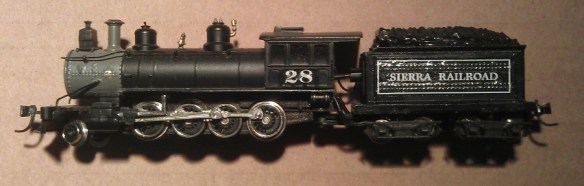
The engine in question is an N Scale 2-8-0 steam engine made by Roundhouse (formally Model Die Casting). Sierra 2-8-0 No 28

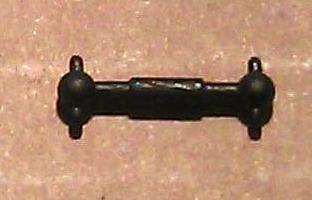
These are great models and run like sewing machines.  Due to the size there is next to no room inside for big motors and drive parts so Roundhouse installed a small motor in the tender, they even managed to fit in a small brass fly wheel.  The motor connects to the locomotive via a drive shaft which protrudes from the tender into the back of the cab.  The drive shaft then turns a worm gear in the boiler which connects to gears on the axles, consequently driving the wheels.  Because the tender is hinged where it joins onto the back of the engine the drive shaft has to be flexible.  This has been done using a form of ball joint. The balls on the ends of the drive shaft press fit into sockets and are held in place by the springiness of the plastic sockets.  Normally this configuration would simply spin in the sockets but the balls on the end of the drive shaft has two spigots sticking out from each ball.  Each socket has slots corresponding to the spigots so when the drive shaft turns so does the socket while allowing for the movement of the tender.

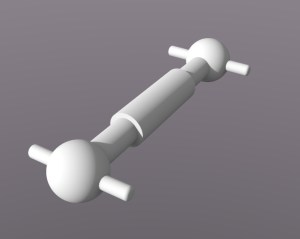
The drive shaft is made form black plastic and is very small, measuring only 11.25mm long with a diameter of 0.7mm.  So not to be beaten I decided to 3D print a new one.  Luckily I have a another Roundhouse 2-8-0 so I was able to pop out the drive shaft, pictured below, and copy the dimensions. MDC Old Drive Shaft

This was s fairly simple model, the main concern was getting the length and diameters correct.

Roundhouse 2-8-0 Drive Shaft

Then it was off to the printer and a week later I now have a replacement drive shaft.  I printed this in FUD but it should be printable in WS&F or BS&F as well.

After an overnight soak in Goo Gone and a wash off it was ready for a coat of paint.  Pictured below, the drive shaft on the left is the original, the one on the right has been painted.MDC Drive Shafts - New & Old

I first test fitted an unpainted drive shaft, which was successful, then once the paint was dry I fitted the black painted one.  Make sure the pegs in the drive shaft line up with the slots in the socket before you push it in.  It takes a reasonable amount of force to push the ball into the socket and if the pegs are not lined up they will snap off.MDC 2-8-0 No Drive Shaft MDC 2-8-0 White Drive Shaft

MDC 2-8-0 Black Drive Shaft

And there you go, a repaired Roundhouse 2-8-0 with a 3D printed drive shaft.

If you too have been unlucky enough to loose your drive shaft from either a 2-6-0 or 2-8-0 by MRC/Roundhouse or even the newer Athearn ones you can get a replacement here.  I also do a set of two, just in-case you need a spare which you can get here.


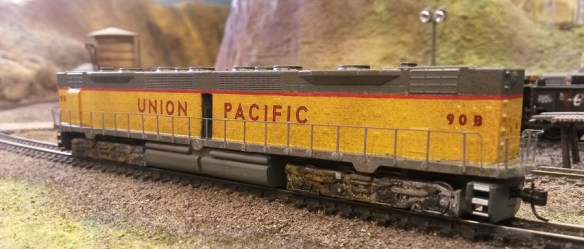
A Baldwin DT6-6-2000 Center Cab In N Scale

Over the last few weeks I have been drawing and designing a kit to make an N scale DT6-6-2000 using an Atlas C-628 or C-630 powered chassis. The test print has now been made and in this post I will share with you the results, the small changes I have made and where you can buy your own.

You can read more about the design in Part 1, Part 2 and Part 3 of the drawing process.

Straight out of the Shapeways box the DT6-6-2000 shell looked great.  Even though it was covered in the normal waxy residue I could already see most of the detail, and nothing seemed to be damaged, badly printed or missing.  To get the model ready for initial photos I simply washed the parts in warm soapy water. This still leaves a waxy residue on the parts and they can’t be painted yet, but as you can see from the pictures below it is enough to show you what  it looks like.
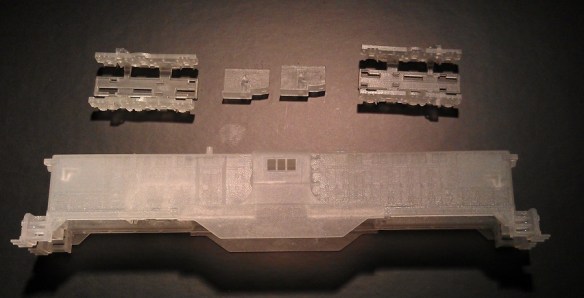
DT6-6-2000 Test Print 1

Even though the parts haven’t been properly cleaned yet I couldn’t resist trying them out! First I looked at the truck side frames, and they fitted perfectly.  All the little clips and catches on the Atlas power truck lined up with the printed side frame and it fitted together with a positive click. Below is a comparison showing the Atlas truck side frame on the left and the printed one clipped onto the power truck on the right.

DT6-6-2000 Test Print 9

From the under side you can see the clips and catches as well as the gear holes.

DT6-6-2000 Test Print 10

Having gone this far I had to try them both in the chassis and do a test run.
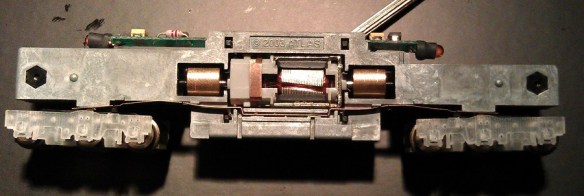
DT6-6-2000 Test Print 11

The chassis ran perfectly proving the side frames where not too tight on the axle ends and there wasn’t a clearance issue between the underside of the printed side frames and the rail tops etc.

The detail on the actual shell is very crisp as you can see from the photos below showing the exhaust stack, lifting lugs and horns.
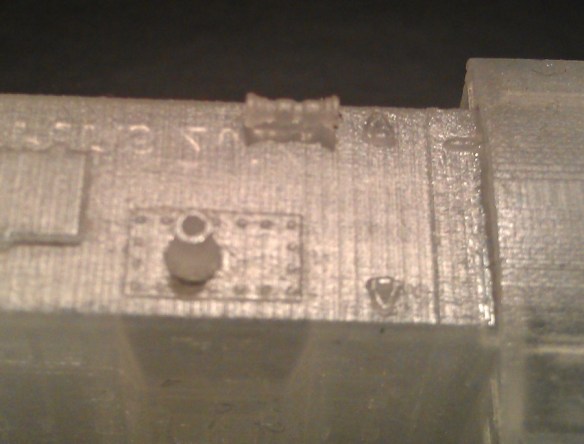
DT6-6-2000 Test Print 8 DT6-6-2000 Test Print 4

Even the uncoupling bar that runs across the top of the knuckle coupler has printed perfectly although it is very hard to see in the image below.  When the FUD material is freshly printed and transparent like this it is very difficult to photograph and being wet with waxy residue doesn’t help!

DT6-6-2000 Test Print 7

Next I wanted to test fit the shell on to the chassis but to do that I needed to remove the handrails from inside the shell. As with my EMD DD35 kit I have printed the handrails fixed to the inside of the shell. This is firstly to protect them and secondly to avoid adding expensive material to the model in the form of a sprue.  The handrails are mounted on cross braces that also hold the shell square as you can see below.  Sometimes when a print run is finished the parts cool a little bit too quickly and thus can cause a little bit of distortion, so the braces help prevent that.  If you get a printed model which has distorted you can read about how to fix it here.

DT6-6-2000 Test Print 17

I cut the handrails out using an X-Acto knife but I’d made the ends of the cross braces a little too big which made them hard to cut. I ended up pushing very hard which is not recommended with FUD as it can be a brittle. I have since reduced the ends of the cross braces which will make the hand rails much easier to cut out.  All six hand rails come out in one piece as you can see below.

DT6-6-2000 Test Print 6

The shell was now ready to fit onto the chassis and it slid over the metal frame and located onto the metal lugs with ease.  As one end of the chassis is higher than the other I added locating brackets inside the shell to sit on top of the chassis at the relevant heights; this means the shell will only fit on one way.  In the photo below you can see the lower end is on the left.

DT6-6-2000 Test Print 12

With the shell test fitted the first thing I noticed was the trucks seemed very close to the triangular section next to the front steps.  I was worried that this would prevent the trucks from turning but after doing several tests around a tight corner on my layout I discovered it was not close enough to touch but as a good measure I have moved the triangle away from the truck a little bit more.  The locomotive trundled around my small yard quite happily as you can see below.
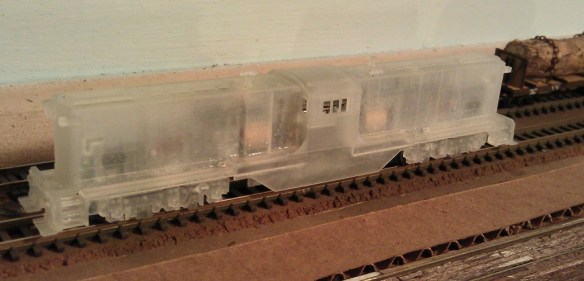
DT6-6-2000 Test Print 13

The last big check I wanted to make was the coupling pockets.  The shell has been designed to receive Micro-Trains N scale body mount couplings in a pocket on the underside.  There is a pilot hole ready for the mounting screw and a gap in the pilot to allow the coupling to poke through.  As the pilot hole was full of wax residue, and slightly smaller than the screw diameter by design I drilled out the hole using a #62 tap drill from Micro-trains and taped it using the 00-90 tap from the same tool set.  Once I had assembled the Micro-trains body mount coupler I pushed the screw through the coupler.  The standard screw that comes with the body mount couplers is two long for the shell, it would protrude up through the walkway if left as it is, so I cut it short with a pair of side snips. Please use safety goggles if you are going to do this as the ends fly all over the place.  I left about 2mm (0.078″) of the screw protruding from the coupling and inserted it into the pocket. The screw lined up perfectly with the hole and I was able to do them up.  As FUD is a plastic, don’t over tighten the screw or it will pull out and ruin the thread in the shell. Also if it’s too tight it will prevent the coupler from working properly.  Once both were installed I was able to check their heights and see if they functioned correctly.  I did this using a Micro-Trains N scale coupler height gauge as pictured below.

DT6-6-2000 Test Print 15

The high was perfect.

DT6-6-2000 Test Print 16

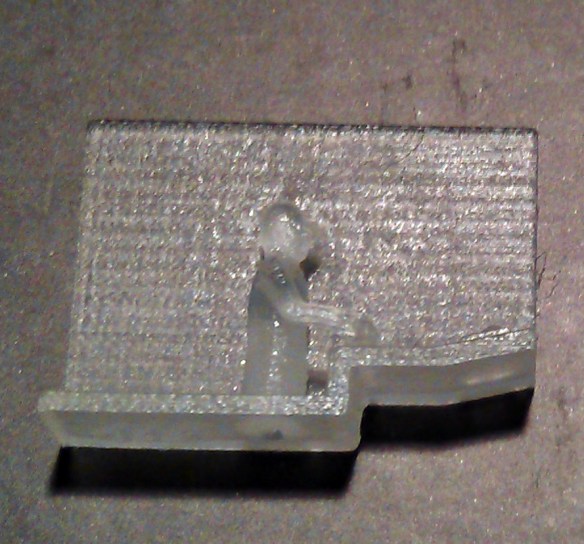
And finally, as you may recall, I also included an engineer for the cab. and here he is.
DT6-6-2000 Test Print 2

He is very small, and this photo doesn’t do him justice.  The only issue I had was not with him but with my design.  I found that even though I had put locating locating lugs in the shell to fix him in the right place it would be very difficut to do as there is nothing to get hold of him by.  So I have now added a tab on the underside so you can grab him with a pair of tweezers.

Now all the checks and tests are complete I’m happy to make the kit available to buy in several options such as unpowered dummies and with or without truck side frames.  You can find them all on the new website page here.

In a future post I will share how my DT6-6-2000 looks painted up in Santa Fe colors transferring freight from one yard to another.