Simply Running Trains

This week’s post is simply about the pleasure of running trains.  As well as public shows, when we take our layout around the country to exhibitions, we also try to meet up about once a month in the local village hall.  These ‘Running Meets’ are used to set up parts of the layout to fix any issues, work on any problematic areas, and test new stuff.  But once that’s done, we use the rest of the day to run trains.

This weekend we were testing some modifications we have made to our yards so the only scenic section was ‘Solent Summit Station’.   This gave us a layout in the shape of a bowtie.  Although our yards can store up to 238′ of trains each there is still only one track in and out.  This is because our layout is based on the one track system with a single track mainline and passing places.

Recently I have been trying to find ways to take better videos with my camera phone.  So I have invested in a tripod and phone mount hoping this well at least alleviate the wobble.  So needless to say I took a lot of video over the weekend and I want to share some of that with you.

To start with I finally got round to repainting and weathering up my Model Power 4-4-0 as Yosemite Valley Railroad no 22, well Steve at Model Railway Solutions did, as he is much better at weathering than me!

yv-no22-with-log-train

The log cars are unique to the Yosemite Valley Railway and were used on their 88% incline to bring huge logs down from the mountain.  These cars are 3D printed and you can find them and more about them here.

No 22 still has some paint on the wheels to clean off but she did okay hauling a short train around the layout as you can see in the video below, which, if you click on the link will take you to Videscape where I’m now housing all my videos.

The Union Pacific had a big presence this weekend and as usual they also had the biggest engines.  Below is a video of UP Bigboy No 4006 with an empty coal train drifting through town.

UP Bigboy with a coal train through Solent Summit

Later in the day a rather grubby-looking No 4006 was seen hauling a boxcar train through Solent Summit.  These freight cars were also weathered by MRS and you can read about them here.

Not to be outdone the UP diesel department sent through a long freight headed by five EMD locos.  A GP35 upfront followed by a GP7, two GP20 and a massive DD35.  The DD35 is also 3D printed and you can find out about it here and by searching this site for DD35.

But when it comes down to sheer length of trains BNSF had it topped with a very long coal drag headed by a leased SD90MAC, two AC440CWs and tailed by two more.

This sort of heavy traffic plays havoc with the track and BNSF had a GP39M out on maintenance of way duty.

BNSF GP39M with maintenance of way train pulling into Solent Summit

A visitor from just over the border was a Canadian Pacific RS3 with a short propane train.

CP RS3 with propane tankers

We also had a visitor from the other border.  N de M or (Ferrocarriles Nacionales de México) México’s state-owned railway’s Baldwin Centipede made an appearance with a train of Harriman coaches.

N de M Baldwin Centipede with Cross Country Passenger at Solent Summit

Southern Pacific got a look in with a gleaming set of A-B-A Alco PA’s hauling the Morning Daylight.

SP Alco PAs with Daylight Leaving Solent Summit

The UP was still thundering up and down the line with long freight trains but this time with a change of power.  This train is headed by an A-B-A set of Alco C-855s.

UP C-855 Set with a freight train through Solent Summit

The C-855s are 3D printed shells on modified Con-Cor U50/Turbine chassis and you can find out more about them here and by searching for C-855 on this site.

UP C-855 Set with a freight train at Solent Summit

Santa Fe was also spotted rumbling through town with a train of brand new Cat excavator equipment.  The three SD40-2 have all been weathered by MRS; the lead loco, painted in the proposed colors for the failed merger between Southern Pacific and Santa Fe, could do with a good clean.

SF EMD SD40-2s with Cat train Leaving Solent Summit

Amtrak passed by with its combined Super Chief and El Capitan.  Clearly it has not been long since Amtrak took over as some of the rolling stock is still in the former Santa Fe colors.

Amtrak F7 with a combined Super Chief and El Capitan

Burlington Northern had a few trains working the line.  The first was an SD40-2 with a local freight.  This locomotive was the only one to be painted with the tiger stripe front.

BN other train, also hauled by SD40-2s was a loaded coal destined for the power station.

BN SD40-2s with a loaded coal train through Solent Summit

Former Norfolk and Western J class 4-8-4 No 611 was also in town this weekend as part of a steam excursion.  It passed through a few times with a mix of heavyweight coaches.

No 611 was later joined by a SP Hudson No 2486 and together they worked the train over the summit.

N&W J Class No 611 & SP Hudson No 2486 with excursion train

Lastly the Northern Pacific passed through with an A-B set of F7 and a very familiar set of weathered boxcars!

NP F7 with freight

And that is just about it for this week. It’s always a good weekend when there’s no issues to fix and you get to simply run trains.

Next week is the NMRA (BR) annual convention and I will be there.  This year it’s taking place at the The Best Western Plus Manor NRC Birmingham Hotel, Meriden.  And as usual I will be there from Friday to Sunday.  This year we are not taking a big layout, just a few modules to form a switching layout.  If you are coming to the convention please come by and say hello.
 

One Exhibition to the Next

In last weeks post I had promised to bring you some photos and videos from the Andover Model Railway Exhibition however it was fairly late by the time I got home Sunday Night and today is my wedding anniversary so the overview from the show will have to wait until next week.

In the meantime; next weekend is the Swindon Railway Festival 2016 and I will be there on the Sunday operating the wonderful layout ‘Horfield’ which depicts the GWR four track main line between Bristol & South Wales.  Maybe I will see you there.

Little Trains in Big Places

You may have noticed my posts have been a bit short recently, and not really about my normal 3D printing projects, and this one will be no exception.  This is not because I haven’t been doing anything; rather I have been very busy traveling.  In this post I will bring you a bit of steam railway history from Iceland.

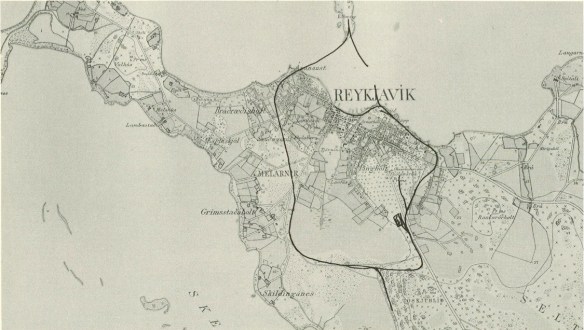
Does Iceland have a railway?  Well not right now but did, in fact it has had three.  The first was built in 1913 and was used to construct the quay and breakwaters now shielding the Reykjavík harbour.  The railway was called the Reykjavík Harbor Railway and operated until 1928.  It was a 900 mm (2 ft 11 716 in) narrow gauge line and ran to two quarries around Reykjavík as well as along the water front.  You can see the extent of the railway on the map below which was created by By N. P. Kirk.Map_of_Reykjavík_Harbour_Railway

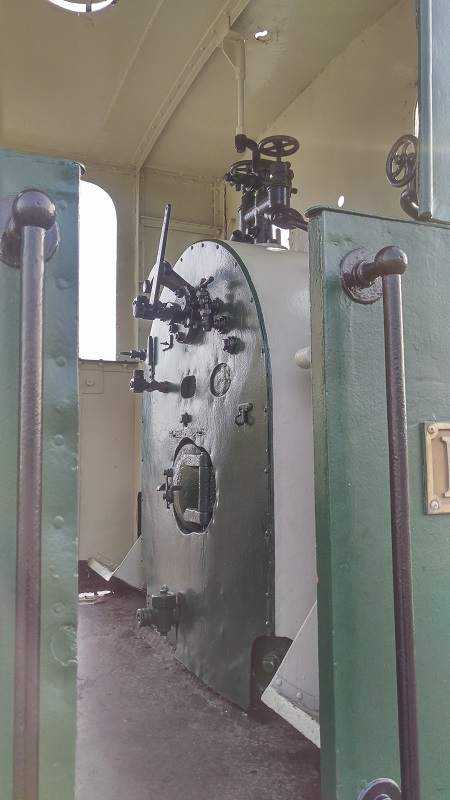
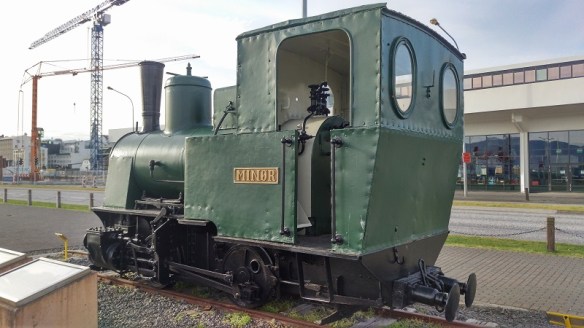
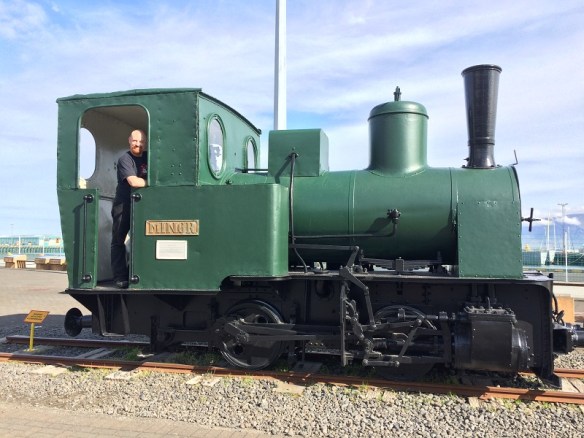
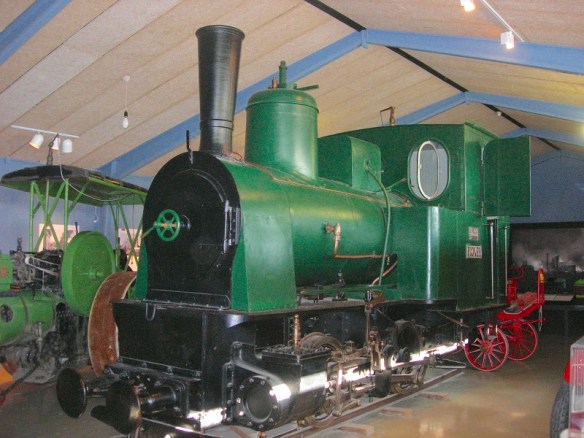
The railway had just two locomotives, Minør and Pioner, which were built by the Jung engine company of Germany in 1890.  From new, they did a sort stay in Denmark before being shipped to Iceland in 1913.  The engines both have 0-4-0 wheel configurations and have standard out side cylinders.   Although there is now nothing left of the railway, luckily both engines have been preserved. Minør sits proudly on Reykjavík dock side.

Reykjavík Harbor Railway 1 Reykjavík Harbor Railway 2 Reykjavík Harbor Railway 3 Reykjavík Harbor Railway 4 Naturally I had to have a go!
Reykjavík Harbor Railway 6

The only rolling stock used on the line were the open sided flat cars as you can see in the photo below.  None of these are believed to have survived.

Reykjavík Harbor Railway 5

The other locomotive, Pioner, is on display at the Icelandic Folk Museum at Arbær, Árbær Museum.  The photo below is courtesy of Timothy Titus.

RHR-Pioner

The second railway in Iceland was built in the 1930s and was the Korpúlfsstaðir Farm Railway.  It ran around an industrial farm on a 600 mm (1 ft 11 58 in) narrow gauge track.  It had no locomotives so all the four-wheel skip wagons were pushed by hand.  Nothing of this railway now exists.

The third Iceland railway was built just after 2000 to transport materials and workers to build the Kárahnjúkar Hydropower Plant.  The Kárahnjúkar Light Railway was powered by three diesel locomotives which ran around the clock.  The railway was removed once the facility was completed and, as with the second railway, nothing now exists.

There have been plans to build a standard gauge railways in Iceland dating back to 1906 but the roads always won the battle.  The most recent was for a railway between Reykjavík and Keflavík International Airport however a new dual carriage way road was built in 2008 allowing the trip to be done in fifty minutes by coach, but I am led to believe the scheme is still being considered.

And that is my brief history of the railways of Iceland.

Next week I will be at the Andover Model Railway exhibition so hopefully I will have something to share with you from there.

On Board with a Really Big Steam Engine

Although most of my posts are model railway related I also have the odd post about real trains; see last month’s post about the Dean Forest Railway.  Also I have the odd post about other steam equipment such as traction engines; see last year’s post about the Great Dorset Steam Fair! By the way this year’s GDSF is less than two weeks away for anybody who’s thinking of going.   But this post is a little different; it’s still about a steam engine, but not on dry land.

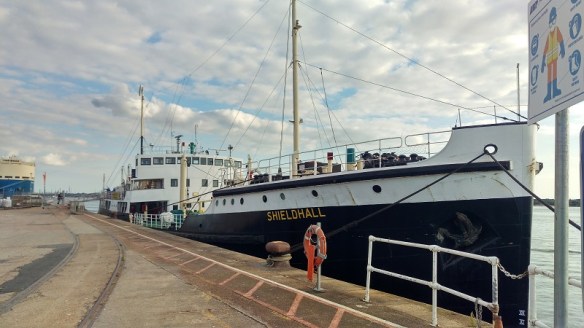
The ‘Steamship Shieldhall’, which is the largest working steamship in Britain, was steamed up and ready to meet me at Southampton Dock. And I went for a nice cruise down to the Solent and back.

Shieldhall 15

The Solent is the body of water between Isle of Wight and the mainland at the Southern Coast of England.  It’s in this area where most of my fellow modellers building American railroad layouts live, hence why our layout is called ‘Solent Summit’.

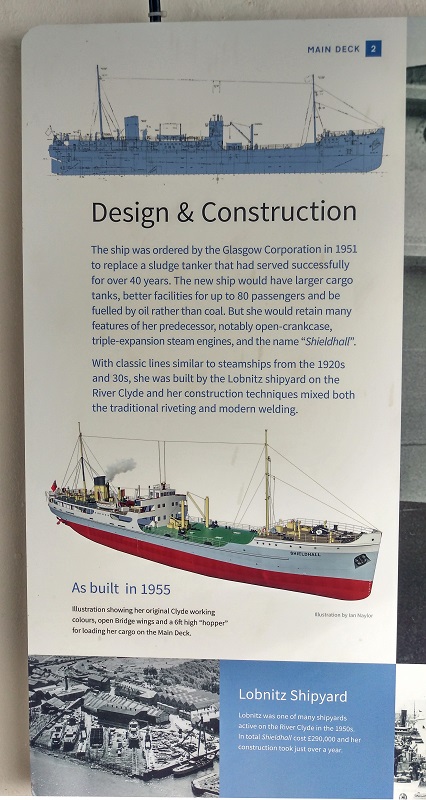
The ‘Shieldhall’ was built in 1955 as a sludge tanker, not the most glamorous of duties.

Shieldhall 13

She was one of seven ships which worked out of Glasgow between 1900 and 2000.

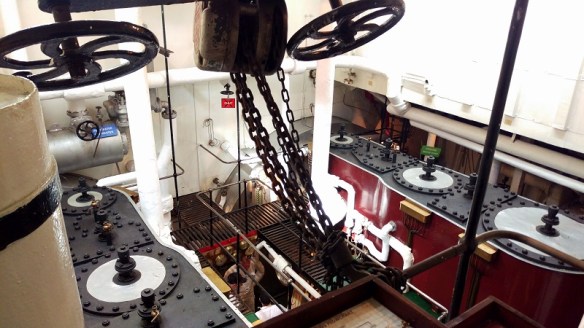
Unlike her predecessor, the boilers on this ship are oil-fired, making it a much nicer ship to work on.  The engine room is located at the rear of the ship under the main funnel and looking down from the main deck level all you see are the cylinders.  There are two steam engines, each with three cylinders.  In the picture below you are looking towards the front of the ship, the smallest cylinder is the first and is a high pressure cylinder,  followed by a medium and low pressure.

Shieldhall 10

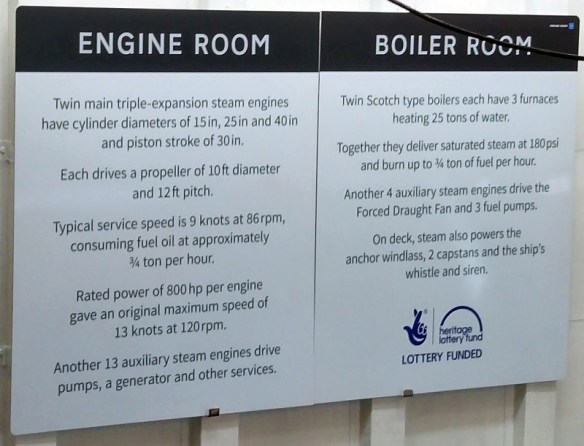
Here is what they had to say about their engines and boilers.

Shieldhall 33

The term ‘triple expansion’ means the same steam is used in all three cylinders: as it exits the first cylinder it goes into the second and then into the third.  As a steam engine works by the expanding force of the steam in a cylinder each cylinder has to get bigger to give the same amount of power as the previous.  Hence why there are 15″, 25″ and 40″ cylinders in one engine.  When the steam comes out of the last cylinder it has almost used up all of its expanding power and is condensed back into water.  This is then put back into the boiler.  Unlike railroad locomotives and traction engines, ships can only use the water they carry as anything other than fresh water will damage the boiler.  Therefore the condensing of steam to water is essential, and that is also why you don’t see lots of steam blasting out of the funnel in the same way you do with railroad locomotives and traction engines.

Below is a quick video of the cylinders. It was extremely hot at this level but surprisingly clean.  All the action is on the deck below.

Heading down the second ladder puts you right next to the motion as you can see in the video below.  The wind you can hear is from the cold air being pumped in behind me, which was very welcome.

The engines were running slow, or idling, at this point.  Although we were still tied to the dock both engines were turning to warm up.  As the engines are permanently connected to the propellers one was in reverse as not to create too much driving force.

Below is a video of the other engine, looking down the pistons.

Once we got under way the engines were turning much faster, and both in the same direction.

In the video below when it pans up you can see the crank slides and the oil way pattern used to evenly distribute oil for lubrication.

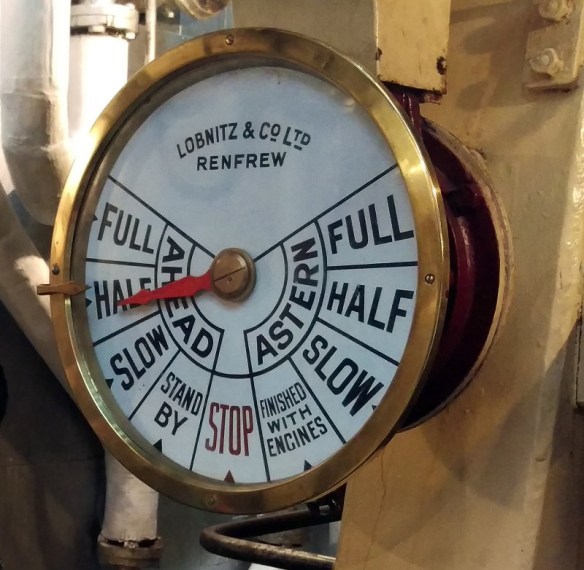
Each engine has its own regulator and reverser, and they are very similar to railway and traction engines.  All the controls are right next to the engines and instructions are sent to the engine room by these.

Shieldhall 17

There is one for each engine and a corresponding pair on the bridge.  The red arrow states what the bridge wants the engines to do and the gold arrow is an acknowledgment from the engine room.

The drive shafts are exposed as they run out from the engines at the back of the ship, as you can see below.

The four boilers, being oil-fired, are very self-contained and although they need to be managed they don’t need to be worked as you do with a coal-fired boiler.

Shieldhall 4

Getting photos was tricky as they are fairly big and the working space behind them was not.

Shieldhall 5

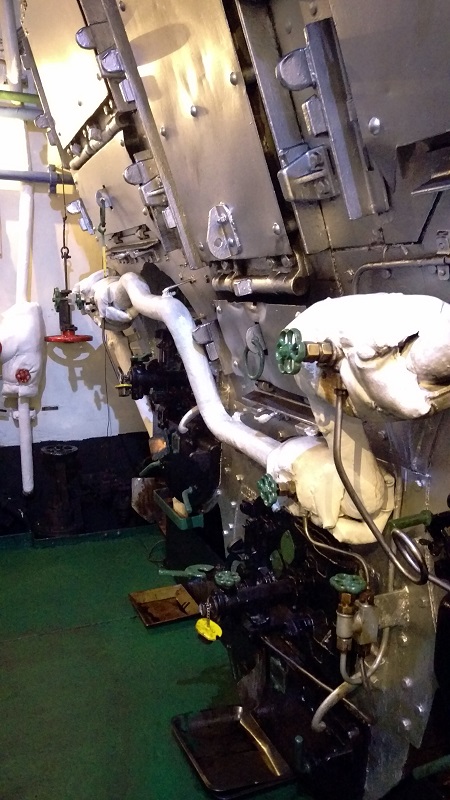
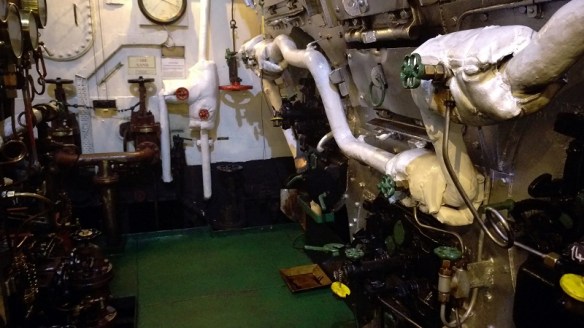
The fuel oil was a fairly medium viscosity and is sprayed into the burner.  The actual nozzles receive the oil from the side under pressure which causes it to spin within the nozzle, giving a decent spread of oil for an even burn.

As with the fuel oil used on the UP Gas Turbine locomotives, this oil needs to be heated before it can be injected and that is done by the apparatus you can see on the left in the above photo.

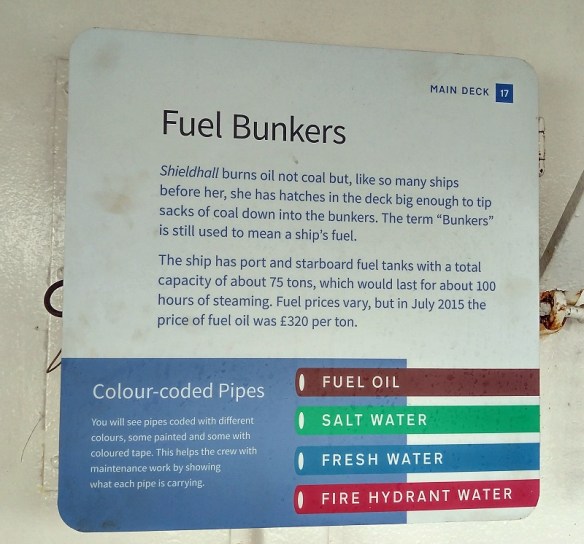
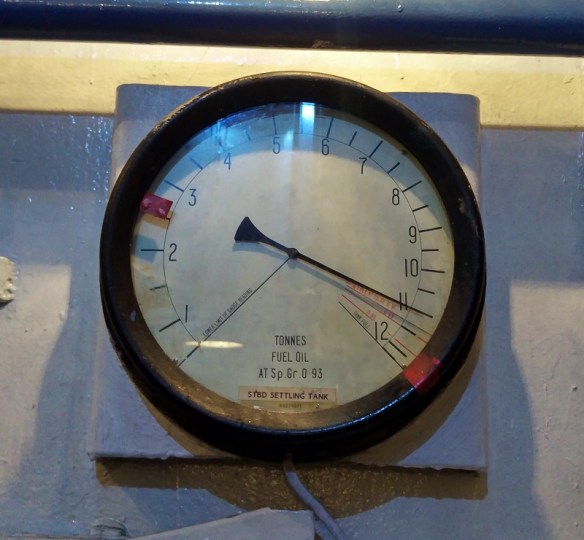
The walls of the ship either side of the engine room are the fuel tanks and as you can see from the gage below, she had recently been topped up.

Shieldhall 6

And I don’t think I would like the bill from that fuel stop!

Shieldhall 14

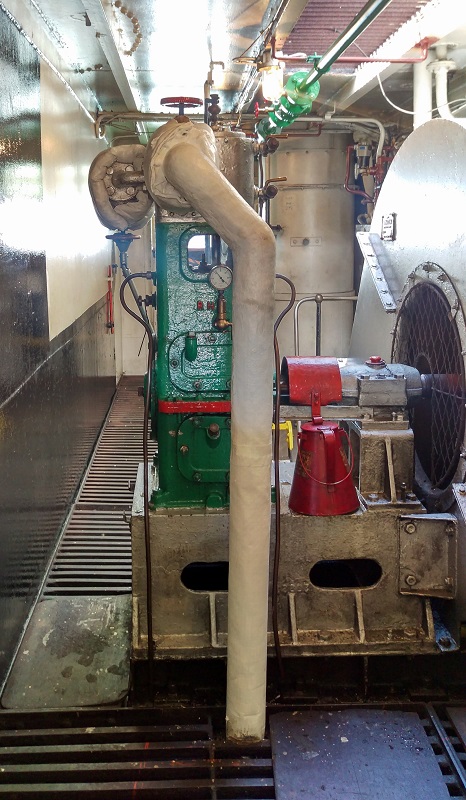
One of the smaller steam engines is the Forced Draught Fan.

Shieldhall 2

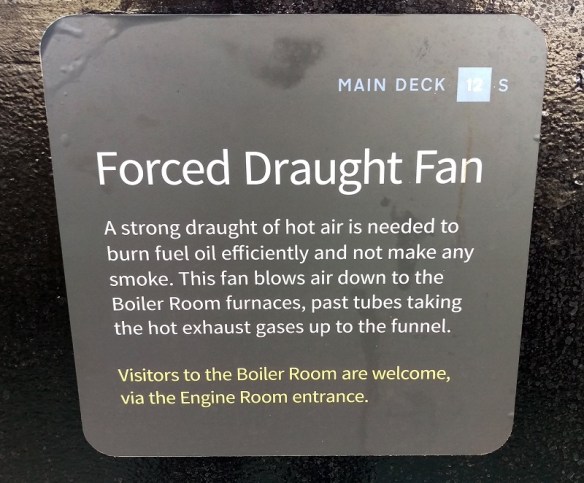
It was this that was causing the cool air to blow into the engine room you could hear on the previous videos.  It’s not as exciting as the main engines but in this video below you can hear it pumping away, driving the fan on the right.

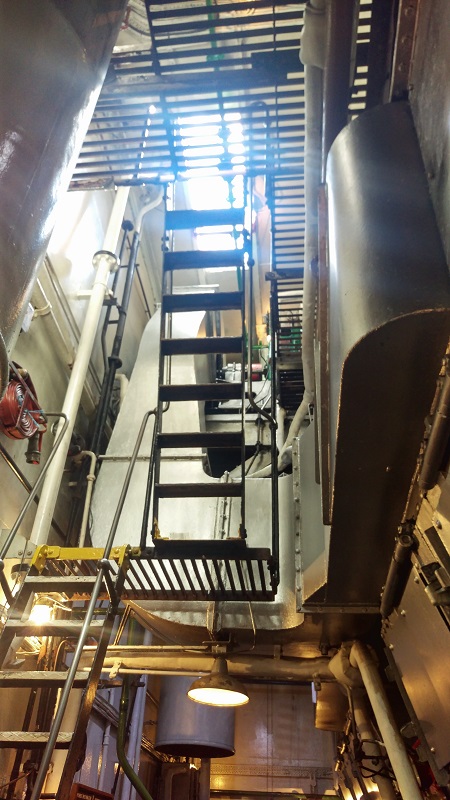
This draught, as well as cooling the engine room, is also the main draw for the burners and in the picture below taken from the boiler room looking up, you can see the air ducts from the fan running to the boiler tops.  And you can just about make out the little green steam engine.

Shieldhall 19

Shieldhall 1

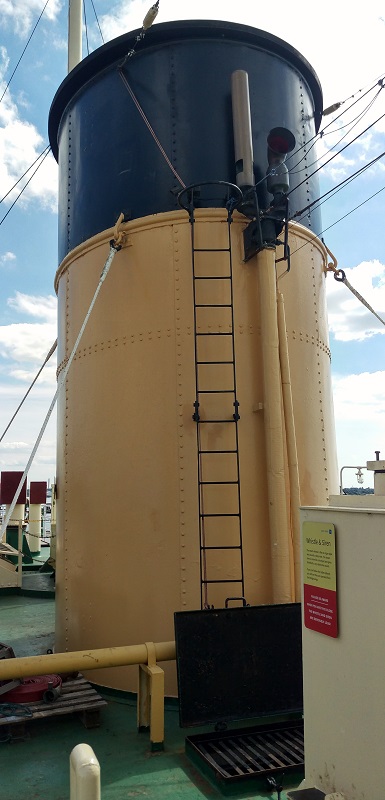
The ships funnel also has the ships whistle mounted to the front as you can see below.

Shieldhall 11

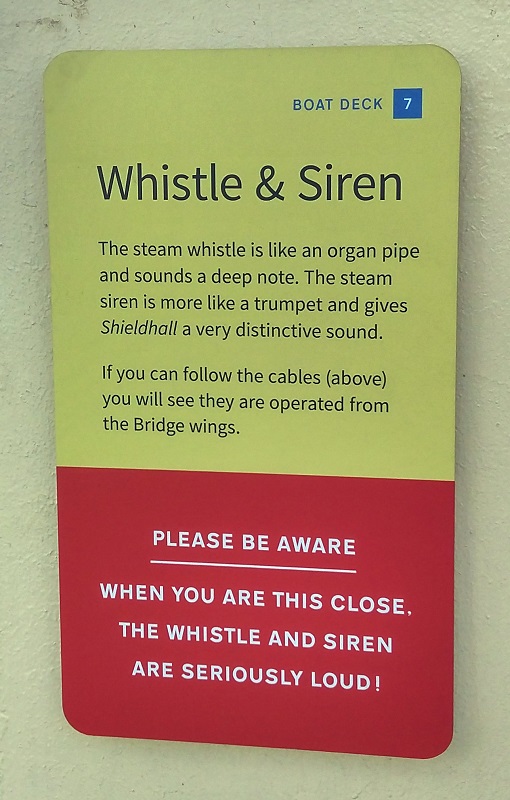
And this came with a warning!

Shieldhall 12

Several times I was caught standing near it and they weren’t kidding.  In the video below we were passing a large cruise ship coming out of Southampton heading for Copenhagen.  The cruise ship got in first with its fantastic horn but the ‘Shieldhall’ answered with the siren and then whistle.

The trip on ‘Shieldhall’ was great fun and the visit to the engine room was fantastic. It was a privilege to see it working although I am pleased it’s now a pleasure cruise ship and not still a sludge hauler.

Before I wrap up this post I wanted to let you know that Shapeways have free worldwide shipping on all orders over $25 untill August 21, 2016 at 11:59PM PDT.

Next week I’ll be updating you about my club’s upcoming shows.

A Visit To The Dean Forest Railway’s Steam Gala 2016

In this week’s post I will be sharing with you some photos and videos of real trains taken at the Dean Forest Railway while they where having a steam gala.

The Dean Forest Railway, situated in the Forest of Dean, currently runs from Lydney Junction to Parkend, along the old Severn & Wye Railway route.  The line is 4 1/4 miles long and snakes its way up hill into the forest.

Map

A third of the way along the line are the main locomotive sheds at Norchard.  This is also the center of the railway with all the shops, museum, facilities and parking. Interestingly the main Norchard station is considerably lower than the line to Parkend giving the railway a junction at Middle Forge.  This makes for some interesting train movements throughout the running day.  Lydney Town and Whitecroft are the other two stations along the line where passengers can alight or catch a train.

Normally the railway operates a single steam train or diesel rail car service up and down the line, but this weekend was special.  The DFR has teamed up with the Flour Mill who are professional steam locomotive re-builders.  They have the expertise and facilities to completely rebuild any steam railway locomotive and are located just a few miles into the forest at Bream. Over the last few years they have been restoring several locomotives for different railways but for this Gala, three have come back to turn their wheels on the DFR.

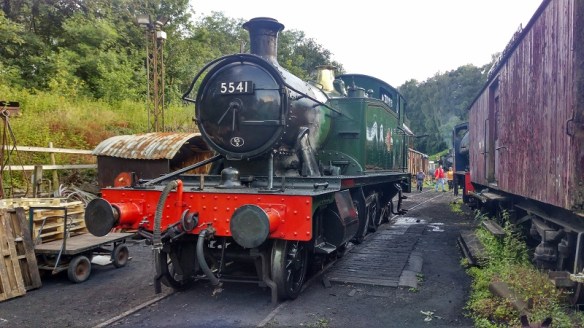
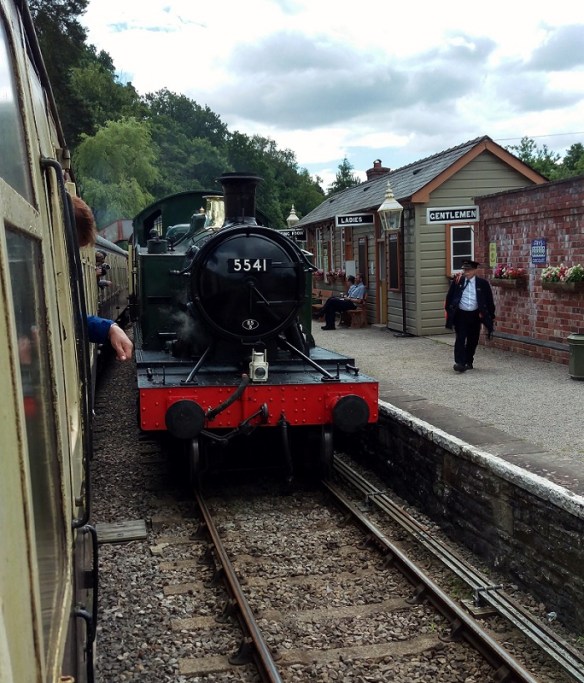
Four steam engines where running on the day I visited, one of which was the DFRs resident GWR 2-6-2T prairie, No. 5541.

5541 7

5541 was built in 1928 and has been a resident at the DFR ever since it was rescued from the Barry Scrap yard in October 1972.

5541 4 5541 -8

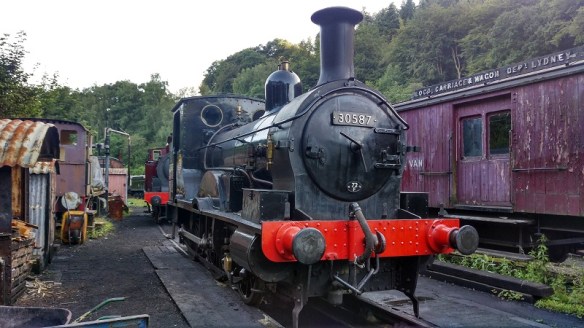
The first of the visitors, and also the smallest, was No 30587, the Beattie Well Tank from the Bodmin & Wenford Railway.

BT Well Tank 1

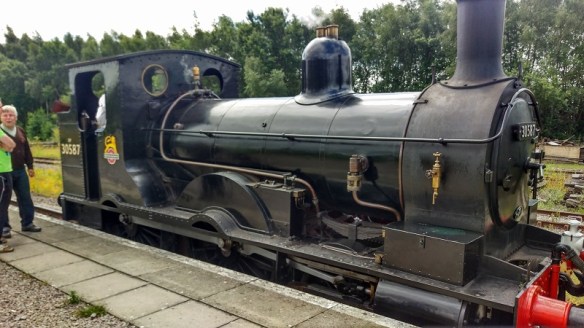
This 2-4-0T is a very compact locomotive. It was designed by W. G. Beattie and built for the London & South Western Railway by Beyer Peacock in 1874.

BT Well Tank 5You can see in the photo below, the driver has his feet up on the wheel arches which protrude into the cab space.
BT Well Tank 6

The bunker behind the cab is only for coal with the water being stored in two well tanks between the wheels, one under the bunker and cab and the other under the smoke box.  Both are linked with a balance pipe.

But don’t let it size fool you, this engine pulled very well and sounded fantastic working up the line.

Here is a video of the BT tank arriving at Lydney Junction taken from the signal box; having friends in the Signal and Telegraph department has its advantages.

The BT tank ran around it’s freight train to get ready for its next trip to Norchard.

The Lydney Junction station has two platforms and two separate run round loops.  At the south end it also has a connection to the main line allowing specials to run up into the forest.

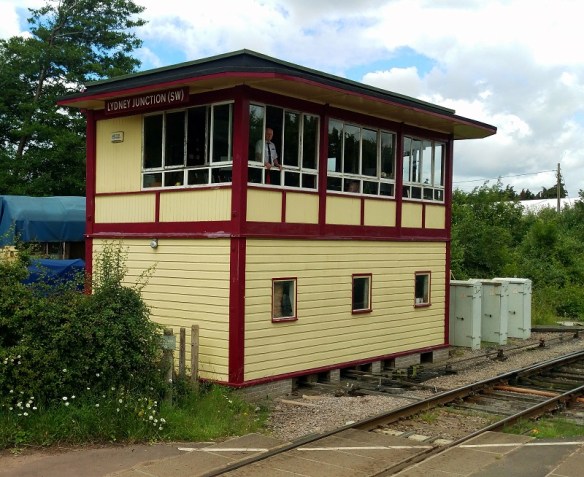
The Signal box, as pictured below, controls the whole station and the road crossing.

Lydney Junction Box 5

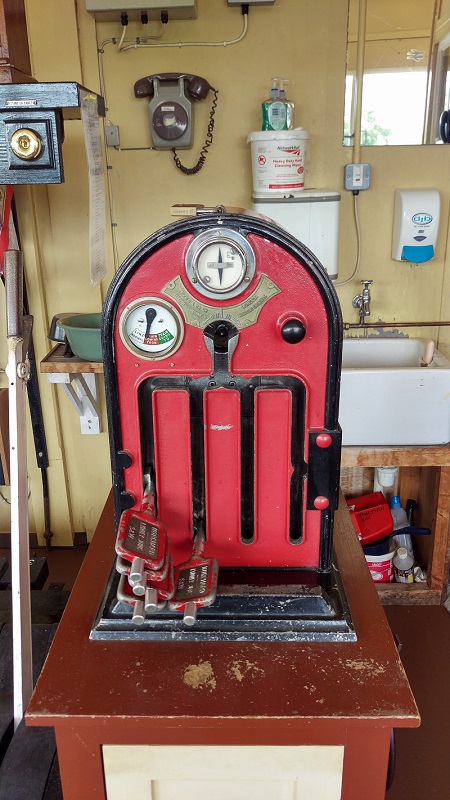
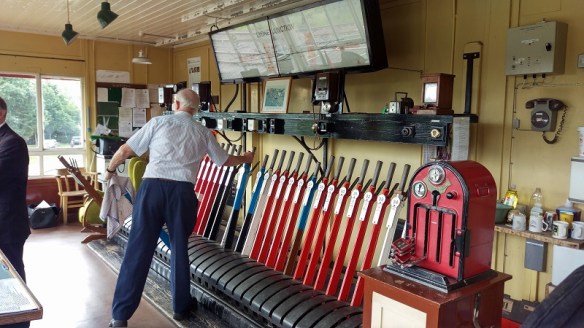
The leaver frame inside operates all the points, point locks, signals and pedestrian crossing gates allowing access to the island platform.

Lydney Junction Box 1

The line operates on a token system and the box to the right of the leaver frame, also shown below, is the token machine.  A train can only run up the line to the next signal box if it is in possession of a token.  And a token can only be removed from the machine with the permission of the signalman in the next box.

Lydney Junction Box 4

In the previous video of the BT tank arriving at Lydney Junction you could see the fireman handing the token over to the signalman as the train cleared the section.  Once that token was reinserted into the token machine the line becomes free again.  When the signalman is ready to send a train up the line he pushes the large black button on the top right of the machine.  That rings a bell in the next signal box, if they are ready to receive a train they will respond which will allow a token to be removed locking the section to whichever train holds the token.

Later in the day the BT tank headed to Norchard from Lydney Junction East Platform, you can see signal man waiting next to the track with the section token for the train.

Being a freight train, the BT tank didn’t stop at Lydney Town and I was able to catch it trundling through.

The BT tank came into the Norchard Low level platform, which is a terminus, so again it needed to run around its train.  Although it was masquerading as a freight train it was actually giving brakevan rides; hence the need to go into the station.  The Norchard Signal box is situated at the end of the platform.  This box controls both the high and low lines.

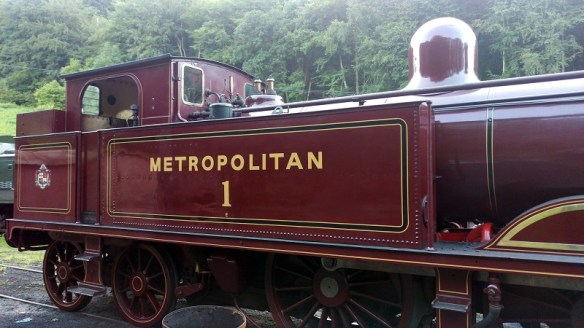
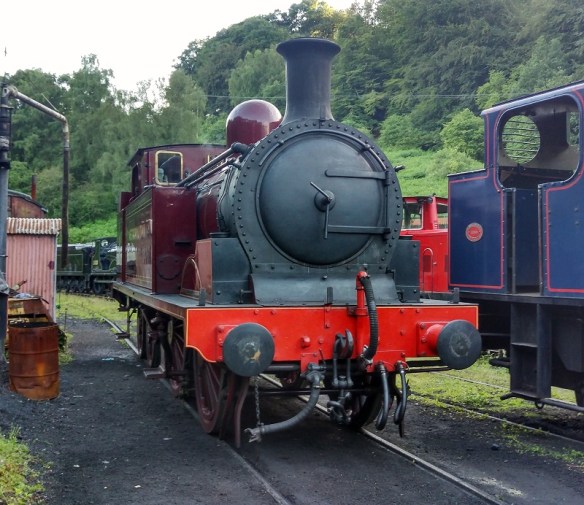
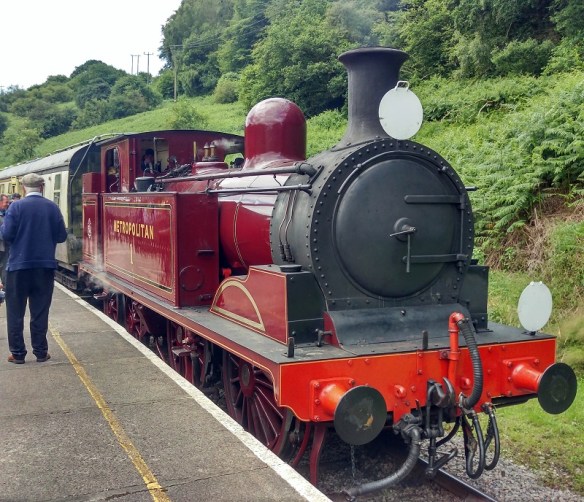
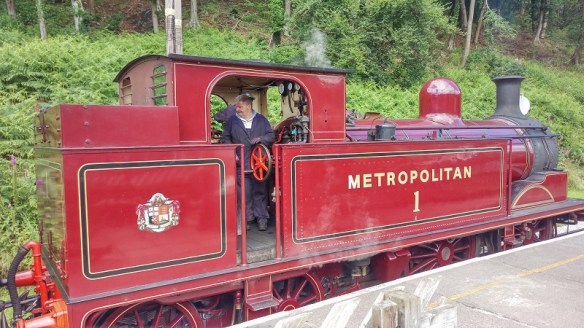
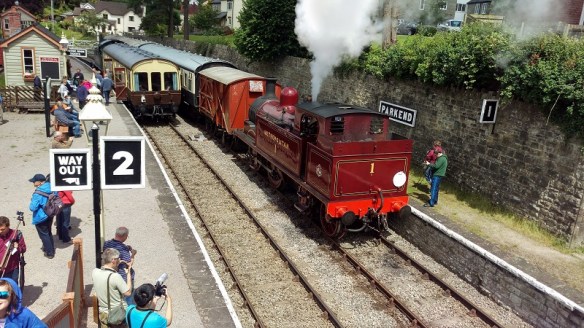
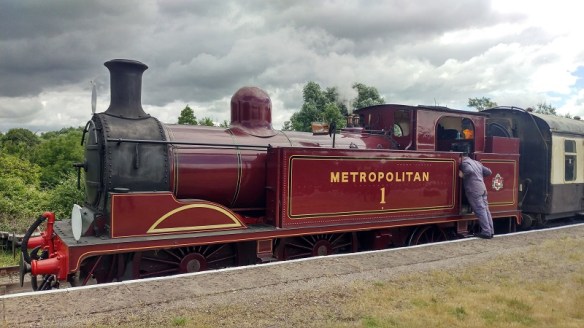
The second visiting engine was Metropolitan No 1, or Met 1.

Met 1 1

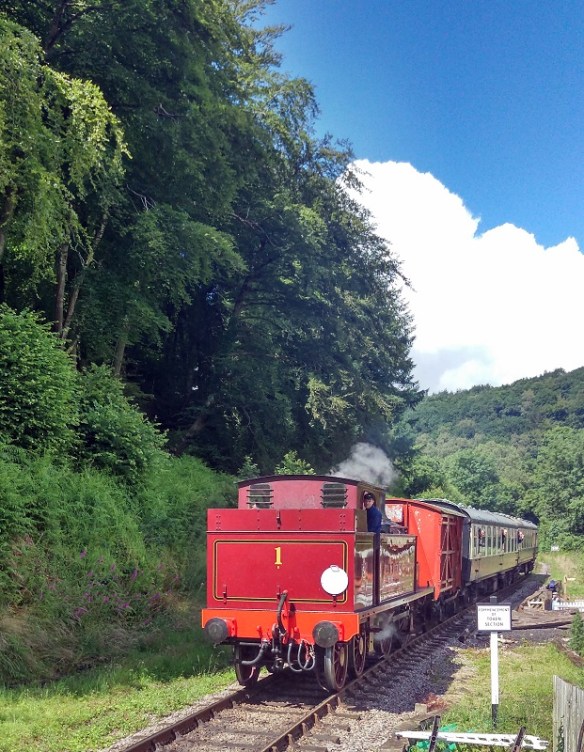
This 0-4-4 Tank engine was built in 1898 for the Metropolitan Railway of London.  It now belongs to the Quainton Railway Society at the Buckinghamshire Railway Centre.

Met 1 2

This engine was one of the original underground locomotives, that’s right I said underground!  And if you don’t believe me, here is a video made by Geofftech showing it running on the London underground back in 2013 as part of the 150 year celebration.

Heading back to the DFR, the Met 1 was puling a pair of coaches and a box van and I was able to catch it at Norchard High Level platform heading to Parkend.

Met 1 15 Met 1 16

It returned about 40 minuets later where I joined the train.

Met 1 21

I think the train was running about 5 minuets late so the driver was keen to make this up, leaving Norchard High level he wasn’t sparing the horses.

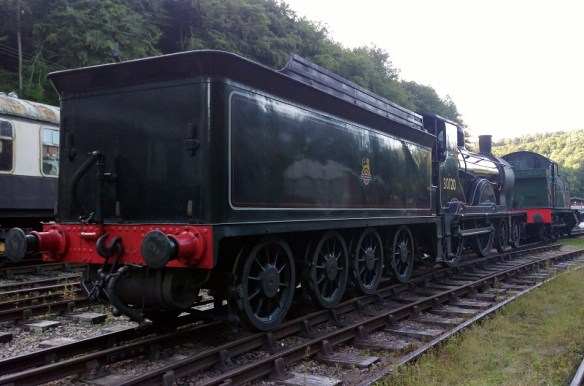
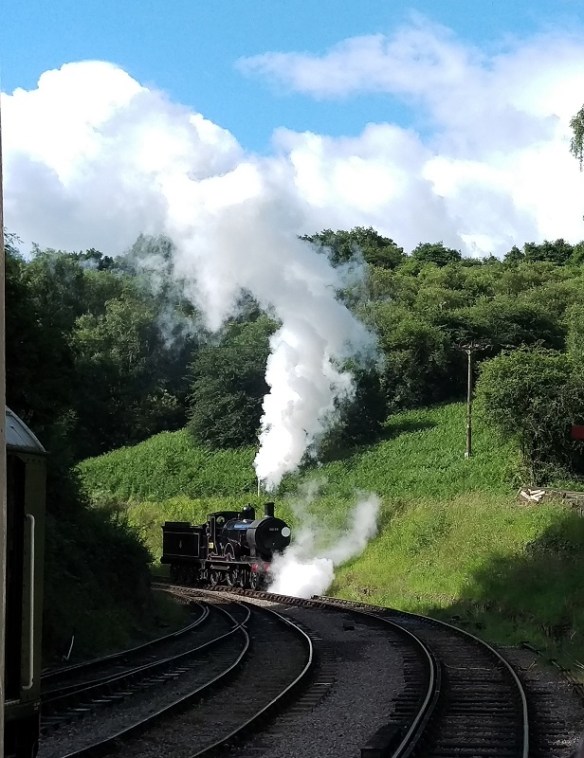
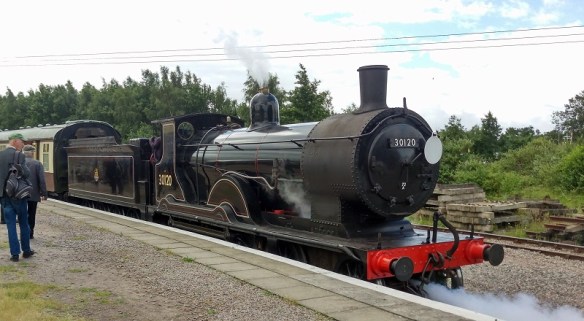
Arriving at Lydney Junction again I met up with the third and final visitor to the DFR.  The ex-LSWR ‘Greyhound’, No. 120, later BR T9 no. 30120.

T9 1

This 4-4-0 was built in London at Nine Elms in 1899 and was my favorite visitor.

T9 3

With its sleek lines and eight wheel tender its understandable why this class was called the greyhound.

T9 12

The T9 is part of the National Railway Collection.

Again I was in the box at Lydney Junction when the T9 arrived.

The T9 did a quick turn around before heading back to Parkend.

The nice thing about Lydney Junction having two run around loops is two trains can run around at the same time and I was able to catch Met 1 and T9 doing just that later in the day.

The T9 was again the first to leave for Parkend.

I found it again coming into Lydney Town.

The next train through was the Met 1 and I took it all the way to Parkend, in the video clip below the train stops at the outer home signal before Norchard High Level and has to work hard to pull up the hill, it also sounds nice pulling out of the station.

Parkend is beautiful forest town and is currently the end of the line.  The original line carried on to Cinderford via Speech House road and the railway is in the process of planning to extend up to Speech House; which will add a few more miles to line as well as some lovely forest scenery past Cannop Ponds.

Arriving in Parkend the Met 1 found the T9 already run round and ready to go to Lydney.

A full Parkend Station

T9 13

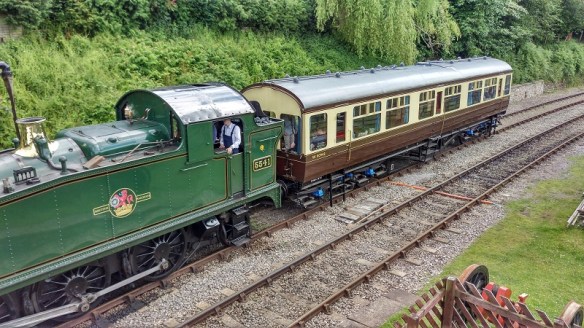
But as this is a Steam Gala there are trains everywhere and 5541 makes an appearance with the inspection saloon.  The saloon is a beautifully restored inspection coach designed for railway officials to inspect the line and that was exactly what was happening today.  A private party from the National Railway Museum where enjoying a trip up the line in luxury.

Obsivation Coach

Although Parkend has two platforms it also only has two tracks, which where both full. So 5541 had to pull up behind the Met 1 to let the M9 out, then back out as the Met 1 ran around its train.  And I caught it on film from the platform bridge.

The video does cut short, that’s joy of camera phones, but I assure you 5541 did make it to the platform as you can see below.

Met 1 17

Before returning on my train I took a few more shots.

5541 1 5541 3 5541 5

Once back at Norchard I drooped down to the low level platform in time to see T9 running round its train.

T9 6

Then I took the T9 to Lydney Junction.

The Met 1 had also carried on to Lydney and both where basking in the sun.

T9 10

T9 7

Met 1 12

My final video is the T9 pulling out of Lydney Junction with the last train to Parkend for the day.

The DFR/Flour Mill Gala is also on next weekend, the 9th and 10th of July 2016 so if you happen to be in the area; it’s well worth a look.

And that wraps up my visit to the DFR, it was a fantastic day and I am already looking forward to my next trip up. To close I would like to say thanks to all the volunteers who run the railway; because without them it would not be possible and these fantastic locomotives would not be with us today.

Etched Brass Additions for an N Scale C-855B

This week’s post will be short as I’ve had very little modeling time due to the unfortunate demise of my much-loved motorcycle and the search for a replacement.  However there is good news; not only have I found another bike but the C-855B brass Additions have arrived and they look great.

C-855B brass Additions

The C-855B brass Additions are very similar to the C-855 set, although there are no windscreen wipers or sun shades.  There are also less grab irons, but two larger end handrails have been added as well as the extra end handrail.  These are the three parts on the left hand side.

For those that have pre-ordered your C-855B brass Additions, they have now been posted and should be with you very soon.  I have several sets in stock and they can be ordered here. Alternatively you can contact me through the contact page.

As I said, time has been short, so I haven”t test fitted the C-855B body onto an extended chassis yet but I will have it all done for next week’s post.  The body’s also going into the paint shop so there’s a small chance I might have the whole set finished and ready to share with you then.