Getting Back on Track

As well as the big 3D printed locomotive shells and parts, I often get asked for small parts and this week I wanted to share with you my design for my smallest yet.  I was asked by a fellow modeller if it would be possible to produce an N Scale Re-Railer to super detail his locomotives.

Re-Railers or Rerail Frogs as they are sometimes called come in all shapes and sizes, typically they are metal castings which are designed to be easy manhandled.  The type I will be looking at is a Y shape with a slot in middle which is designed to straddle the rail.  These are usually carried on locomotives, incase of rolling stock derailment, either on the side of the trucks or slung under the chassis.  They work by straddling the rail next to the derailed train car wheel, then the locomotive either pushes or pulls the car so that the derailed wheel runs up the Re-Railer and back onto the track.  Normally a pair of Re-Railers are used because when one wheel comes of so does the other, the Re-Railers are handed and are designed to work as a pair.

A good photograph of the exact Re-Railer I am modeling can be found here on the translation directory.

Modelling the Re-Railer was not the challenge with this project, that came with the actual size and making it printable at 1:160.  A real Re-Railer is barely 1 Meter (39″) long which in N scale is only 6.25mm (0.24″).  My first draft as shown below was an accurate model of the Re-Railer with some of the details over-sized such as the mounting lugs and flanges to make it printable.

Re-Railer Type 1 Draft 1

However even with the increased sizes the overall part was still unprintable.  The problem lay with the hole in the mounting lug.  In order to get enough material around the hole to make it printable the lugs became unrealistically large, and if the hole was made any smaller it would also not be printable.  To resolve this I also included the mounting bar and corresponding lugs as shown in the images below; these are normally part of the locomotive.

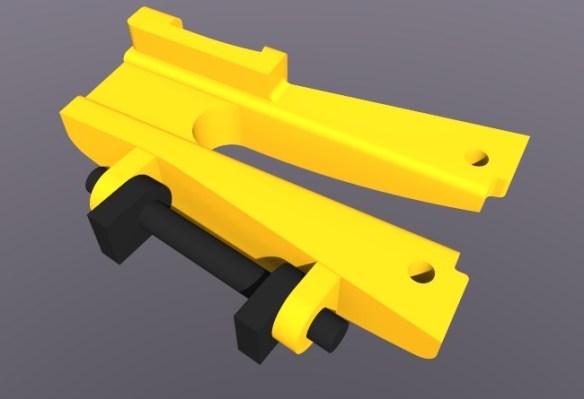
Re-Railer 1

Re-Railers 4

This solved two problems; firstly, by replacing the holes in the lugs with the bar the thickness of the lugs was no longer a problem, and secondly it would be easy to glue the part, once painted, directly to the underside of a locomotive chassis, as illustrated below on one of my DT6-6-2000 locomotives.
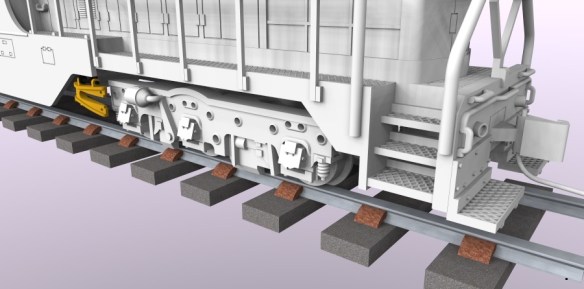
Re-Railer on Loco

However this design was also unprintable, but not by much.  The black mounting bar shown in the images above is technically a wire by the 3D printers definition of parts.  This means it has to be twice as thick in order to survive the post print process and to guarantee that it will arrive in one piece.  Where the bar protrudes out of the mounting lugs is okay because this is classified as a detail and is supported by the thickness of the lug. I didn’t want to increase the size of the mounting bar as again it would become too unrealistic so as a compromise I filled in half of the area between the bar and the main body of the Re-Railer as shown below.

Re-Railer Type 1Given the actual size of the part and that it hangs under the locomotive in shadow this will not be noticeable, especially if the raised part of the bar is painted a different color to the filled-in section.

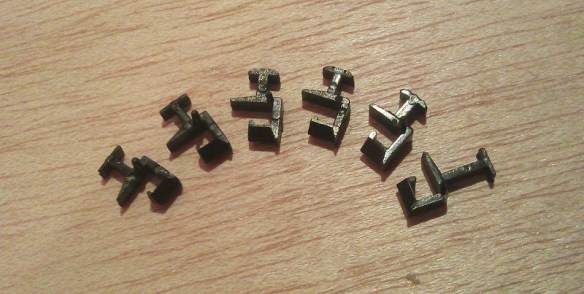
The test print for the Re-Railer has now been completed and is due for delivery later this week.  In a later post I will share with you how it came out and what it looks like on real model.


Discovering the Possibilities of Etched Brass Part 3

Following on from last week’s post, where I showed you the first two sets in my new ‘Additions’ series of etched brass details, I promised to share with you some photos to demonstrate how effective the ‘Additions’ details really are. So in this week’s post I have some of the current work-in-progress photos for you.

So far we have only been working with the EMD DD35 Additions set; the weather here in the UK has been unusually fantastic so we’ve been making the most of it!

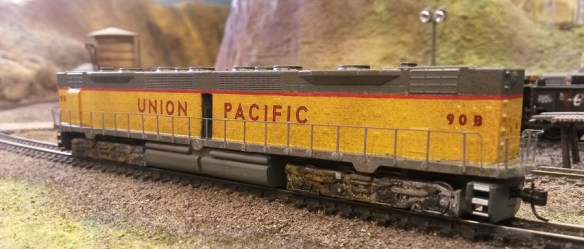
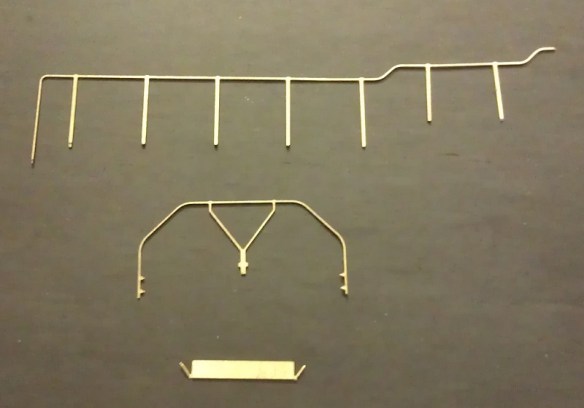
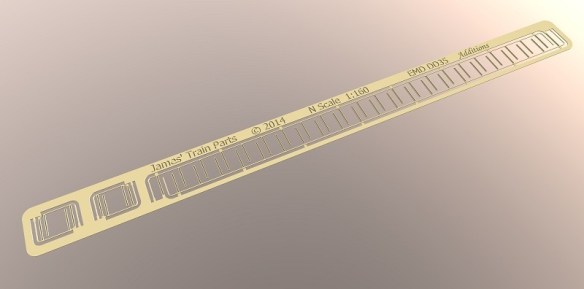
The DD35 set, pictured below, comprises of two long handrails for the sides and four corner handrails that need to be rolled into shape as I showed you in last week’s post.

DD35 Additions Set

DD35 Additions 1

DD35 Additions Parts

Below are some photos of a DD35 using the stock 3D printed handrails which will still be provided with the kits should you wish to use them and I think they work well when using the DD35 with a Con-Cor U50 as the stock handrail sizes match.

DD35 & U50 1

DD35 2

Having already cut out a set of Additions for a DD35 and having a new one under construction it was simply a matter of glueing them on.  They were a good fit using the same mounting locations on the side of the shell as the 3D printed rails and, as you can see below, they look very realistic.  They still need the final coat of paint to finish the model but I think the brass Additions really finish it off nicely.

EMD DD35 With Brass Etched Additions 1 EMD DD35 With Brass Etched Additions 3

EMD DD35 With Brass Etched Additions 5

Once complete I will have some more photos of this model to share with you as well as some of the Baldwin DT6-6-2000 with its brass Additions.

In the meantime, if you would like to purchase one of these brass Additions kits please drop me a message using the Contact page.

Discovering the Possibilities of Etched Brass Part 2

A few weeks ago I shared with you my designs for etched brass handrails and details to improve my Baldwin DT6-6-2000 and EMD DD35 locomotive shells.  These etched brass sets are the first in my ‘Additions’ series which will be available for all my locomotive shells.  Now that the first batch have arrived I wanted to share some of the results with you.

DT6-6-2000 Additions Set

DD35 Additions Set

The sets pictured above are etched from a sheet of 0.2mm or 8 thou brass and this has given me the ability to make handrails the correct actual scale size.  Although the brass is very thin I recommend using a very sharp, if not new blade in a craft knife to cut the parts out because pressure applied to remove them with a blunt blade will distort the parts.

The parts have small tabs which are only half thickness showing you where to cut them out, and making it easer to cut.  Depending on how close to the part you can make the cut it is likely there will be a small bur which can easily be removed by carefully filing the area with a flat needle file.  I found the best way to handle the parts was with a set of tweezers with a flat end.  Even between my fingers I could see the parts had the potential to bend out of shape. Below is one of each part from the DT6-6-2000 set.

DT6-6-2000 Additions Parts

The center leg of the end handrails, shown in the center above, is designed to be bent to form a dog leg as shown below. At the bend line the brass has again been etched to half thickness to mark the bend and make it easer to do.  I used my flat end tweezers to grip the brass at the bend line and pushed it over with my fingers.

DT6-6-2000 Addtions End Handrail

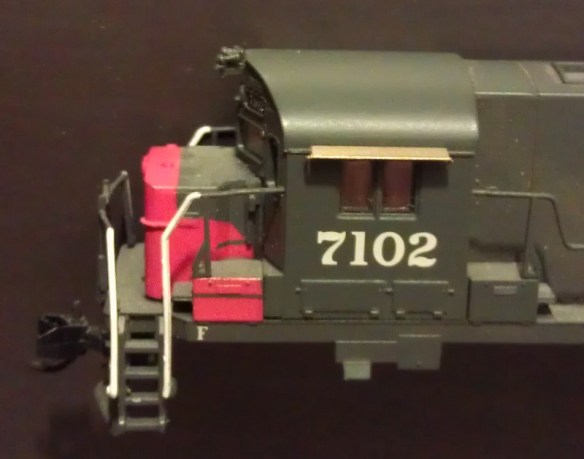
The sun visors for the DT6-6-2000 also have two stay bars that are designed to be bent back as shown below.  This again was done simply with the tweezers and there is an etched section at the bend point.

DT6-6-2000 Addtions Sun Visor

This can then be glued directly above the window as shown below on a different locomotive.

DT6-6-2000 Additions Sun Visor 2

These particular sets only have additional etched details on one side, for example the real DD35 handrail stanchions, as pictured below, are made from a folded plate made into a channel section.

EMD DD35 Handrail stanchion

To accurately model this detail I etched the middle of the stanchion to give a fluted effect as shown in the 3D rendered image and photos below.

DD35 Handrails Additions Close Up Render

DD35 Additions 1

DD35 Additions Close Up 1The small handrail sections shown above are for the ends of the DD35 and there is one for each corner.  Once they have been carefully cut out as shown below, again using the half thickness brass as a guide, they need to be shaped.

DD35 Additions Parts

To shape the end rails I rolled the brass handrail around the handle of a watch mender’s screwdriver handle which had the radius I was looking for.  As you can see from the results below the handrail section is now ready to be fixed to a DD35 Shell.

DD35 Additions End Rail 1 DD35 Additions End Rail 2

The ‘Additions’ series are designed to complement my range of 3D printed locomotive shells, enabling you to model in finer detail to suit your budget, and in a later post I’ll show you how effective the ‘Additions’ details really are.

In the meantime, if you would like to purchase one of these brass Additions kits please drop me a message using the Contact page.


Replacment Short Rapido Couplings

Having spent the majority of my N scale modeling time in the American arena I have not kept up-to-date with the British N gauge modeling scene. However I’ve recently become involved with the Poole and District Model Railway Society in England who focus on British N gauge modeling and I now have the opportunity to find out what’s been going on.

The Rapido coupling has been an industry standard for more than 30 years in both N scale and N gauge and in this post I wanted to share with you some of the things that can be done to make your older British rolling stock with Rapido couplers look comparable to the new NEM coupled stock.

The majority of American N scale modelers and manufacturers have moved away from the Rapido coupling in favour of knuckle couplings from companies like Micro-Trains, formally Kadee.   British N gauge modelers and manufacturers are now also moving away from the Rapido and using NEM couplers from companies like Dapol and Graham Farish.

The classic Repido pictured below is a very simple but extremely functional coupler.  It allows trains to navigate very tight corners whilst remaining strong and reliable.

Rapido Couplings

Because Arnold-Rapido, the inventors, allowed the design to be freely copied by other manufacturers it soon became the standard for the scale.  As shown above there are many variants to the design but the fundamental parts are all the same. Up until recently Rapido was the industry standard but now technology has moved on and manufacturers have started to introduce new coupling designs which look like the real thing in size and shape.  Initially the new design of couplers still used the Rapido socket and often new rolling stock would come with Rapido couplings installed with the new design coupling in the box to be installed if required.  Now a lot of manufactures only have their new style of couplers fixed to the rolling stock.  With new British stock even the socket has been updated to the new NEM standard socket although the actual Rapido coupling is still in use.

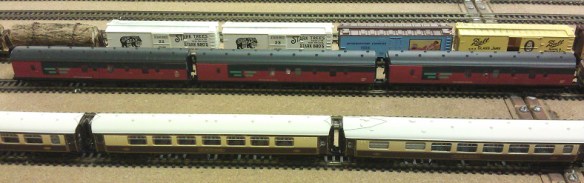
The biggest immediate difference between Rapido and NEM coupled stock is the gap between them.  Below is a photo of some British N gauge coaches made by Graham Farish,  the red GUV or mail express system coaches behind have the traditional Rapido couplers and the Pullman coaches in the front have the new NEM couplers.

Graham Farish Coaches 1

There has to be some gap between the coaches to alow them to navigate corners without becoming buffer locked.  This is when the buffers on the corners of the coach touch each other and prevent the body of the coach from swinging.  With full size trains this is not an issue as the buffers are sprung allowing the buffer to compress and the coach corridor connections to touch.

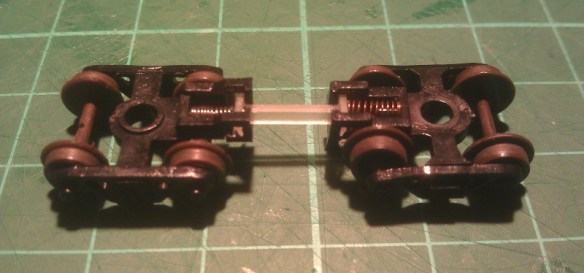
My first solution is to use my fixed link couplings, pictured below. These fit into the standard Rapido socket on two coaches permanently coupling them together.

Fixed Couplings

By using a shorter fixed link the gap between the coaches is reduced, as shown below.  This is ideal for connecting locomotives together, particularly if they share a DCC decoder as with my E7 DCC conversion, but it is not so good for lots of coaches.

E7 Coupling 2

For short trains with three coaches or less this would work well but for longer trains with, say ten coaches, it would be very hard to transport them if they were all coupled together.

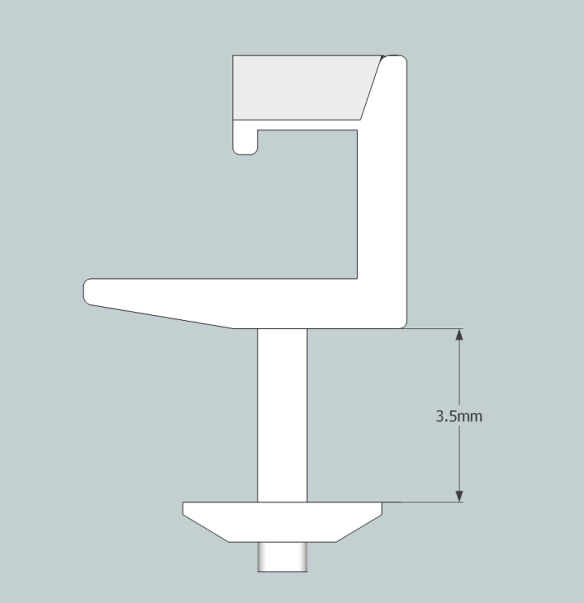
My second solution is to 3D print a shorter Rapido coupling. The standard Rapido coupling has a shank length of 3.5mm as shown below.

Standard Rapido

So I re-drew the Rapido in a range of lengths decreasing by 1/2mm at a time.

Rapido Replacments

Because I wanted these to be cost-effective they have been designed to be printed in the Black Strong And Flexible material offered by Shapeways.  This has three main advantages over the Frosted Ultra Detail material in that it doesn’t need cleaning on arrival, it is already black so they are ready to use right out of the packet and it’s cheaper.  The BS&F material does have a rough finish but this just helps to make them look a bit more realistic.

The first test prints have arrived from Shapeways and have already been successfully tested with Graham Farish coaches.  Although I ordered the full range of sizes all the coaches we tested worked best with the smallest coupler which has a shank length of only 1.5mm. Using a pair of these couplers, one in each coach, it reduced the gap between the coaches by 4mm which in N gauge is a lot.  Below are the same Graham Farish GOV coaches as pictured before but the pair on the left have the new 3D printed Rapido couplers installed.

Graham Farish Coaches 2

The difference was considerable but a test on a corner was required to check for buffer lock.  We used one of the tightest corners on the club’s N gauge layout for the test and as you can see below it was successful.

Graham Farish GOV Coaches On On Bend 3

Below is a close up on the original Rapido couplings.

Graham Farish GOV Coaches On On Bend 2

And below is a close up on the new 3D printed short Rapido couplings.  You can see that the buffers don’t actually meet.

Graham Farish GOV Coaches On On Bend 1

We also tested the short couplings on some Graham Farish Suburban coaches with equal success.  Again the short couplings are between the left hand pair.

Graham Farish Suburban Coaches 1

And a close up of the 3D printed ones.

Graham Farish Suburban Coaches 2

The 3D printed couplings still need to go through a few more tests and I have also made a few tiny improvements to the design to help with the fit into the Graham Farash coaches.  Once complete I will make them available to buy, and I will also offer them for sale in packs of 20 direct from this site.

One of the tests currently going on is looking to see which length 3D printed couplers work best with an N Gauge HST set, but that will have to wait for another post.

Discovering the Possibilities of Etched Brass

With two locomotive shells already available to buy and several more in the pipeline I have started to look at what can be done to develop them further.  The most frequent request I have had from customers has been for brass handrails so in this post I want to share with you how I’m working on that.

3D printing offers many advantages over other forms of modeling; one of them is the level of detail which can be achieved.  My current locomotive shells and parts have been designed to be printed with a detail level of 0.1mm which for parts such as small vents and door handles is perfect.  But when it comes to self-supporting items, such as handrails, they need to be thicker in order to survive the print and handling process.  Typically a wire part such as a handrail has to be at least 0.8mm in diameter.  Now I know that doesn’t sound a lot but in N scale at 1:160 that is equivalent to 128mm which is very big, and although it is passable, compared to injection molded or wire handrails on a lot of the new ready to run models, it is huge.

The 3D printed handrails on the EMD DD35 pictured below are clearly much larger than the injection molded ones on the Atlas C-628 model pictured underneath.

Locomotive Shells

Atlas C-628 1

The answer lies in brass etching.  Referred to as acid-etching, resist-etching and photo-etching, it’s a process of removing metal in varying layers around a design, leaving behind the composite parts of the model. The main advantage to this is we are dealing with metal which allows it to be incredibly thin and detailed.  The brass metal sheet which I will be working with is only 0.2mm thick and I can etch out parts that are only 0.24mm wide.  This is ideal because I can model handrails at actual scale size.  Although the parts are etched from a flat sheet, once the handrails are painted their ‘squareness’ will be smoothed out.  They can be also designed to be bent in the correct places to achieve the shapes we need.

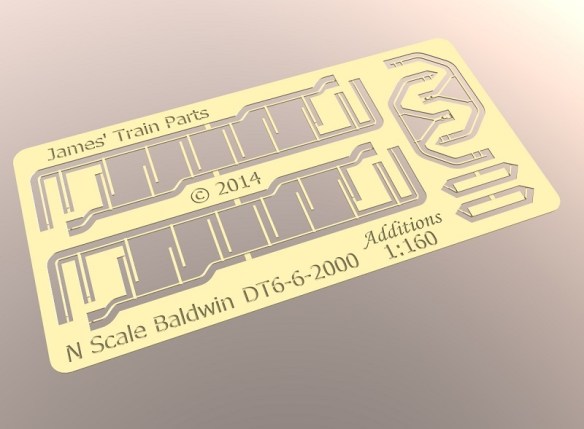
To begin with I looked at the handrails for the Baldwin DT6-6-2000. There are four side rails and two end rails on this locomotive and I needed to find an efficient and cost-effective way to lay them out so they didn’t take up too much room on the sheet but still had enough metal around them for support.  At this point I realised there would be some spare space on each handrail set so I looked again at the DT6-6-2000 to see what else I could add.  Looking at the photos of the original locomotives working up and down the country I noticed a lot of them had sun shades over the cab windows.  So I have included a set of sun shades with each set of handrails.  Below is the rendered image.

Baldwin DT6-6-2000 Additions Render

I’ve also designed a set of handrails for my EMD DD35 model as pictured below and will be making this set available soon.  The set includes the two main side rails and the four corner rails, there are no sun shades with this locomotive as it has no cab!

EMD DD35 Additions Render

The corner rails also shown below will be etched flat and once removed from the sheet can be bent to form the correct shape.

DD35 Handrails Additions Close Up Render

As you can see from the images above the brass etched parts will form part of my new ‘Additions’ series, which will be available alongside my established range of Shapeways products soon. You’ll have the choice to buy the complete locomotive kit from Shapeways and then if you choose you can add further detail by using the Additions products which will be available direct from this site. I’m striving to make both options as affordable as possible, and at the same time giving you a working, detailed locomotive model to suit your budget and modeling choice.

If you’re interested in being the first to try these brass etched details drop me a message through the Contacts page, I look forward to seeing these in action!

N Scale 2-8-8-2 Y6B & 2-8-8-0 EL5 Replacmet Pilots With Couplers

Last week I shared with you how I added a working Micro-trains coupler to the front of a Rowa 2-8-8-2 Y6B as pictured below; you can find the post here.  The only thing left to do was a running test and this week I’m going to share how it went.Rowa Y6b Finished Pilot N 1

Although the 3D printed replacement pilot fitted perfectly, I had some reservations about the Micro-trains body mount coupler hanging down too low underneath the pilot and preventing the lead wheel set from swinging freely.  This could prevent the locomotive navigating tight bends and turnoughts.

So to test this I took a pair of Rowa Y6B locomotives, and some rolling stock, down to a local model railway club, the Poole and District Model Railway Society, based in Poole, Dorset, who kindly let me use their N scale layout.

As well as having a test track setup for all scales the club also has a reasonably sized N scale layout under construction with a fast double mainline section and a single track branch line. All three lines run in loops through the layout and back to a large storage yard at the rear.  The layout is designed for UK prototype operation and the double track mainline has some lovely sweeping curves, but I was more interested in the branch line.  This was because not only did it have a gradient on a curve but also some very tight curves, particularly for large US outline articulated mallet locomotives, and as the intention was to test the pilot coupling this seemed ideal. Here are the pair working up the grade and around the first curve.


We had to have a couple of goes at this, not because the locomotive struggled but being big US steamers and wider than UK trains the cylinders on the front of the locomotives caught the platform and the guys at the club had to do a quick bit of sanding so the train could get past.


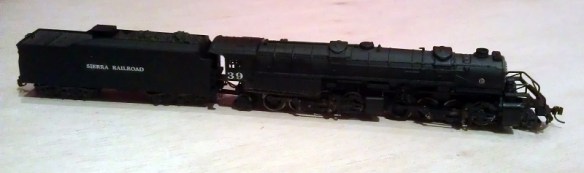
The two locomotives I used for the test run have different makes of DCC decoders installed.  The lead locomotive, DRG&W’s number 3561, has a Hornby R8249 decoder and the second locomotive, Sierra Railroad number 39, has a Digitrax DZ125.  This gave the locomotives different characteristics and having never run the locomotives together before it became clear that the lead locomotive was running faster. This was also a good test to see how the new pilot stood up to the punishment from the lead 2-8-8-2.


The tightest curve on the layout is at the rear where the branch line returns into the yard.  The line at this point is also on a steep downhill gradient.  As you can see from the video below, the new pilot on the front of number 39 had no issues at all going round the bend.


So now the pilots have been thoroughly tested I am happy to release them for sale and you can get them below in five versions…..

One single pilot with a mounting hole for a Z Scale MT body mount coupler.

A pair of pilots with a mounting hole for a Z Scale MT body mount coupler.

One single pilot with a mounting hole for an N Scale MT body mount coupler.

A pair of pilots with a mounting hole for an N Scale MT body mount coupler.

A pair of pilots, one with a mounting hole for an N Scale MT body mount coupler and one with a mounting hole for a Z Scale MT body mount coupler.

Rowa Y6b Finished Pilot N 2

Thankyou to the Poole and District Model Railway Society for use of their layout.

I will have both these locomotives, and maybe a 2-8-8-0 EL5, double heading at my next exhibition pulling some nice long trains.