The Andover Modelex 2016

As promised in this week’s post I’ll be bringing you some photos and videos from the Andover Model Railway Club’s annual exhibition, ‘Modelex 2016’.

The exhibition was held at the John Hanson School in Andover over the 3rd and 4th of September 2016.  As expected there was a good selection of layouts and traders to entertain the crowds.  I was there along with my club, the Gosport American Model Railroad Group, and we were exhibiting our modular N Scale layout ‘Solent Summit’: well about two thirds of it.  As normal what happens with these shows is my time is consumed by operating our layout, even with a team of five it takes all of us, but I was able to get around the show and see most of the layouts.

So here is a whirlwind tour.

To start we have ‘Botleigh Old North Road’.  This is a 4mm/00 Gauge layout by Ian Corps.

andover-2016-botleigh-old-north-road-5

The layout is modeled on a fictitious engine shed on the Southern Region.

andover-2016-botleigh-old-north-road-1

The layout is all about showing off locomotives.
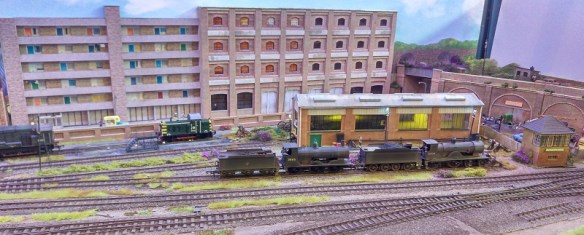
andover-2016-botleigh-old-north-road-2

Steam and diesel locos worked the yard; naturally the diesels looked a lot newer and cleaner.

andover-2016-botleigh-old-north-road-3 andover-2016-botleigh-old-north-road-4 The beautiful T9 on the right reminds me of my trip to the Dean Forest Railway Gala a few months ago.
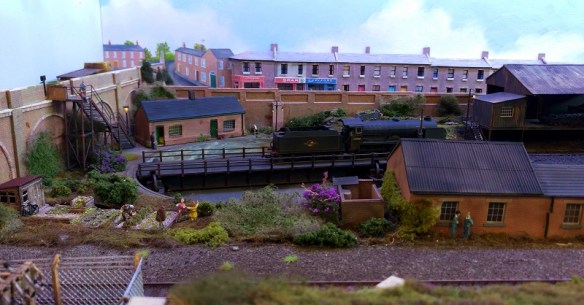
andover-2016-botleigh-old-north-road-6

The layout itself had a lot of detail and I’m sure I could spend hours looking at it before I found everything.
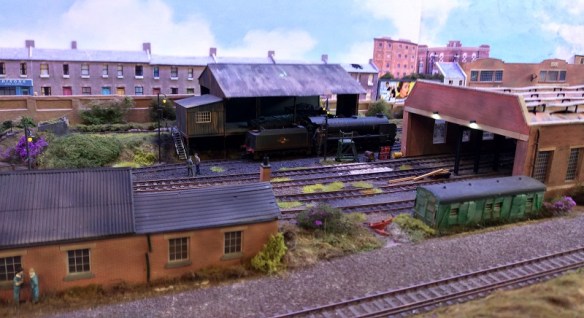
andover-2016-botleigh-old-north-road-7

I think the Q1 on the turntable needs a good scrub!

andover-2016-botleigh-old-north-road-9 andover-2016-botleigh-old-north-road-10

Next we have the first of two O scale layouts ‘Goonhilly’ built by Steve Rogerson of the Andover Model Railway Club.

andover-2016-goonhilly-1

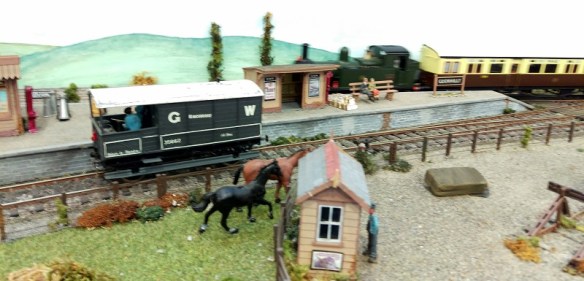
O scale is fantastic at showing detail, in the guards’ van or ‘Toad’ the crew are sitting down having a chat while the class 14 and auto coach trundle into the station.
andover-2016-goonhilly-2

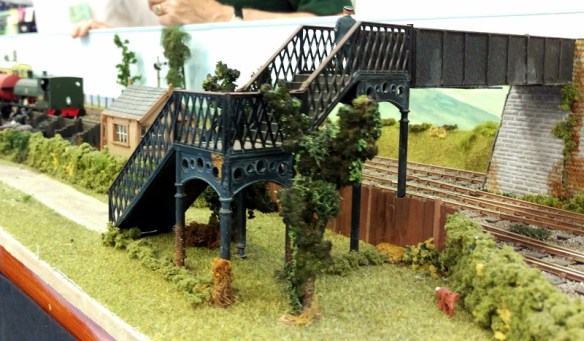
At one end of the layout was a beautifully modeled bridge.

andover-2016-goonhilly-3 andover-2016-goonhilly-4

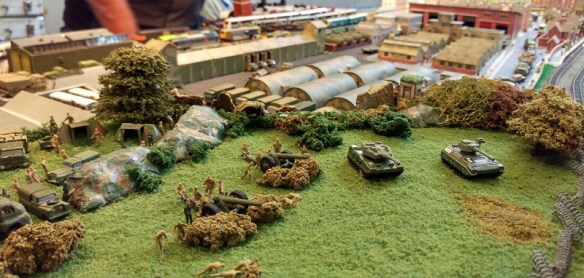
The first N gauge layout is ‘Barrack Way’ built by Dave & Rene Lear.  The layout is aptly names and it’s based around a large army barracks.

andover-2016-barrack-way-1

As with all Dave & Rene’s layouts it’s the hundreds of vehicles, people and scenes that makes them fun and this one is no exception.
andover-2016-barrack-way-2 andover-2016-barrack-way-3 andover-2016-barrack-way-4 andover-2016-barrack-way-5 andover-2016-barrack-way-6

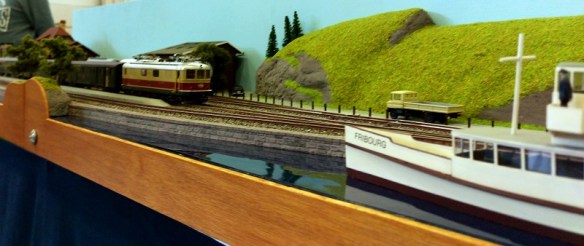
Next we go to a layout modeling an imagery terminus next to an alpine lake in Switzerland, ‘Schwarzee’, built by Martin Axford.
andover-2016-schwarzee-1 andover-2016-schwarzee-2 andover-2016-schwarzee-3

Mike showed me pictures of the actual building he based the station on from his travels in Switzerland and he has this one spot on.

andover-2016-schwarzee-4 andover-2016-schwarzee-5

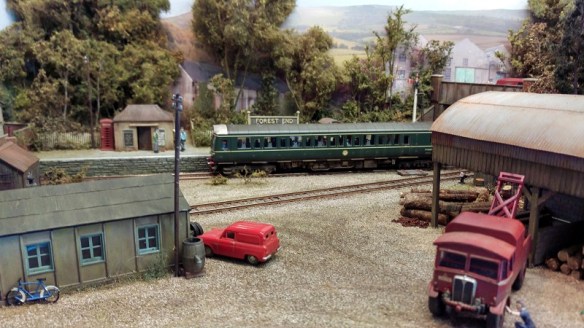
The next layout was, I think, the best in the show and it won the public choice for best in show as well.  ‘Lydgate’ built by Dave Spencer is an imaginary 4mm/00 Gauge layout based on the railways of the industrial Forest of Dean.

andover-2016-lydgate-1

As I’m from the town of Lydney in the Forest Of Dean, and have been a member of the Dean Forest Railway for most of my life, this layout was a joy to see.

andover-2016-lydgate-2

The attention to detail was wonderful and the depth created by the scenes transported me back to the forest.

andover-2016-lydgate-3  andover-2016-lydgate-5

andover-2016-lydgate-4 andover-2016-lydgate-6 andover-2016-lydgate-7

The second O scale layout was ‘Praa Sands’ built by Tony Collins also from the Andover Model Railway Club.

andover-2016-praa-sands-2Again O Scale is fantastic for detail and this GWR tank looks just like the real thing.

andover-2016-praa-sands-1

The next N Gauge layout is ‘Garsdale Head’ built by Michael Le Marie.

andover-2016-garsdale-head-1

It is designed to have a Settle & Carlisle look (an iconic railway in the UK) and it does that well.

andover-2016-garsdale-head-2 andover-2016-garsdale-head-3 andover-2016-garsdale-head-4 andover-2016-garsdale-head-5

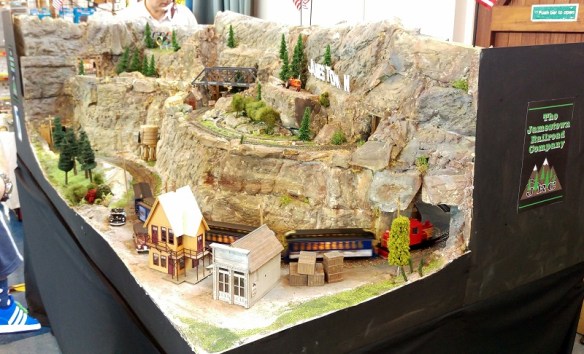
‘James Town’ is the next layout although it has nothing to do with me!  It belongs to Andrew & James Bernett and is a fictitious American-themed On30 layout and was lots of fun.
andover-2016-james-town

The layout has several loops on different levels with a variety of trains running around.  Below is a short video of one of the larger steamers passing by.  As you can see from the character in the foreground, from the movie ‘Cars’, having fun is what this layout is about.

‘Mortonhampstead’ is the next layout and is 4 mm/OO Gauge.  Built by Andy & Ryan Lamb it depicts a branch line terminus.

andover-2016-mortonhampstead-1 andover-2016-mortonhampstead-2 andover-2016-mortonhampstead-3 andover-2016-mortonhampstead-4

There were also four other layouts at the show, two I have covered in other exhibition reviews so I will simply link back to those, but it was nice to see them again.

Brighton East – 4mm/EM Gauge layout built by David Smith.

Hollow Fosse – 3mm / TT Gauge layout built by John Thomas.

‘Portsea’  –  3mm / TT Gauge layout built by Paul Hopkins & John Wakeman.  Sadly I didn’t get any photos of this great layout thinking I had already covered it in a different exhibition review; so it will have to wait until the next time I see it.

The fourth layout is ‘Croydon North Street’ built by Darren Johnson, this lovely layout will be appearing in the Poole Model Railway Exhibition on the 6th of November so I will share it with you then.

So that just leaves our layout, ‘Solent Summit’.  For this exhibition we had 23 of our scenic modules plus the two big yards and I managed to catch some shots and videos from different points.

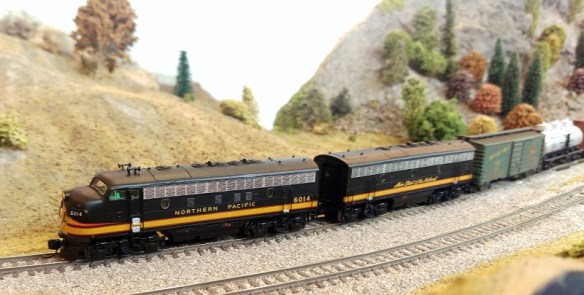
An A+B set of Northern Pacific F7s leaving ‘Cascade Falls’ with a local freight.
andover-2016-solent-summit-2

A pair of Burlington Northern SD24s on the oil train.

andover-2016-solent-summit-3

The oil train rumbled on through town heading for ‘Solent Summit’ in the video below.

A lone Santa Fe SD45 switched ‘Dilithium Propellants’ as the big trains rolled by.

andover-2016-solent-summit-4

A Great Northern switcher collects paperwork from the tower at the lumber yard ready for the day’s work.

andover-2016-solent-summit-5

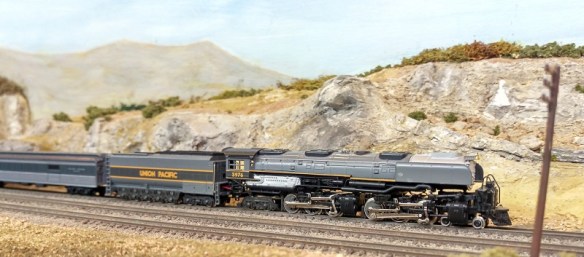
Sierra Railroad no. 38 waits with a former Northern Pacific rotary snow plow, heavy snow is forecast for tonight high on the pass.  The Union Pacific Portland Rose awaits its departure from ”Solent Summit and over the pass, hopefully before the snow starts.

andover-2016-solent-summit-6

The UP Portland Rose is now ready to head out from ‘Solent Summit’.
andover-2016-solent-summit-11

In the video below the Portland Rose crosses the ‘Warsash Wye Trestle’ just past ‘Solent Summit’. As the last of the cars clear the station limits and the heavy challenger clears the trestle the driver opens the regulator.

The UP was also handling the troop train as it passed through town.  This Big Boy made light work of this heavy train.

The BN oil train finally arrived in ‘Solent Summit’ just ahead of the Southern Pacific Daylight powered by an A-B-A lash up of Alco PAs.

andover-2016-solent-summit-7

A long UP freight powered by a GP35, GP7 and a pair of GP20s crosses the ‘Warsash Wye Trestle’ and runs through ‘Solent Summit’.

As well as snow, ‘Solent Summit’ must be expecting power trouble tonight because UP have supplied an old EMD DD35 to provide power for the small town.

andover-2016-solent-summit-8

Sierra 37 & 39 double head a freight train past ‘Watson’s Siding’.

The Santa Fe California Limited passes ‘New Mills Halt’, this train is too important to stop here and runs on west.

The Aloc PAs prepare to leave ‘Solent Summit’ with the SP Daylight jumping ahead of the BN oil train.

andover-2016-solent-summit-9

The Virginia Rail Express Commuter train powered by a MPI MP36PH-3C waits at ‘New Mills Halt’ for the shift change at the factory.  The factory still uses the trusty Shay to move boxcars around.

andover-2016-solent-summit-10

I had a great time at the Andover Modelex 2016 and I could not have done it without my club.  Thanks to the Andover Model Railway Club and to my team for putting on a great show.  From the left, Chris, myself, Bernie, Ted, Morgan & Chris.

andover-2016-solent-summit-1

‘Solent Summit’, well parts of it, will next be appearing at Fareham Railex on 1st and 2nd of October, the 28th to the 30th of October at the NMRA(BR) convention in Meriden, the 6th of November at the Poole And Districts Model Railway Society’s annual exhibition and the 10th and 11th of November at the Hampton Court Model Railway Societies Tolworth Show.

Maybe we will see you there.
One Exhibition to the Next

In last weeks post I had promised to bring you some photos and videos from the Andover Model Railway Exhibition however it was fairly late by the time I got home Sunday Night and today is my wedding anniversary so the overview from the show will have to wait until next week.

In the meantime; next weekend is the Swindon Railway Festival 2016 and I will be there on the Sunday operating the wonderful layout ‘Horfield’ which depicts the GWR four track main line between Bristol & South Wales.  Maybe I will see you there.

Little Trains in Big Places

You may have noticed my posts have been a bit short recently, and not really about my normal 3D printing projects, and this one will be no exception.  This is not because I haven’t been doing anything; rather I have been very busy traveling.  In this post I will bring you a bit of steam railway history from Iceland.

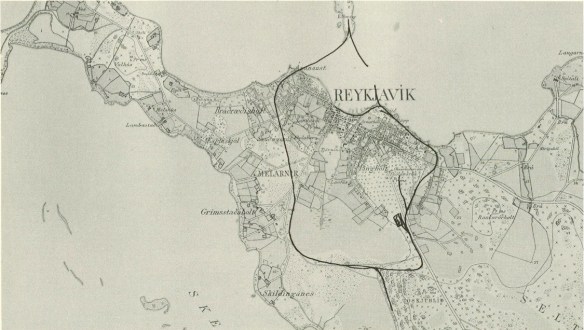
Does Iceland have a railway?  Well not right now but did, in fact it has had three.  The first was built in 1913 and was used to construct the quay and breakwaters now shielding the Reykjavík harbour.  The railway was called the Reykjavík Harbor Railway and operated until 1928.  It was a 900 mm (2 ft 11 716 in) narrow gauge line and ran to two quarries around Reykjavík as well as along the water front.  You can see the extent of the railway on the map below which was created by By N. P. Kirk.Map_of_Reykjavík_Harbour_Railway

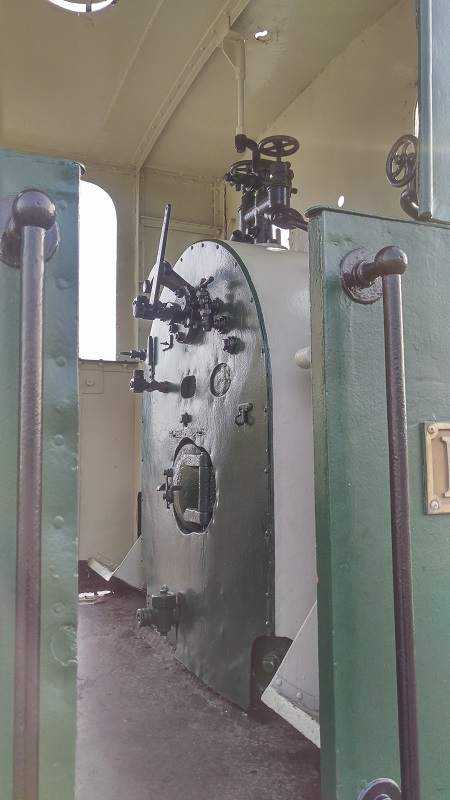
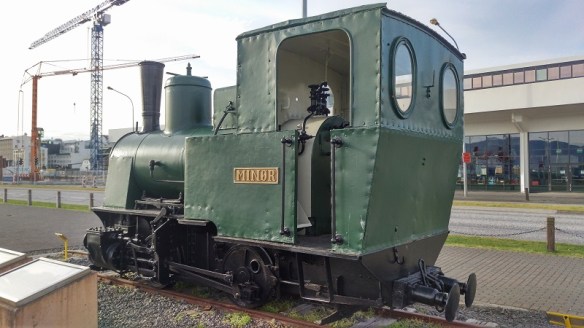
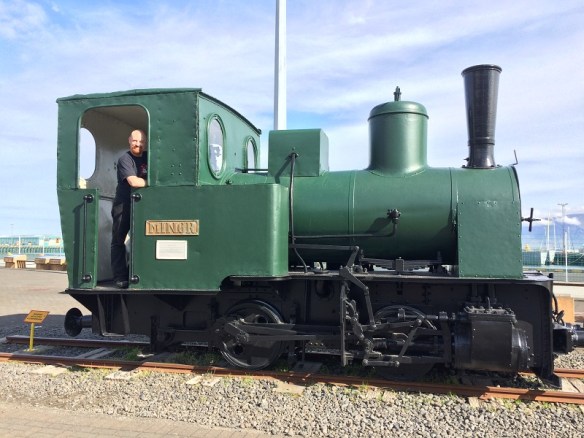
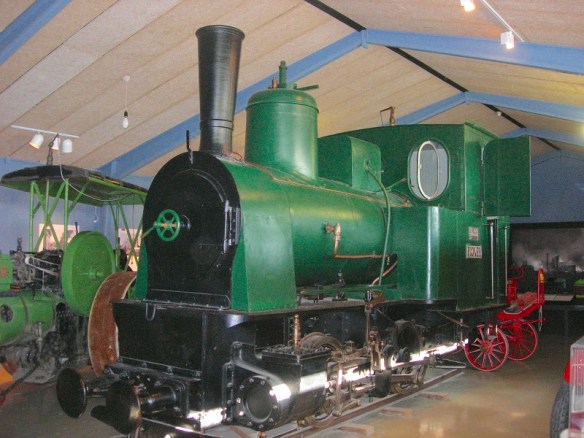
The railway had just two locomotives, Minør and Pioner, which were built by the Jung engine company of Germany in 1890.  From new, they did a sort stay in Denmark before being shipped to Iceland in 1913.  The engines both have 0-4-0 wheel configurations and have standard out side cylinders.   Although there is now nothing left of the railway, luckily both engines have been preserved. Minør sits proudly on Reykjavík dock side.

Reykjavík Harbor Railway 1 Reykjavík Harbor Railway 2 Reykjavík Harbor Railway 3 Reykjavík Harbor Railway 4 Naturally I had to have a go!
Reykjavík Harbor Railway 6

The only rolling stock used on the line were the open sided flat cars as you can see in the photo below.  None of these are believed to have survived.

Reykjavík Harbor Railway 5

The other locomotive, Pioner, is on display at the Icelandic Folk Museum at Arbær, Árbær Museum.  The photo below is courtesy of Timothy Titus.

RHR-Pioner

The second railway in Iceland was built in the 1930s and was the Korpúlfsstaðir Farm Railway.  It ran around an industrial farm on a 600 mm (1 ft 11 58 in) narrow gauge track.  It had no locomotives so all the four-wheel skip wagons were pushed by hand.  Nothing of this railway now exists.

The third Iceland railway was built just after 2000 to transport materials and workers to build the Kárahnjúkar Hydropower Plant.  The Kárahnjúkar Light Railway was powered by three diesel locomotives which ran around the clock.  The railway was removed once the facility was completed and, as with the second railway, nothing now exists.

There have been plans to build a standard gauge railways in Iceland dating back to 1906 but the roads always won the battle.  The most recent was for a railway between Reykjavík and Keflavík International Airport however a new dual carriage way road was built in 2008 allowing the trip to be done in fifty minutes by coach, but I am led to believe the scheme is still being considered.

And that is my brief history of the railways of Iceland.

Next week I will be at the Andover Model Railway exhibition so hopefully I will have something to share with you from there.

Upcoming Shows

This week’s post will be a short one and as promised in last week’s post I’ll be sharing with you some of the shows coming up which I’ll be attending.

The first show is the Andover Model Railway Exibition on the 3rd & 4th of September.  I’ll be there with my club’s layout ‘Solent Summit’ all weekend.

The next show is the Swindon Railway Festival on 10th and 11th of September. Although I won’t be attending with one of my clubs layouts I will be there on the Sunday with ‘Horfield’. This very large OO Scale model of the GWR four track main line through Horfield station is as realistic as they come and recreates 1955 to 1961.  A lot of the rolling stock was scratch built to ensure the correct trains are passing through.

The next show is Fareham Railex on 1st and 2nd of October and this year my club will be demonstrating how to  build and assemble scenic modules for club layouts.

The 28th to the 30th of October is the NMRA(BR) convention in Meriden and we will have a few of the ‘Solent Summit’ modules on display as a switching layout.

The 6th of November is the Poole And Districts Model Railway Society’s annual exhibition and my group will be taking ‘Solent Summit’ there as well.

The 10th and 11th of November is the Hampton Court Model Railway Societies Tolworth Show and again ‘Solent Summit’ will be there.

That’s it for my current layout commitments for the next few months.  If you’re planning to go to any of these please come and say hello.

On Board with a Really Big Steam Engine

Although most of my posts are model railway related I also have the odd post about real trains; see last month’s post about the Dean Forest Railway.  Also I have the odd post about other steam equipment such as traction engines; see last year’s post about the Great Dorset Steam Fair! By the way this year’s GDSF is less than two weeks away for anybody who’s thinking of going.   But this post is a little different; it’s still about a steam engine, but not on dry land.

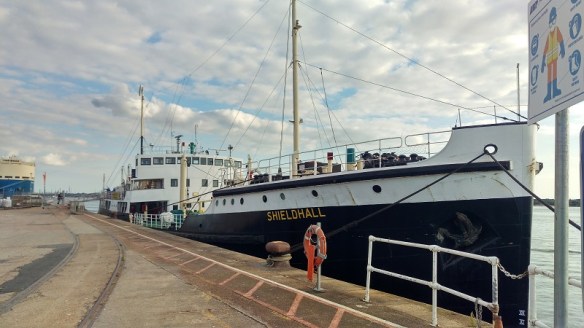
The ‘Steamship Shieldhall’, which is the largest working steamship in Britain, was steamed up and ready to meet me at Southampton Dock. And I went for a nice cruise down to the Solent and back.

Shieldhall 15

The Solent is the body of water between Isle of Wight and the mainland at the Southern Coast of England.  It’s in this area where most of my fellow modellers building American railroad layouts live, hence why our layout is called ‘Solent Summit’.

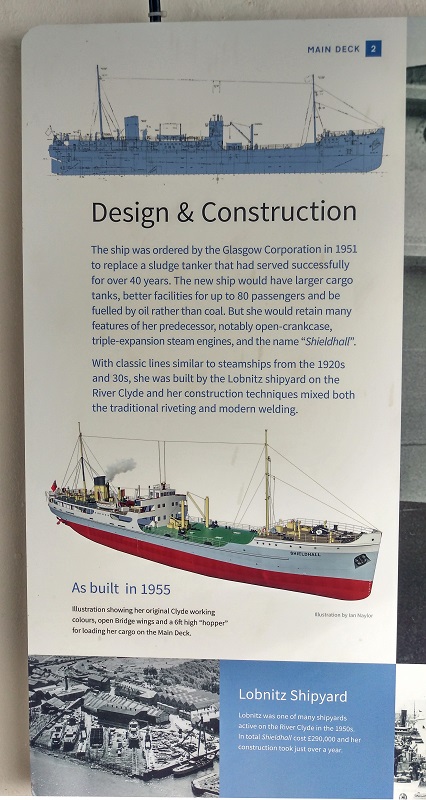
The ‘Shieldhall’ was built in 1955 as a sludge tanker, not the most glamorous of duties.

Shieldhall 13

She was one of seven ships which worked out of Glasgow between 1900 and 2000.

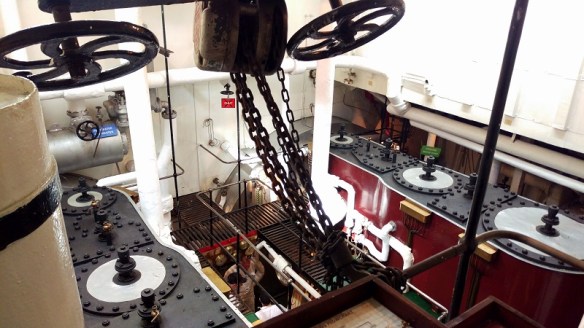
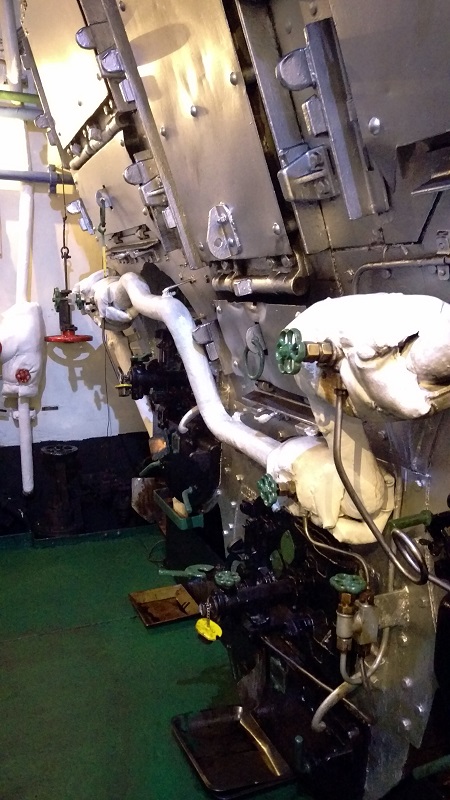
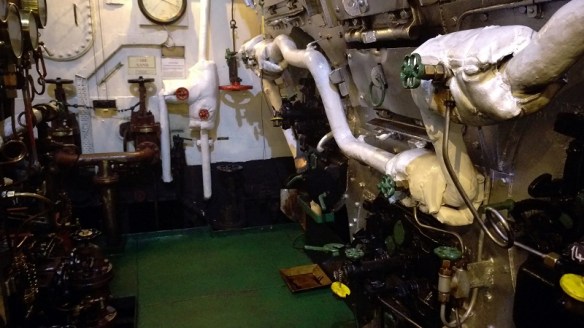
Unlike her predecessor, the boilers on this ship are oil-fired, making it a much nicer ship to work on.  The engine room is located at the rear of the ship under the main funnel and looking down from the main deck level all you see are the cylinders.  There are two steam engines, each with three cylinders.  In the picture below you are looking towards the front of the ship, the smallest cylinder is the first and is a high pressure cylinder,  followed by a medium and low pressure.

Shieldhall 10

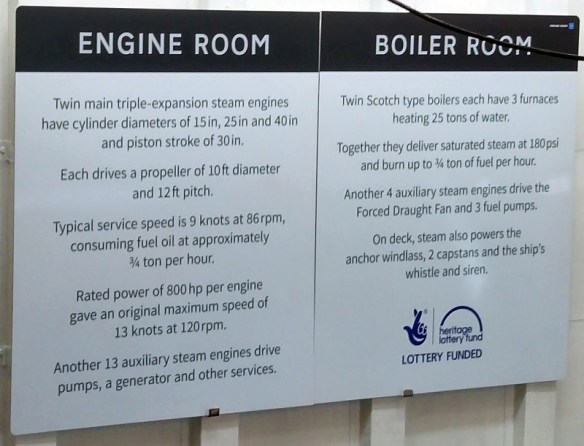
Here is what they had to say about their engines and boilers.

Shieldhall 33

The term ‘triple expansion’ means the same steam is used in all three cylinders: as it exits the first cylinder it goes into the second and then into the third.  As a steam engine works by the expanding force of the steam in a cylinder each cylinder has to get bigger to give the same amount of power as the previous.  Hence why there are 15″, 25″ and 40″ cylinders in one engine.  When the steam comes out of the last cylinder it has almost used up all of its expanding power and is condensed back into water.  This is then put back into the boiler.  Unlike railroad locomotives and traction engines, ships can only use the water they carry as anything other than fresh water will damage the boiler.  Therefore the condensing of steam to water is essential, and that is also why you don’t see lots of steam blasting out of the funnel in the same way you do with railroad locomotives and traction engines.

Below is a quick video of the cylinders. It was extremely hot at this level but surprisingly clean.  All the action is on the deck below.

Heading down the second ladder puts you right next to the motion as you can see in the video below.  The wind you can hear is from the cold air being pumped in behind me, which was very welcome.

The engines were running slow, or idling, at this point.  Although we were still tied to the dock both engines were turning to warm up.  As the engines are permanently connected to the propellers one was in reverse as not to create too much driving force.

Below is a video of the other engine, looking down the pistons.

Once we got under way the engines were turning much faster, and both in the same direction.

In the video below when it pans up you can see the crank slides and the oil way pattern used to evenly distribute oil for lubrication.

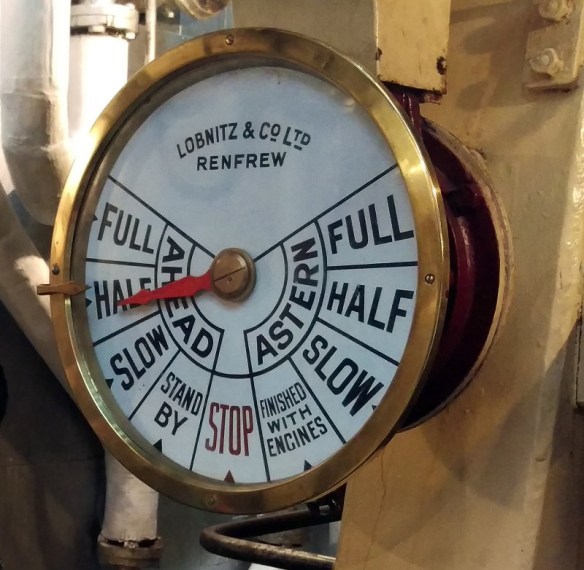
Each engine has its own regulator and reverser, and they are very similar to railway and traction engines.  All the controls are right next to the engines and instructions are sent to the engine room by these.

Shieldhall 17

There is one for each engine and a corresponding pair on the bridge.  The red arrow states what the bridge wants the engines to do and the gold arrow is an acknowledgment from the engine room.

The drive shafts are exposed as they run out from the engines at the back of the ship, as you can see below.

The four boilers, being oil-fired, are very self-contained and although they need to be managed they don’t need to be worked as you do with a coal-fired boiler.

Shieldhall 4

Getting photos was tricky as they are fairly big and the working space behind them was not.

Shieldhall 5

The fuel oil was a fairly medium viscosity and is sprayed into the burner.  The actual nozzles receive the oil from the side under pressure which causes it to spin within the nozzle, giving a decent spread of oil for an even burn.

As with the fuel oil used on the UP Gas Turbine locomotives, this oil needs to be heated before it can be injected and that is done by the apparatus you can see on the left in the above photo.

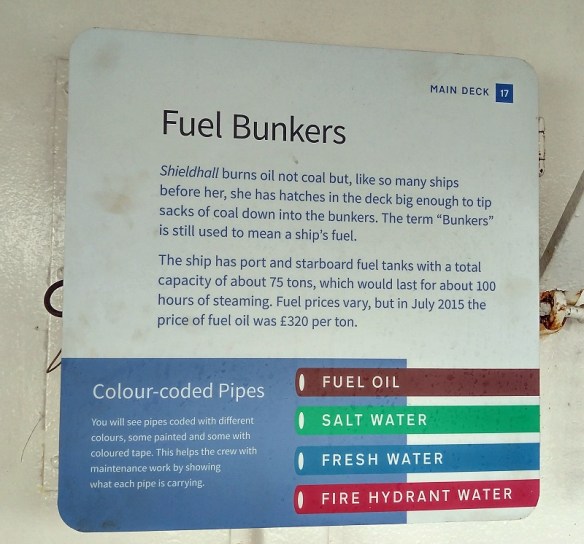
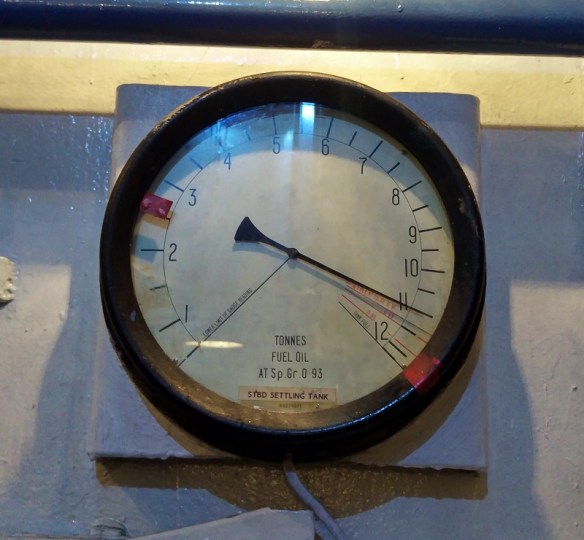
The walls of the ship either side of the engine room are the fuel tanks and as you can see from the gage below, she had recently been topped up.

Shieldhall 6

And I don’t think I would like the bill from that fuel stop!

Shieldhall 14

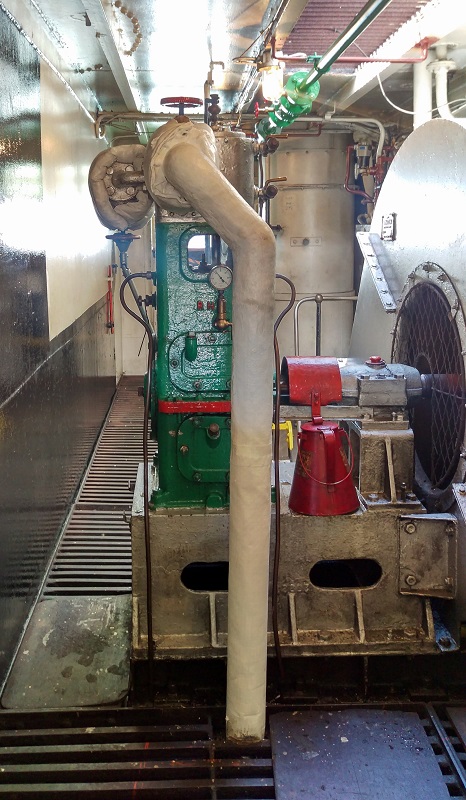
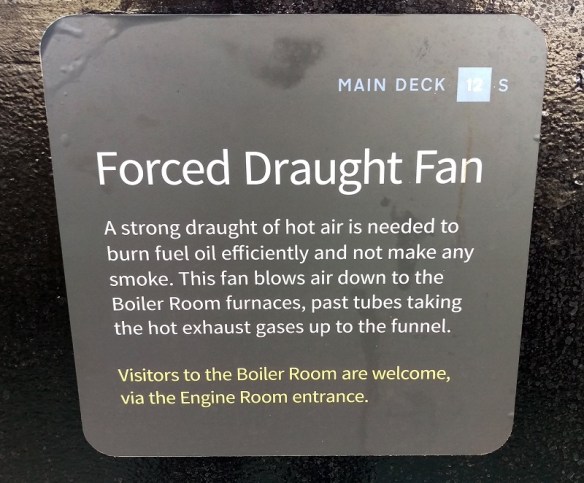
One of the smaller steam engines is the Forced Draught Fan.

Shieldhall 2

It was this that was causing the cool air to blow into the engine room you could hear on the previous videos.  It’s not as exciting as the main engines but in this video below you can hear it pumping away, driving the fan on the right.

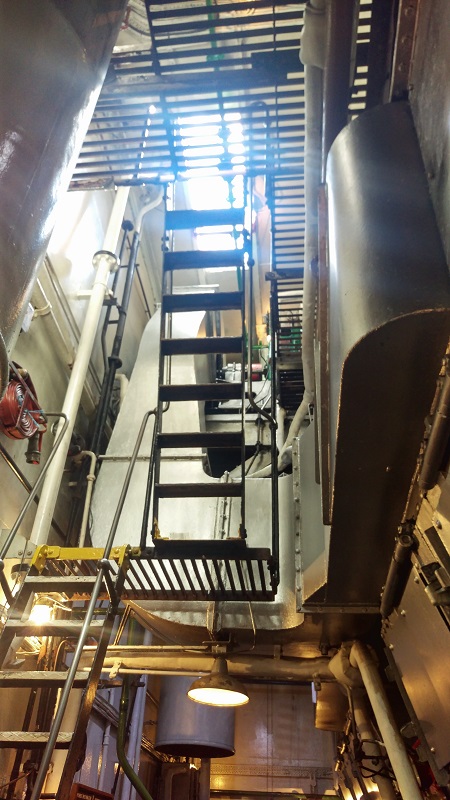
This draught, as well as cooling the engine room, is also the main draw for the burners and in the picture below taken from the boiler room looking up, you can see the air ducts from the fan running to the boiler tops.  And you can just about make out the little green steam engine.

Shieldhall 19

Shieldhall 1

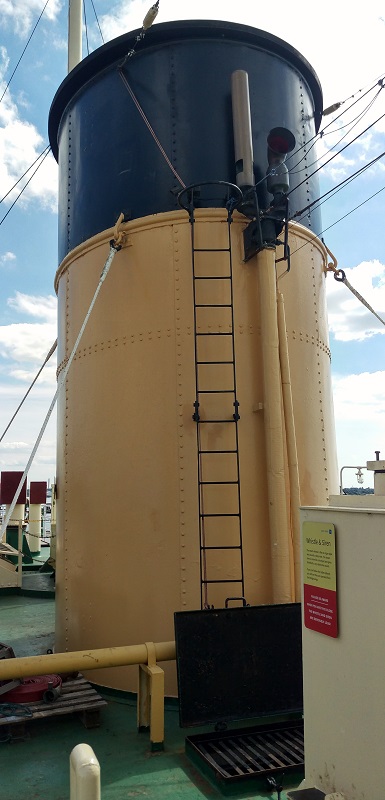
The ships funnel also has the ships whistle mounted to the front as you can see below.

Shieldhall 11

And this came with a warning!

Shieldhall 12

Several times I was caught standing near it and they weren’t kidding.  In the video below we were passing a large cruise ship coming out of Southampton heading for Copenhagen.  The cruise ship got in first with its fantastic horn but the ‘Shieldhall’ answered with the siren and then whistle.

The trip on ‘Shieldhall’ was great fun and the visit to the engine room was fantastic. It was a privilege to see it working although I am pleased it’s now a pleasure cruise ship and not still a sludge hauler.

Before I wrap up this post I wanted to let you know that Shapeways have free worldwide shipping on all orders over $25 untill August 21, 2016 at 11:59PM PDT.

Next week I’ll be updating you about my club’s upcoming shows.

A Tip to Avoid DCC Bus Wiring Headaches

In this post I have a simple tip that I always use when wiring up a layout which can save you hours of head-scratching and frustration.

Although DCC wiring can become complicated, the basic principle that all rail feeder wires are joined together applies. Well, all the left rails together and all the right rails together.  Even if you have sections separated with electronics like a Digitrax PM42 Quad Power Manager or different boosters, you’ll still have areas with lots of feeders joining to a common point or bus.  The frustration starts when you finish connecting all the feeders and you have a short where something is connecting the left and right rails.  The headache starts when you slowly start un-soldering wires or cutting feeders to find the short. It’s guaranteed to be the last one!

To avoid this I use a multi-meter as I work.  Just about all multi-meters have a setting for continuity.  Some even come with a buzzer which sounds when the probes touch.  In the image below you can see I have set my multi-meter to continuity.

Continuity Check

I always check the bus for continuity before I start and after I join each wire, or group of wires.  If I am working in an area with lots of feeders I sometimes clip the multi-meter to the rails or bus.  Then if a feeder with a problem, or the wrong feeder is touched to the bus, it will sound the alarm.

This simple tip has saved me hours of searching and re-working areas.

Some of the common causes of shorts when you’re building a layout are:

Shorts in the frog section of an Electrofrog point/turnout due to no insulating rail joiners being installed.

Shorts in the frog of a modified Electrofrog point/turnout because the jumper wires have not been removed.  See my post here regarding how to modify your points for better operation.

Copper strips used to hold the track in place when rails cross base boards joints.  If these are not cut in the middle they will short the rails.

And the biggest cause, believe it or not, are tools lying across the track.

Hopefully this will help you have a trouble-free time when wiring up your DCC bus.