An Alco C-855 for N Scale

In this weeks post I will share with you the first N Scale 3D printed Alco C-855 and all the accompanied parts.  If you want to read more about the history of this project click here and it will open a new page listing all my posts about it.

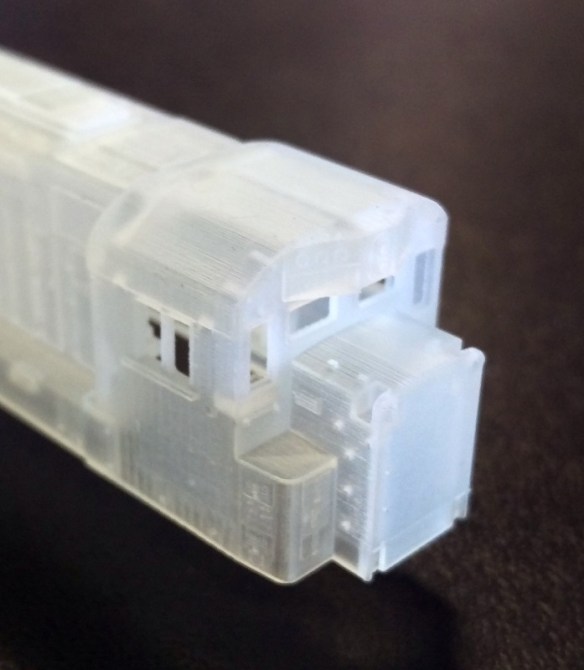
This model has been in the pipeline for a few years, so as you can imagine, I was very excited when last week the first test print arrived from Shapeways, and I must say I am very pleased with it.  Below you can see all the parts as Shapeways delivered them.

Alco C-855 First Print 1

At the back is the main shell; all in one piece.  The eight parts in front and to the left are the sand boxes, which fix onto the sides.  Each sand box has a locating peg which fixes into a hole on the side of the shell.  Next to the sand boxes are the crew and control consoles for the cab interior.  Below the two crew is a square plug which acts as a screw mount for holding the fuel tank on.  Next to the crew are the horns, these again have a simple peg which fixes into a hole in the shell.  The fuel tank is next to the horns and the two round parts are the drive shaft extenders.  The final two parts at the bottom are the 3D printed stainless steel chassis extenders.  The plastic parts have been printed in Shapeways’ Frosted Ultra Detail.  Although the Frosted Extreme Detail has a smaller layer thickness than FUD giving an even better finish, this was a test print and I wanted to see how it would come out before going to the best quality.  But even in FUD the details are clear and smooth and I will be very happy with this as an actual model.  Here are some close-ups of some of the detail

Alco C-855 First Print 2 Alco C-855 First Print 3

As normal with parts printed in FUD or FXD they need to be cleaned to remove the waxy residue, so after a rinse of in warm soapy water they spent 24 hours submerged in Goo Gone.

While the parts where getting cleaned I prepared another chassis.  I already had one extended chassis but as I have made some improvements to the chassis extenders I wanted to make up another.  As I have already covered this procedure in a previous post, which can be found here, I will only show the differences today.  I will be making a downloadable PDF available with full instructions soon.

As before I started with a standard Con-Cor U50/Turbine chassis.

Alco C-855 First Print 4

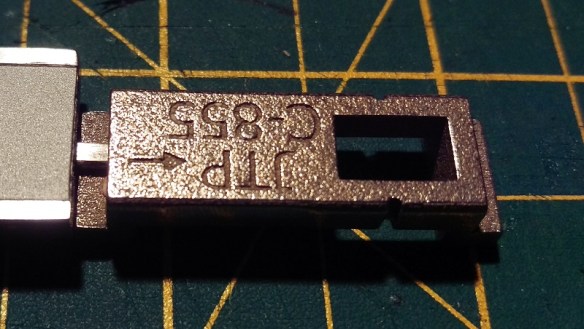
The new  chassis extenders have been tweaked in several places but the most obvious is the introduction of a forward arrow on both parts, this should help with orientation in the chassis.

Alco C-855 First Print 5 Alco C-855 First Print 6

The top section should be done first.  And this simply means removed the section highlighted below.  I used a cutting disc in a Dremel type tool.

Alco C-855 First Print 7The three parts where then glued together.  The key is to make sure the dog leg part of the chassis extender is flush with the underside of the remaining parts.  There should be a small gap at the location where you made the cut.  That way the chassis will be the correct length and it will be easer to keep it square.

Alco C-855 First Print 8

Unlike last time, I also need to make some cuts at the front because the body of the locomotive is narrow below of the cab.  The two wings need to be cut off as shown below.
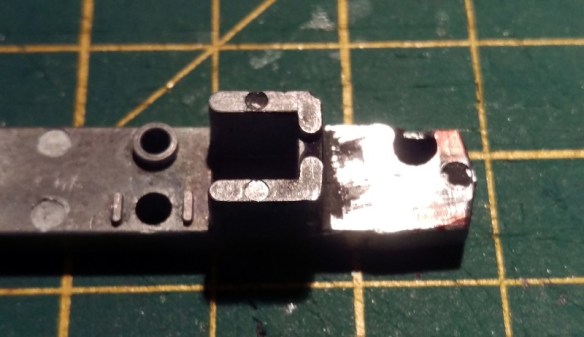
Alco C-855 First Print 9

Also two notches need to be made.  I will give the sizes of these in the downloadable PDF.  The top notch ended up a bit larger than I had hoped because of the screw hole.  You could simply cut it all off but I want to keep as much weight as possible.

Alco C-855 First Print 10

As I pointed out earlier there is a plastic square plug used to screw in the fuel tank.

Alco C-855 First Print 11

This simply fits into the square hole in the bottom chassis extender.
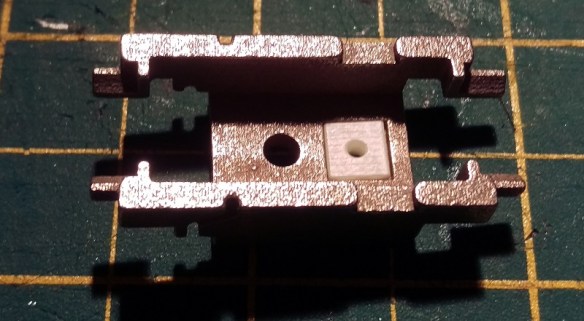
Alco C-855 First Print 12

It will be held in by the motor and when you screw on the fuel tank, using the same screw from the U50/Turbine fuel tank, it will pull tight.

Alco C-855 First Print 13

With the bottom chassis section it is important to cut it as close to the parts that hang down as possible.  Other wise you may end up with a gap in the chassis frame. Indicated below is the section to be removed.
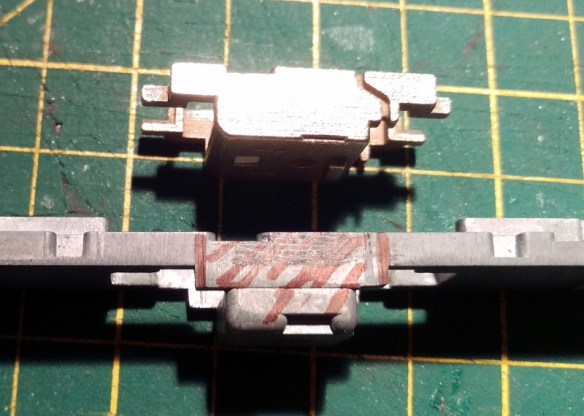
Alco C-855 First Print 14

Once fully assembled it should look like this.

Alco C-855 First Print 15

My C-855s will be DCC so I have installed a decoder in the space at the rear of the locomotive.

Alco C-855 First Print 16

The next step was to test fit the shell.  In the photo above you can see a square hole at the front of the fuel tank.  Inside the shell is a tapered peg so as the shell slides onto the chassis the shell will spread untill the peg pops into the hole holding it tight.

Alco C-855 First Print 17

The shell is nice fit and once the pegs locate into the fuel tank you can comfortably pick it up by the shell and it wont fall apart.

One of the identifying details on the C-855 is the large sand boxes on the side and because of the locating pegs these can easily be clipped into place.  I have made them a separate part to make it easer to paint the model.  In the photo below they are not glued in place but simple press fitted.
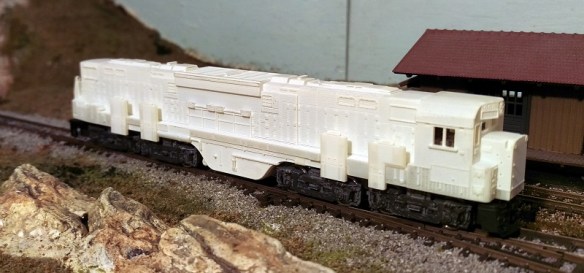
Alco C-855 First Print 18

But as great as the loco now looks there are still lots of parts missing.  And today I took delivery of the first batch of etched brass Additions for this loco.

Alco C-855 First Print 19

As I am going to paint the loco a lot of the parts are not ready to go on yet, plus I only got them today, but to give you and idea of what the finished loco will look like here are some picture with some of the brass Additions loosely fitted.

Alco C-855 First Print 20

Because just about all the brass Additions have mounting holes or slots they should be very easy to install.  The handrails drop into the top of the sand boxes which makes them easy to align.  There are a lot more parts to be added and some, like the ladders, can’t be shown yet as the handrails need to be fixed properly first but as you can see from the image below even the windscreen wipers have mounting holes.  It has swung to its natural hanging position but once glued in, it will line up with the left of the window frame.
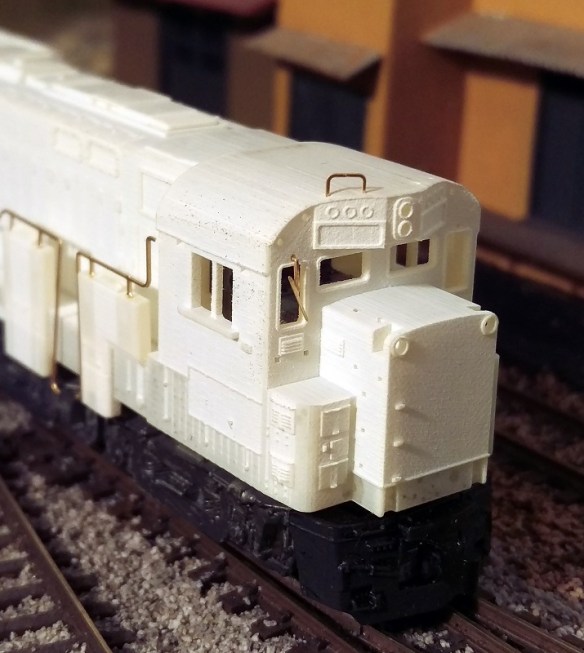
Alco C-855 First Print 21

I want to do a few checks to make sure everything is where it should be for all the brass Additions and then the shell will be made available on Shapeways. I think that will happen in the next few days.  The chassis extenders are available now and can be ordered in sets of one, two or three by clicking on the links below.

Set of one C-855 chassis extenders.

Set of two C-855 chassis extenders.

Set of three C-855 chassis extenders.

There is an option to print the chassis extenders in WS&F and FUD which are both cheaper than the stainless steel but you will lose a lot of weight and please note: I have not tested them in these materials.

Although I normally post on a Monday I will do an extra post this week to let you know when the C-855 body and parts are ready as I know several of you are keen to get them.  If you order the chassis extenders now you can add the shell to your order at Shapeways without paying for shipping twice, as long as you do it in good time.  I also have brass Additions in stock, these are £6 GBP each.  Please contact me though contact page or email me if you would like to order some.

The next step, apart from painting and finishing the C-855, is to finish drawing the C-855B.  The chassis will be exactly the same so the extenders will be need for that too.  I will also be drawing a dummy chassis for both locos and will be sharing that with you soon.
A Replacement Drive Shaft for an N Scale Bachmann 4-4-0

Since releasing my N Scale MDC/Roundhouse/Athearn 2-8-0 & 2-6-0 drive shaft repair kits back in 2014, which can be found here, I have been asked to produce replacement drive shafts for several other N Scale locos.  One of these is the Bachmann 4-4-0.  So in this post I will share with you the results.

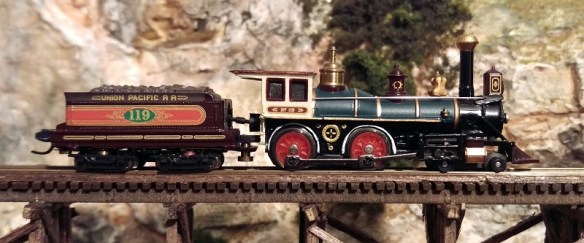
The Bachmann 4-4-0 or ‘American’ has been around since 1979 and for years was the only choice for a ready-to-run model of this locomotive.  The first generation, as pictured below, housed the motor in the tender.  This was then connected via a thick drive shaft to the driving wheels through to the back of the cab.

Bachmann 4-4-0 Old Style

The model had several improvements over the years but the one that I’m interested in  was made in 1998 when the drive shaft was changed, leaving the locomotive looking like the one below.

Bachmann 4-4-0 New Style

Together you can see the locomotives are basically the same, the newer one just has finer paint and details.

Bachmann 4-4-0 New & Old Style

The original locomotive’s drive shaft was a Hex-Cup style, pictured on the left in the image below.  This drive shaft was fairly bulky and dominated a lot of the space between the cab and tender.  On the end of the motor and worm gear inside the locomotive is a hexagonal nut that the ends of the drive shafts fit over.  This arrangement allows the linkage to flex as it goes round curves in the track.  The improvement in 1998 was to replace the bulky Hex-Cup with a Ball-Cup and peg design, as shown on the right.  The ball fits into a cup with slots on ether side.  The ball can rotate in all directions within the cup and the pegs rotate the shaft via the slots.

Bachmann 4-4-0 Drive Shafts

The Ball-Cup and peg design, apart from being much smaller, makes for a smoother motion which improves the performance of the loco.

However, as with all small parts it’s possible to lose these bits when servicing the loco or possibly they could break, particularly with those tiny pegs on the ball and cup connection.

Bachmann do sell replacements parts for the newer style drive shafts but they have been out of stock for a long time. As for the older Hex-Cup shaft it is likely that these are no longer available.

So I have drawn up both drive shafts and made them available on Shapeways.

Bachmann 4-4-0 Drive Shafts Rendering

The larger and earlier Hex-Cup type is available here and can be printed in either Shapeways’ Frosted Ultra Detail or their Frosted Extreme Detail materials.  As usual with these materials they can be used directly out of the bag but they are a white or translucent color.  They can be painted but they will need of be cleaned with a product such as Goo Gone in order to remove any wax residue left over from the print process.  The wax will prevent the paint from drying or adhering to the part.

The smaller Ball-Cup style drive shaft is available here and comes in a pair.  This is because, unlike its predecessor, the Ball-Cup drive shaft is a bit more delicate, particularly around the pegs so just in case the first one gets broken I have supplied a spare.  Again the second generation drive shaft is printable in both FUD and FXD materials from Shapeways.

This Ball-Cup and peg system has become a commonly used drive shaft across a lot of model manufactures but sadly the actual drive shafts are all a bit different; whether it is length or peg diameter the chances of one manufactures drive shaft fitting into an others locomotive is slim.  However if you are in need of a drive shaft for a particular model please let me know through the contacts page and I can draw up the parts and make them available on Shapeways.

New Gears for an O Scale Rivarossi F9 Revisited

Back in February of 2015 I shared with you my 3D printed replacement gears for the Rivarossi O Gauge F9, you can read the post here.  Since producing the gears we have picked up a few anomalies in the different Rivarossi locomotives, mainly caused by a large manufacturing tolerance, that causes an issue with the gears.  In this post I will be showing you the new updated gears.

Although the 3D printed gears are vertically identical to the original Rivarossi ones they have been coming out at about 0.3mm to 0.5mm larger in diameter than anticipated.  For the majority of the Rivarossi O Gauge F9s that were fitted with the new gears, this had no impact as there was room for this.  But a few seemed to bind up.  The problem was traced to the 3D printed gear teeth hitting the corresponding gears root.  The root is the bottom of the gap between the gear teeth.

To solve this the 3D printed gears teeth where reduced in length by a fraction each reducing the overall diameter of the gear.

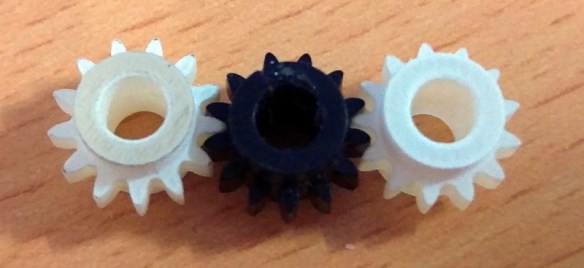
Below is an image with all three gears.  On the left is one of the first run of 3D print gears, in the middle is the original injection molded gear and on the right is the new 3D printed gear.

Rivarossi o Scale Gears 1

Although it is hard to see, as the difference is small, the teeth on the new gear are slightly shorter than on the first run.  This will make the new gears mesh perfectly with all the existing Rivarossi gears even if the drive gear position is a bit out of tolerance thus eliminating the problem that arose with a few models.

All the gear pack in my shop have been updated to the new versions and you can get them here.

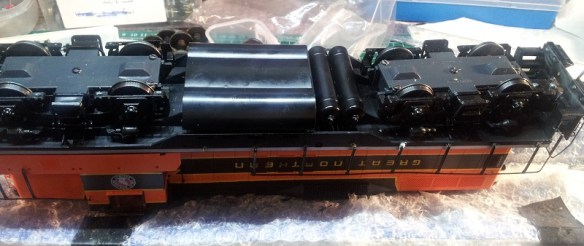
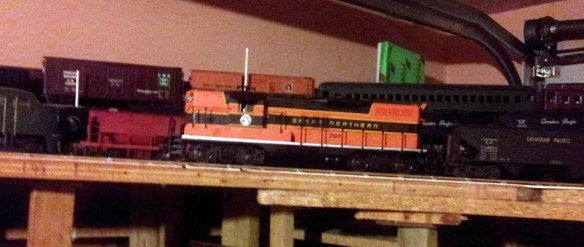
Mike Dobson is the fellow modeler who first asked me to 3D print the gears to repair his locomotives and below you can see the new gears fitted to a chassis under a Great Northern GP7 shell.

Rivarossi F9 (O Scale Gears 6 (Mike Dobson)

As you can see below Mike has several sets of axles already repaired with the new gears ready to be fitted to his locos.

Rivarossi F9 (O Scale Gears 7 (Mike Dobson)

Rivarossi F9 (O Scale Gears 8 (Mike Dobson)

With the locomotive reassembled, it was time for a test run.  Mike storage yard is above his layout in the roof and there is a fair climb up to it.  This is a great test for the gears.

Rivarossi F9 (O Scale Gears 9 (Mike Dobson)

And finally we have a video of his repaired GN GP7 running on Mike’s layout.

And that ‘wraps up’ my last post before Christmas, but not wanting to leave you with out a gift, the nice people at Shapeways are having 15 days of deals to close out 2015, and today’s deal is $10 off all Frosted Detail Plastic orders of $30 or more!  As all the gears and my locomotive shells and detail parts are printed in Frosted Detail Plastics this could be useful.  Simply enter the code FROSTY2015 at the checkout.  This offer ends at 11:59PM Pacific Time on the 21 December 2015.

Happy Christmas

Repairing an N Scale Minitrix Steamer

The German firm Minitrix, now owned by Markin, used to produce a range of US and UK steamers as well as their native German locomotives.  Most of these early models date back to the 1970s and are still running strong.  However there are a few parts that are prone to breaking and in this post I will share with you how to repair the crank pin on a Britannia class locomotive.

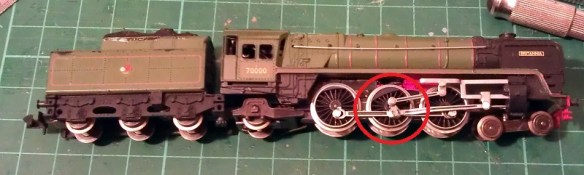
Minitrix used the same chassis or a variation of the chassis on a variety of locomotives.  In the US it was the 4-6-2 K4 and 2-10-0 Decopod.  In the UK it was the 4-6-2 7P Britannia, 4-6-2 A3, 4-6-2 A4 & 2-10-0 9F class engines.  These all had metal side rods, drive rods and eccentric cranks but the eccentric pin that holds it all together is plastic.  And it’s this part that has been known to break. If you look at the model in the picture below I have circled the crank pin in red. The side rod connects all three driving wheels together and is the nearest to the wheel.  The connecting rod or main rod is fixed to the center wheel and runs into the cylinder.  The crank pin holds the connecting road and side rod to the center wheel.  The eccentric rod connects to the cranked end of the pin and drives the valve gear in the cylinder.

Minitrix Crank Pin 1

The crank pin is designed so that the side rod and connecting rod can easily rotate without binding on the pin but are also held in place. So you can see how this works I have modeled the crank pins below.  The square shaft on the end of the pin fits into the wheel.  Because it’s square this will ensure it will rotate with the wheel. The side rod and connecting rod fit over the round section and are held in place by the wheel and cranked top.  The holes in the side and connecting rods are larger than the pin to allow free moment.

N Scale Minitrix Crank pin

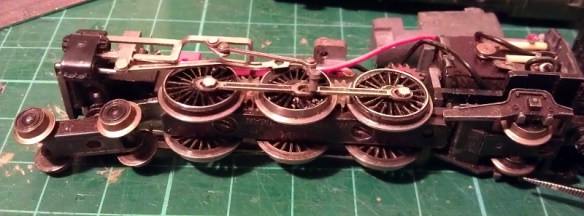
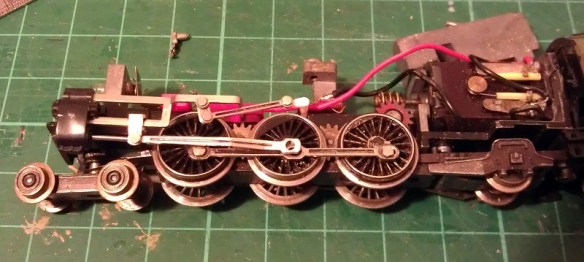
What normally happens is the metal rod assembly becomes jammed and the weakest point is the plastic crank pin. The pin breaks where the round section meets the square section and falls out.  The connecting rod then flails about and can become bent.  With this 4-6-2 that is exactly what has happened, although luckily the connecting rod wasn’t bent.

Minitrix Crank Pin 2

So to fix this engine the first thing needed is a new crank pin.  Spare parts for these engines ran out years ago so my next option is to 3D print one.   I printed some using the 3D model above in Shapeways Frosted Extreme Detail material.  It will also print in their Frosted Ultra Detail material.

Minitrix Crank Pin 3

Next the old square section on the crank pin needs to be removed.  For this I used a small drill in a pin vice as you can see below.  I selected a drill that was a bit smaller than the pin.  Once I had drilled through the pin the remaining materiel was so thin and weak it pulled out with a pair or tweezers.  You can see the remains of the pin under the new one.

Minitrix Crank Pin 4

In the image below you can see the old and new parts next to each other.  The old crank pin is connected to the eccentric rod by a metal pin which has a flared end and cannot easily be removed.  One option is to cut off the old plastic crank and un-flare the end of pin hoping to fit it into the new one.  However that is very hard to do.

Minitrix Crank Pin 5

To make this job easier I did cut off the old plastic crank but I did not un-flare the pin.  Instead, using a very sharp craft knife, I cut through the loop on the end of the new crank pin.  This then forms a C shape although the two ends still touch.  Carefully spreading the new C shape I was able to push it over the metal pin as you can see below.

Minitrix Crank Pin 6

The connecting road and eccentric rod were then refitted to the loco.

Minitrix Crank Pin 7

The new crank pin simply push-fits into the driving wheel, ensuring it passes through the hole in the connection and side rods.

Minitrix Crank Pin 8

It is important to make sure the crank pin is pointing in the right direction, which is towards the center of the wheel.

Minitrix Crank Pin 9 Minitrix Crank Pin 10

The next part is to test the the new assembly and what could be better than running it on a layout.  Below is short video of the engine running demonstrating that the new crank pin works perfectly.

The rocking motion is caused by the traction tires as the loco is supposed to be moving.

The last thing to do is to add some silver paint to the new crank pin to help blend it in.  It’s best to put on as little as possible as you don’t want to paint the parts together or cause a bind.

Minitrix Crank Pin 11

A pack of four replacement crank pins is available from Shapeways here.

Alternatively if you would like this repair made to your locomotive for you, you can contact me though the contact page or directly at jamestrainparts@yahoo.co.uk and we can arrange to get it done.

N Scale EMD GP7/GP9 & GE P42 Brass Additions

The NMRA (BR) convention is approaching and I am putting a lot of time into getting my new modules ready so this week’s post will be short.  But I do have some new releases to tell you about.  Back in June I shared with you my designs for some more brass Additions; you can find the post here.  These are now ready for release and you can find them in the shop under Etched Metal Additions.

There are two new sets of brass Additions available.  The first is a set of replacement handrails and details for N Scale EMD GP7 & GP9 Locomotives.  These were originally designed to replace oversized handrails on older Atlas/Kato locomotives.  The older locomotives also had round handrail stanchions which were incorrect. EMD made them from channel sections which has been represented in the new brass Additions. This set can also be used for most other GP Locomotives as the shape of the GPs is fairly constant and the handrails can easily be adapted.

JTP Additions GP7-9

The fret includes a full set of replacement handrails, four sets of MU Hoses, two Sinclair antennas, three rear view mirrors, four windscreen wipers, two sun visors, seven sets of grab irons, one grab iron drill plate, two drop steps for the end handrails and two cab doors so they can be modeled in the open position.

The second set of Additions is a pair of rear view mirrors designed to fit N Scale GE Genesis Locomotives, in particular the P42 made by Kato.

JTP Additions P42 Mirrors

Both sets have been tested and I will have some images of those locomotives to share with you soon.
It’s now time to get back to my modules. Once they are a bit more presentable I will be sharing more of the progress with you as well.

Etched Brass Name Plates

As well as all the American Railroad modeling I do I also like the British outline trains and through my local clubs and societies I get to see many from across the country.  In this post I will share with you how a British Hornby Ready-to-Run locomotive was renumbered and more importantly renamed using etched brass.

British steam locomotives, particularly the express locomotives, are usually named as well as numbered.  So are many of the smaller and industrial locomotives.  Some are considerably more famous than others around the world, such as the Flying Scotsman and Mallard, but most are simply named in groups depending on their class.  The locomotives often changed numbers when companies merged or the railways were nationalised but the names were always kept the same, giving personalities to the locomotives.

My local model railway club, the Poole & District Model Railway Society, is on the South coast of England and the primary railway here in steam days was the Southern Railway.  Naturally there are a lot of Southern Railway fans at the club and one member asked if it was possible to change the name and number on one of his SR Schools class locomotives.

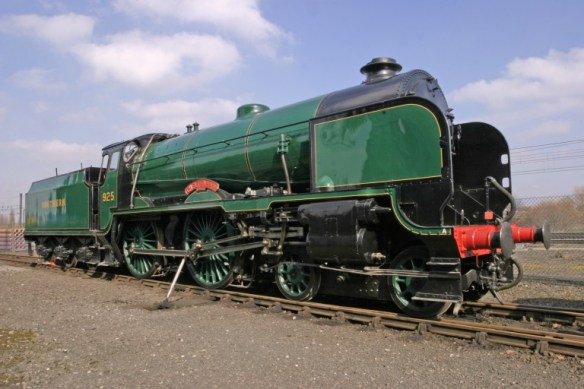
The Schools class, or properly named SR V class, locomotive is a large 4-4-0 Atlantic designed by Richard Maunsell.  This class was Europe’s most powerful 4-4-0 and the last locomotive to be designed in Britain with a 4-4-0 wheel arrangement.  A total of 40 were built between 1930 and 1935 and they were all named after English public schools.  Below is a photo of ‘Cheltenham’ No. 925 restored and part of the National Railway Collection.  You can read more about it here.

SR 4-4-0 V Schools Class No 925 Cheltenham

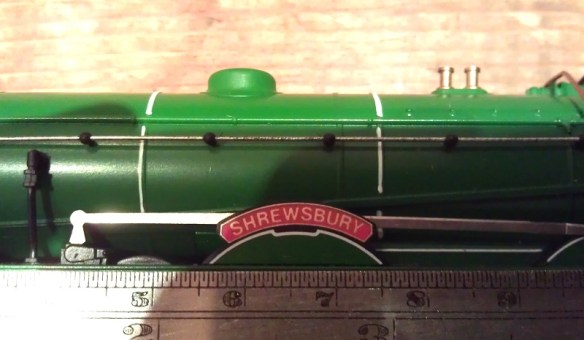
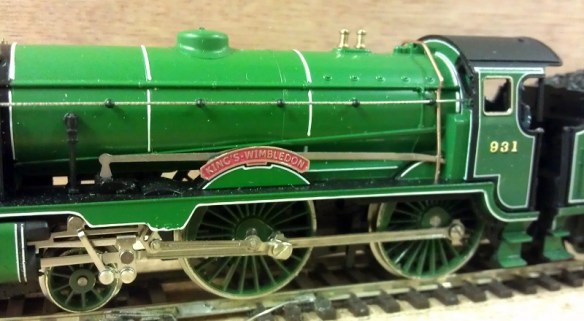
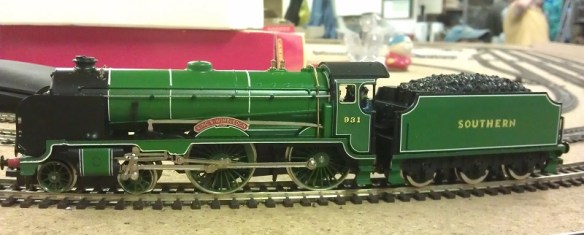
The particular locomotive which my fellow modeller asked me to alter was a OO gauge Hornby model of ‘Shrewsbury’ No. 921. Hornby released this model under a few different names and a few other companies have made replacement name plates for some of the others but the one elusive name was ‘King’s-Wimbledon’ No. 931. And this was the name he wanted.

So to start I measured the existing locomotive name plate as you can see below to get a scale and size for the new one.

New Name Plate 1

The original name plate on the model was a flat paper with a sticky back and was easily removed.  Next I had to find an image of the original ‘King’s-Wimbledon’ name plate and luckily there were a few on the internet.  Here is a link to an image on Flicker taken by Jonathan Wilcox of the name plate hanging at Kidderminster Railway Museum.  Sadly the original ‘King’s-Wimbledon’ locomotive was scrapped; only three of the forty survived into preservation.

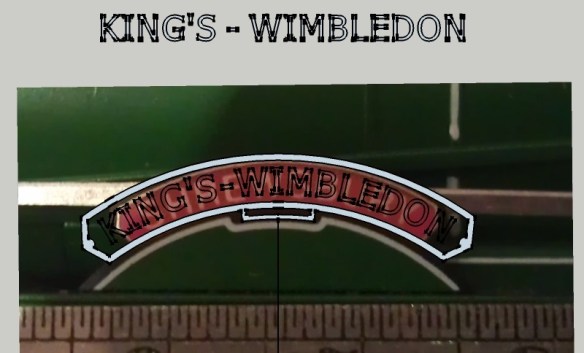
Knowing the required size and having information from the original I was able to layout the new name plate in CAD over the photo of the model.

Kings' Wimbledon Cad 1

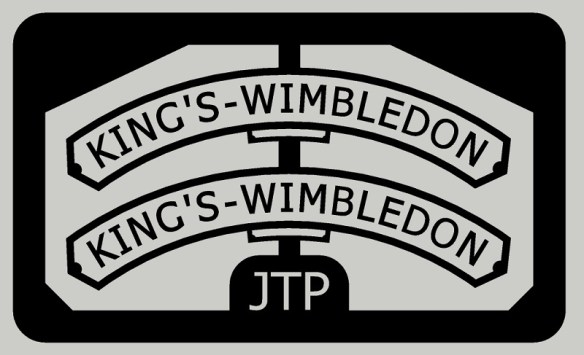
Then I could create a template for the fret etch.  The original had the words ‘Schools Class’ in the small box under the main name but even in OO Gauge that would be too small so I omitted that detail.

Kings' Wimbledon Cad 2

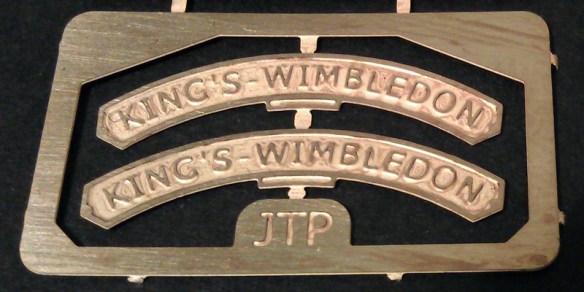
The fret was then added to a much larger sheet with other etched parts which I needed and sent to the etcher.  Below is an image of the actual finished etch.

New Name Plate

The real name plates are brass and only the sunken parts are painted, the border and letters are clean so they can be polished.  To achieve this the whole etch is sprayed red then the top surface is lightly wiped clean leaving only the sunken areas painted.  The new name plate is then glued to the locomotive.

New Name Plate 3

The locomotive number also needed to be changed and this was done using wet slide decals.  Although only the middle number needed changing it is often easier to change all three as sometimes the font or size of the new decals can be slightly different to the model manufactures.

New Name Plate 4

I think the overall effect looks really nice and I prefer the name plate with the proper sunken areas as opposed to being just flat.  Hopefully I will be seeing ‘King’s-Wimbledon’ pulling an express train on the club layout soon.

New Name Plate 2

I have a few spare sets of the ‘King’s-Wimbledon’ name plate available should anybody want to purchase one for their OO Gauge Schools class and they can be supplied plain or painted ready to fit.  Also, if you have another name or number plate for a locomotive that you can’t find and want to get etched in any scale, please contact me for a price.