A Replacment Pilot for A Con-Cor Galloping Goose

As promised in last week’s post I have a replacement part to share with you for one of Rio Grande Southern’s famous pieces of rolling stock.

The ‘Galloping Goose’ is one of those items that Con-Cor made, and made very well, which you just fall in love with. Even though the prototype was a narrow gauge rail car and this model runs on standard N Scale track it’s a great piece of modeling, particularly because it’s so small.

Galoping Goose Pilot 1

This ‘Goose’ is very highly detailed and on the front is the classic cow catcher or pilot and it’s this part that I was asked to make by a fellow modeller who’s missing one.

Galoping Goose Pilot 2

As supplied by Con-Cor the pilot comes in two forms; as shown above and with a snow plow, shown below.

Galoping Goose Pilot 3

The plow is a separate part which simply clips onto the pilot.
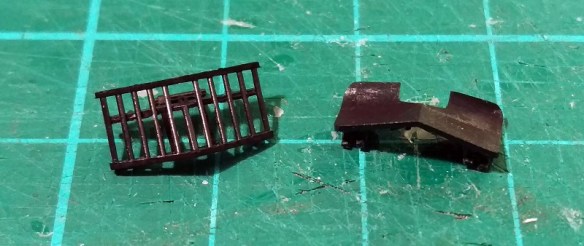
Galoping Goose Pilot 4

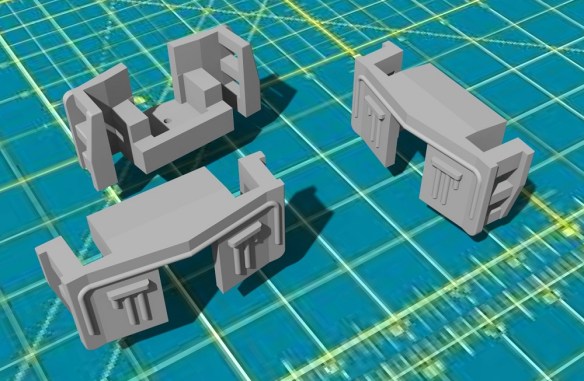
For this replacement part only the pilot section was required, so I removed the plow and measured up the pilot.  The verticals are very thin on the original injection-molded part so the replacement can’t be exactly the same: having such thin 3D printed parts would be very weak.  This can be overcome by increasing the depth of the verticals and making the sections larger, however all the main visible areas and mounting points will look correct.  As usual I produced a rendered image of the 3D model and below you can see the pilot from several angles.

N Scale Goose Pilot Render 3

The two pegs protruding horizontally from the cross beam are all that hold the pilot to the front of the ‘Goose’.  The two bars that slope upwards are purely cosmetic although on the real thing they are a part of the pilot mounting.

I will be ordering a test pice of this pilot in the next week or so. However you can order one already from the Shapeways site.

It is available as a single pilot here.

Or as a pack of two here.

The pilot has been designed to be printed in Shapeways Frosted Ultra Detail (FUD) and Frosted Extreme Detail (FXD) materials so the best detail can be obtained; after all, this part is only 10mm wide and 6mm high.

I can also make the snow plow available if anybody wants one although I expect it will not be a separate part but an entire replacement pilot with the plow permanently attached.

Next week I’ll have another small replacement part to share with you which will help step things up a gear.
Replacement Graham Farish Bolster Pins

With all my recent time being focused on my C-855 project, several of the smaller jobs have been overshadowed, but not forgotten.  So in the next few posts I’m going to share with you some of some of the small 3D printed parts that I have been asked to do over the last few months.

To start with in this week’s post we have some replacement N Gauge bolster pins for Graham Farish coaches and bogied wagons.  The bolster pin, sometimes refered to as a truck pin or bogie pin, holds the truck or bogie onto the chassis.  The pin allows it to rotate and navigate corners.  The pin has to be a tight fit into the chassis so it won’t fall out but still allow the truck or bogie to rotate freely.  This is achieved through the hole in the chassis being exactly the same size as the pin.  This creates a friction grip as the pin is pushed into the hole.   The friction grip is a stronger force than normal gravity and vibration can provide to remove it.

As always, I start with a 3D computer model.  This model is simple but it was important to get the measurements accurate so the peg won’t be too tight or too loose in the chassis hole.

Replacement Graham Farish Bolster Pins 7

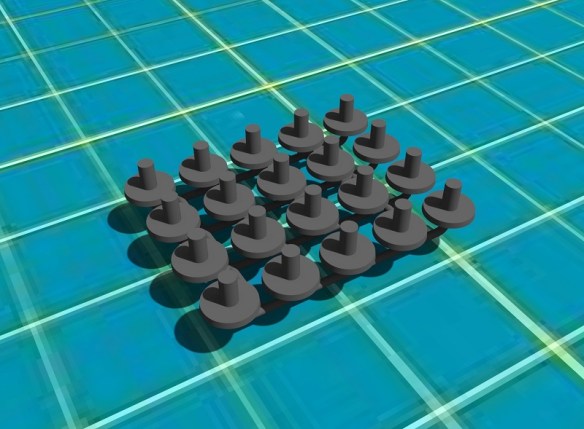
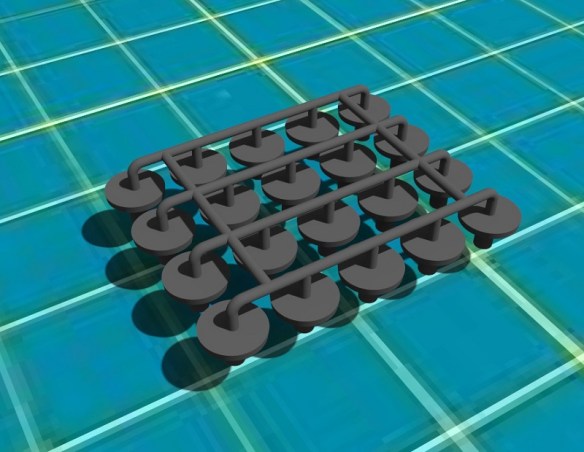
Because these will be printed in Shapeways’ Black Strong & Flexible material and they charge by the part, I have arranged twenty pegs all connected to one sprue.

Replacement Graham Farish Bolster Pins 8

The printed parts came out as expected; I had already removed two before I remembered to take a photo.

Replacement Graham Farish Bolster Pins 1

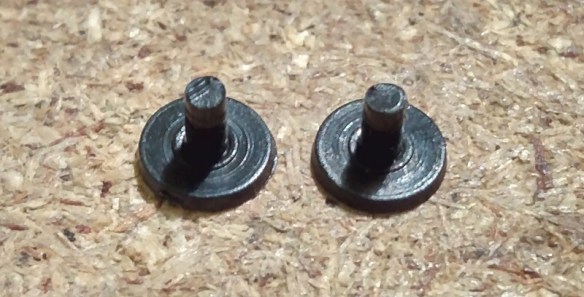
Below are a pair of the injection molded pegs as supplied by Graham Farish.

Replacement Graham Farish Bolster Pins 2

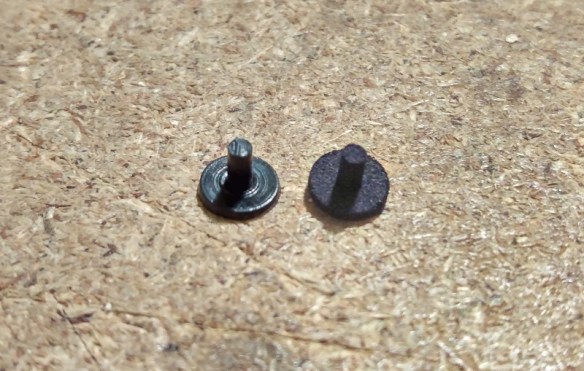
And here is a photo of one of my 3D printed pegs next to an original.

Replacement Graham Farish Bolster Pins 6

The Black Strong & Flexible material does have a grainy finish but this is of little consequence as the pin is never seen once the rolling stock is on the track.  The material is also fairly flexible, as the name suggests, and this helps with ensuring a good fit into the chassis hole.

As a test, the pegs on a standard Graham Farish Mk1 coach were swapped out for the new 3D printed ones, which fitted perfectly.

Replacement Graham Farish Bolster Pins 3

The injection molded original has the same finish as the truck; as you can see below.

Replacement Graham Farish Bolster Pins 5

The 3D printed peg, apart from the finish, is exactly the same.  You can see from the shadow there is a slight gap between the bogie or truck and the head of the peg.  It’s the gap that allows the bogie or truck to move.  If you look closely you can see that the couplings have also been replaced with my 3D printed short Rapido replacements.

Replacement Graham Farish Bolster Pins 4

The pack of 20 replacement Graham Farish bolster pins are available here.

In next week’s post I will have a replacement 3D printed part to share with you for one of Rio Grande Southern’s more famous pieces of rolling stock.

Etched Brass Additions for an N Scale C-855B

This week’s post will be short as I’ve had very little modeling time due to the unfortunate demise of my much-loved motorcycle and the search for a replacement.  However there is good news; not only have I found another bike but the C-855B brass Additions have arrived and they look great.

C-855B brass Additions

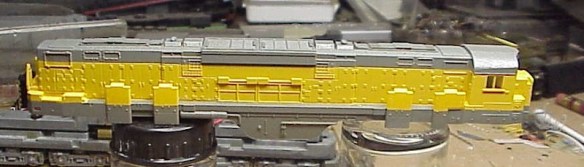
The C-855B brass Additions are very similar to the C-855 set, although there are no windscreen wipers or sun shades.  There are also less grab irons, but two larger end handrails have been added as well as the extra end handrail.  These are the three parts on the left hand side.

For those that have pre-ordered your C-855B brass Additions, they have now been posted and should be with you very soon.  I have several sets in stock and they can be ordered here. Alternatively you can contact me through the contact page.

As I said, time has been short, so I haven”t test fitted the C-855B body onto an extended chassis yet but I will have it all done for next week’s post.  The body’s also going into the paint shop so there’s a small chance I might have the whole set finished and ready to share with you then.

Drawing an Alco C-855B for N Scale

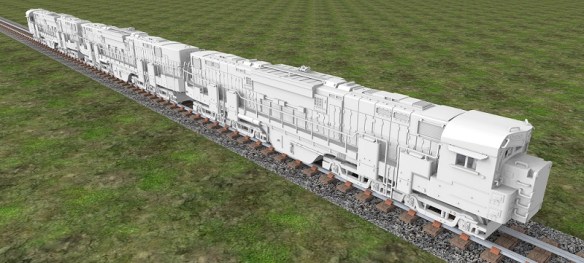
Over the last few months I’ve been posting about my new locomotive project, the huge Alco C-855 built for the Union Pacific railroad.  This iconic engine, despite only being in service for 8 years out of North Platte in Nebraska, was part of the general pool of locomotives and ran in different consists with several varieties of Union Pacific power.  But it was delivered by Alco as a set of three; two C-855s and a C-855B cabless booster.  Together they produced 16,500 HP and were Alco’s answer to UP’s call for a loco to replace the ageing GTEL 8500 Gas Turbines.  In this post I’ll share with you my designs for the C-855B to complete the set.

Alco C-855B (Render)

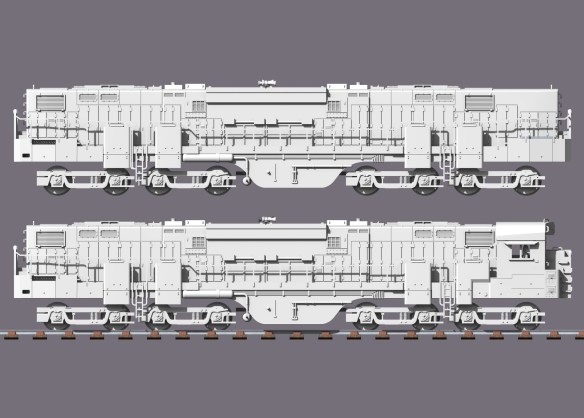
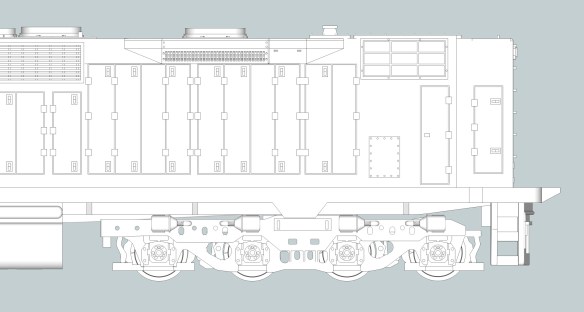
The C-855B is basically identical to the C-855 with the only difference being the lack of a cab at the front end.  As you can see from the images below they are also the exact same length with all the same doors and features.

Alco C-855B Side View

Please note: the trucks are purely there as a representation, I’ve not drawn the proper truck assemblies yet. However I will be doing this so I can make a dummy chassis available soon.

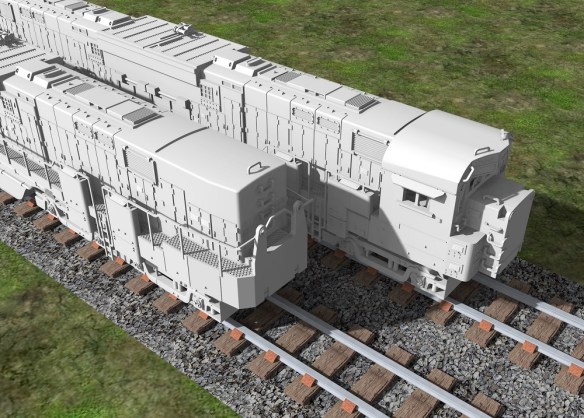
Alco simply removed the cab section and added the same end equipment as the rear end.  Then they filled in the space with bodywork plate as you can see below.

Alco C-855 & C855B Front End

This means that the chassis is exactly the same, well almost.  Because there’s no cab a little bit more will need to be cut off the Con-Cor chassis as it gets wider where the turbine/U50 cab was.

This model is now available in both Shapeways FUD and FXD materials and can be found here.

The brass Additions for this locomotive are not the same as the C-855, the front handrails are different as well as the quantity of grab irons etc, so I’ve drawn a new sheet.  These will be available very shortly but if you wanted to pre-order them or both the C-855 and C-855B brass Additions it will give me a better idea of how many sheets I need to order later this week.  Please send me a message via the contact page or email me if you want to order any brass Additions.

The chassis and assembly instructions for both the C-855 and the C-855B are almost done and, once complete, I’ll be adding them to the site in a PDF format which you can download.  There are a few cuts that need to me made to the chassis in order to fit the shell and the exact dimensions will be included.

Together all three will look very impressive and I am greatly looking forward to seeing them all run.

Alco C-855 Triplents (Render)

My two C-855s are still at the painter’s but hopefully I’ll have some more pics to share with you soon.

In the meantime here are some photos from two customers who have already started painting theirs.

Brian Stewart has re-powered his chassis with an Atlas motor.

Alco C-855 1(Brian Stewart) Alco C-855 2(Brian Stewart).JPG Alco C-855 3(Brian Stewart).JPG Alco C-855 4(Brian Stewart).JPG

Mike Musick has primed his ready for the brass Additions and final paint.

Alco C-855 1(Mike Musick).JPG

If you have any work-in-progress photos or some of the finished locomotives running on your layout and you’d like to send them to me I’d be happy to add them to the site gallery.

A New Pilot for an N Scale EMD DD35

My N Scale kit for Electro Motive Division’s DD35 locomotive uses Bachmann’s massive EMD DDA40X chassis, after some shortening.  But as there’s something not quite right about the pilot on the Bachmann model, in this post I will share with you my designs to add a new body-mounted pilot to the DD35.

All of the real EMD ‘DD’ locomotives use four axle trucks which rotate under the chassis. The pilot, which holds the coupling and multiple unit connections, is part of the main chassis, or body, of the locomotive.  This means that as the locomotive runs around a curve the truck rotates but the pilots remains square to the body.  This is done so the load from the coupling is transferred through the chassis and not through the truck mounting. In this image, from Railpictures taken by Tom Farence, you can see the steps and pilot area are square to the body even though the loco is on the bend.

Bachmann’s model of the DDA40X has the pilot attached to the truck causing it to swing out from under the body on curves, as you can see below in this image of a DD35 between a GP38 and an SD35.

DD35 & Friends 4

This also creates a gap between the steps and the body which is, and looks, un-prototypical.  You can see the steps in the image below disappearing under the shell.

SP DD35 9902 8

So why is the pilot located on the truck? Well Bachmann did it for a good reason.  Because the DDA40X locomotive is so long, without the pilots being on the truck it simply wouldn’t be able to navigate the tight curves, which many of us have on our model railroads, without pulling any connected cars off the track.  Curves on prototypical railroads have a much larger radius and they don’t suffer from this issue. The Bachmann DDA40X can actually traverse some very tight curves but it does look odd doing it.

However there are a few modelers that have the luxury of large minimum radius curves on their layouts and have requested a modification be made to my DD35 kit.  Because I already offer the kit in powered and dummy forms using the same shell I didn’t want to created a whole new shell just for this and, luckily, there is a solution.  The dummy DD35 kit, as pictured below, comes with 3D printed trucks that include a pilot.

DD35 Dummy Pilot

The truck and pilot behave in the same manner as the Bachmann one on the powered chassis and have the same appearance so you can run a powered and dummy unit together.

By extending the pilot section up to meet the underside of the 3D printed dummy chassis or the Bachmann metal chassis, the new pilot can be fixed directly to the body, leaving the trucks free to rotate.

DD35 Dummy Pilot 2

The new pilot section, as pictured below, has been shaped so it will fit the sloping 3D printed dummy chassis or the Bachmann metal chassis, and it has the same mount for a Micro-Trains body mount coupler.

DD35 Dummy Pilot 4

The MU hoses are printed as part of the pilot but can easily be cut off with a craft knife or sanded off if you prefer to fit etched brass ones.

The new pilots are available in two packs.

One pair of N Scale EMD DD35 body mount pilots

Two pairs of N Scale EMD DD35 body mount pilots

Please remember when fitting your N Scale DD35 with a body mounted pilot and coupling it will increase the minimum radius that your locomotive can navigate.  If you are unsure if this will work for you, position your DD35 over your tightest curve and see where the nose of the body swings out to.  If it is outside the sensible condition to be able to couple up to a another car or locomotive then your radius is too small.

I will also be making a similar pilot available for the N Scale EMD DDA40X which I’ll share with you soon.

An Alco C-855 for N Scale Part 2

As promised earlier this week in my usual Monday night post, I am adding this extra post to let you know that the N Scale Alco C-855 kit is now available on Shapeways.  I have finished all the etched brass testing and everything fits perfectly.

You can get the Alco C-855 kit here.  Don’t for get the chassis extenders and the etched brass Additions.

So now it’s back to the drawing board for the C-855B.