2015 is drawing to a close and I have been spending some time this week catching up on some of my projects over the Christmas break. So this week’s post is simply to remind you about Shapeways 15 days of deals which will be running until the end of the year and to wish you all the best for the New Year.
The start of the New Year will bring the completion of some long awaited projects and the introduction of some new ones, I think it’s going to be a good year.
As well as 3D printed models I do a lot with DCC and model railroad wiring. Recently I have been building computer controlled DCC layout and this adds a whole new level of requirements to the layout such as circuit detection. In this post I will share with you how I get rolling stock ready for circuit detection on an N Scale DCC layout.
Circuit detection is fundamental to computer control as it tells the computer where trains are on the layout. It is also useful if you have hidden sidings and you want to know where your trains are. There are several companies that produce circuit boards for circuit detection and on this layout I have used Digitrax’s BDL168 boards. The boards work by measuring a resistance across the track; this can be anything from an LED to a DCC chipped locomotive. So if you have a locomotive in a section connected to a BDL168, even though it’s not moving, the board will detect a resistance and turn on the output for the section. The output could be connected to a display panel or a computer could pick it up through the Digitrax Loconet system.
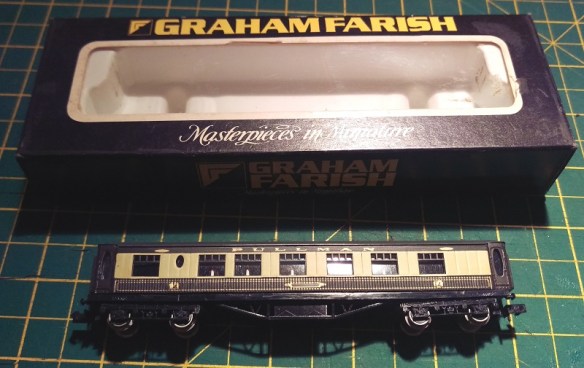
This is fine for locomotives and rolling stock with illumination but what about basic freight cars or wagons? The computer controlled layout I’m building is a British outline model railway and has a lot of coaches that will all need to be modified so the circuit detection can pick them up. A lot of the coaches, as shown below, are made by Graham Farish and luckily have metal wheels, obviously plastic wheels sets are no good for circuit detection..
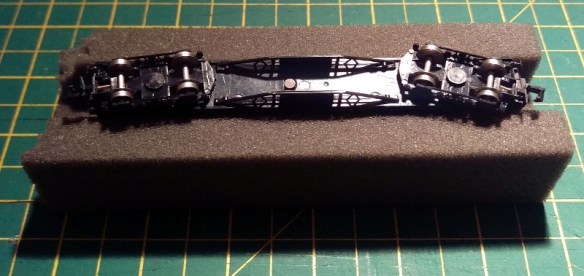
If you do have rolling stock with plastic wheels you can get replacement wheel sets for just about all ready-to-run stock. Although metal wheels usually run better you don’t have to change all the wheel sets for metal ones, only the ones you intend to modify. In fact you only need to modify one wheel set per item of rolling stock. Because of the length of the coach I am going to modify one wheel set in each truck. If it was a short wagon I would only do one. Ideally I would like to modify the two outer wheel sets but as the axle is so close to the coupling box there would be no room.
Adding lighting to the coach would be one way of creating a resistance across the coach but by far the simplest way is to add a resistor to a wheel set.
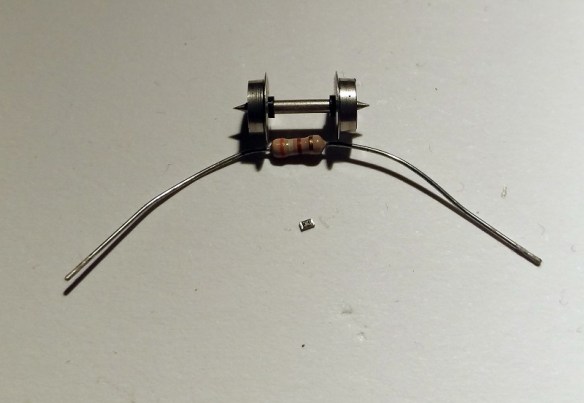
As you can see from the images above with N Scale, and OO/HO, a standard resistor is a bit big and would be very impractical.
To overcome this, tiny resistors called ‘Chip Resistors’ are available, and are also very cheap to buy.
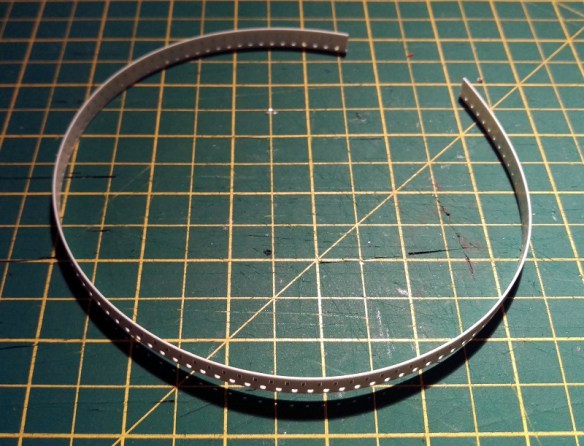
The best size of resistor for this job is a 10K Ohm. The Ohm rating is the measurement of resistance and it is important to get this correct as the wrong resistor may cause heat which might warm up the wheel set and melt your train. The chip resistors are usually supplied in strips as shown below.
Close up you can see the tiny chip resistor, each one is in a pocket in the strip and covered by plastic film.
Below is a comparison of the strip with an N Scale 3 axle tender truck.
Once the chip resistor is popped out of the strip you can see just how small it is.
And immediately you can see the advantage over the traditional resistor.
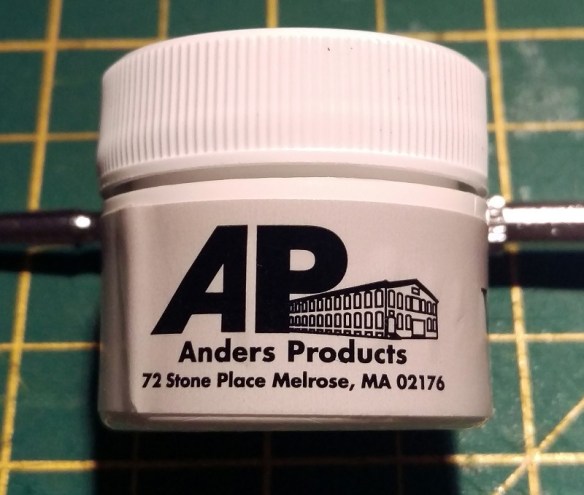
The next issue is how to fix the resistor to the wheel set. If you attempt to solder it on I guarantee it will go wrong. The heat from the iron will heat up the wheel set and melt the plastic spacer between the wheel and the axle. This will cause the wheel to become out of line and wobbly. It may even cause a direct short across the wheel set. The other option is to glue the chip into place. This also has a few problems because if you get glue between the metal contact of the chip and the wheel or axle, the chip will not be able to conduct electricity. To overcome this I have used Wire Glue made by Anders Products.
This is glue that has been designed so once it sets it will conduct electricity.
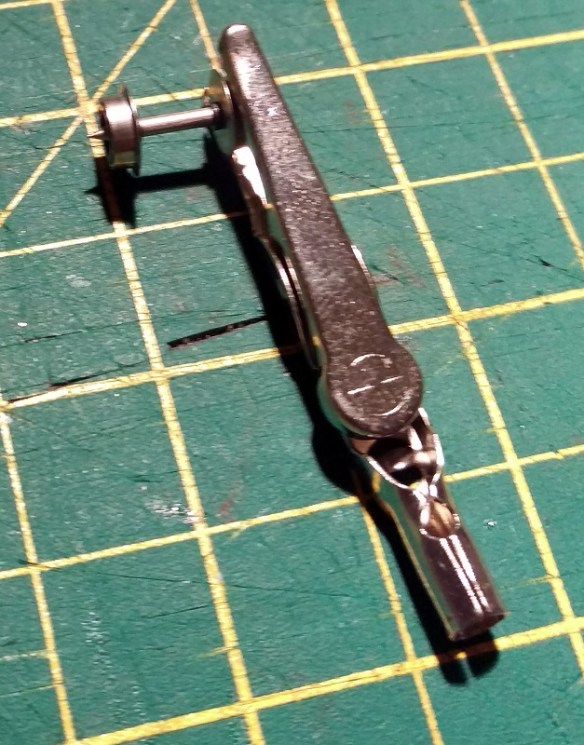
Unlike superglue or CA the wire glue needs time to dry, normally overnight, and that means it needs to be left where it won’t be knocked or moved. Sitting one of those tiny chips on an axle that rotates is not very practical so I pop out the wheel sets and gently hold one of the wheels so the set can’t roll over. Make sure what you are using to clamp the wheel set is not too strong as you don’t what to damage the wheel. I would also recommend checking the wheel centers are correct before gluing the chip in as you won’t be able to move it once the glue has set.
Once you are ready, and have stirred the wire glue, use a tooth pick to put a tiny amount on the axle and the inner face of wheel making sure you don’t bridge the plastic spacer with the glue. Then using a pair of tweezers position the chip so one end touches the axle and the other touches the inside of the wheel.Once it has dried a little I put a bit more glue over the top to ensure everything makes contact.
If, like this particular wheel set, both wheels have a plastic spacer you will also need to bridge the other side. I have done this simply by spreading some of the glue across the spacer from the wheel to the axle.
Once dry you can check the resistance across the wheel set with a multi-meter.
This glue generates a fair amount of resistance itself so it would not be good for main DCC wires etc but for this purpose it does the job nicely. I also don’t think it’s as strong as most glues so to make sure the chip won’t come off you could also put some superglue or CA over the top once you know it works okay.
Then it is a simple matter of fitting the wheel set back into the truck and the coach is ready for use on any layout and will trigger track detection on layouts with circuit detection.
With the NMRA (BR) Convention coming up this weekend I decided that some of my running stock needed some attention before the show. A lot of my older rolling stock still has the Rapido style couplers and some of the newer stuff has Atlas’ Accumate couplers. My preference for couplers has always been to use Micro-Trains as I have found them to be the most reliable. In this post I will share with you how I convert older rolling stock to MT couplers in a fairly cheap way.
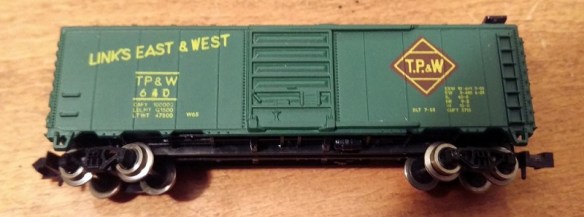
The box car below is a typical 40 foot car with Rapido couplers fixed to the trucks. By far the simplest way to convert this car would be to buy a set of MT trucks, which come with couplers pre-mounted, to replace the originals. However this can become very expensive if you have lots of cars to convert.
Another slightly cheaper alternative is to buy an MT conversion kit that will replace the coupler in the truck. These can be a bit tricky to fit but work very well and you get to keep the original wheels. The car I’m converting has metal wheels which are clean and in good order, making it a good runner.
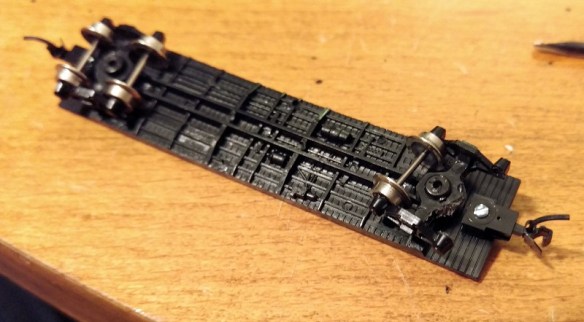
For me the cheapest option is to use body mounted couplers. Again this means you get to keep the existing wheels and trucks but the existing couplers are removed totally. The new couplings are fixed to the underside of the car chassis. This is actually more prototypical and transfers the weight of the train through the chassis, bypassing the trucks and bolster pins.
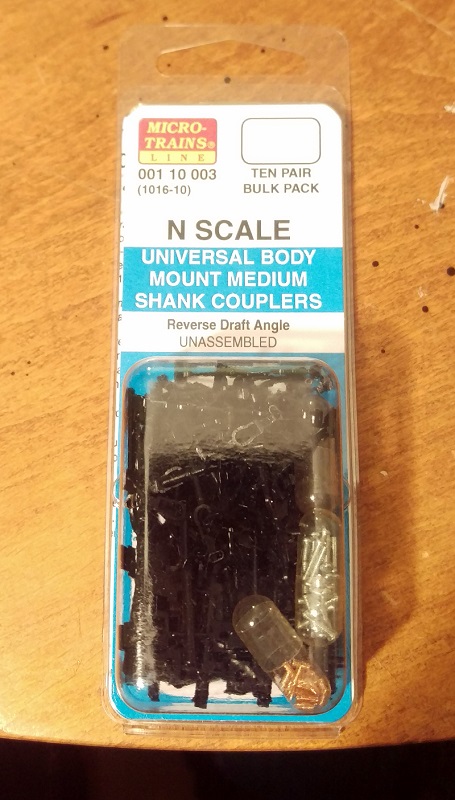
The MT body mount couplers are available in pairs or in bulk packs as shown below which is certainly the cheapest way to buy them.
To make the change you will need a few basic modeling tools as shown below. I use a small watchmaker’s screwdriver, flat file, craft knife, needle nose tweezers, flat end tweezers, MT gauge, pin vice with a drill (from the MT Tap & Drill Set – 00-90), side cutters & pliers.
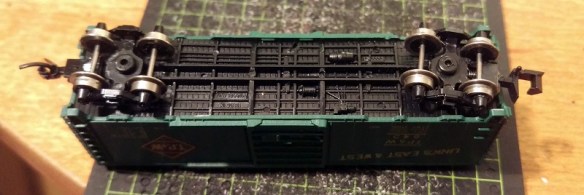
To start you should check that the car is in good running order. You can see I have already changed the left hand coupler.
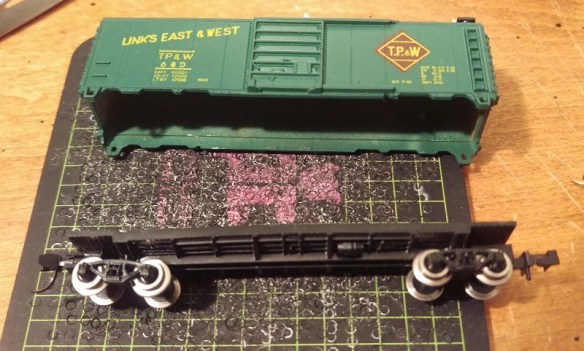
The body should simply pull off the chassis and can be put to one side.
While the body is off it’s a good chance to check that the weight inside the car is properly secured; it’s normal for this to be rusty as it’s simply a strip of unprotected steel. If the weight is loose simply glue it back into place before continuing.
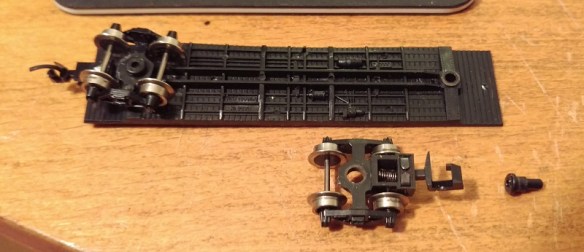
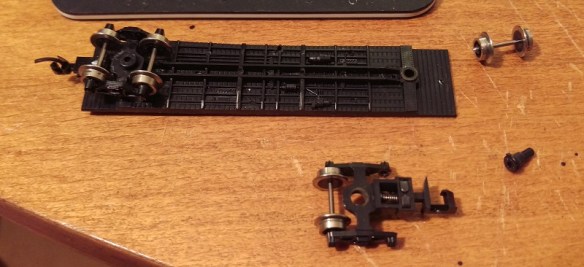
Next remove the truck by pulling out the bolster pin. You can do this either with the pliers or by simply pulling on the truck. Make sure the bolster pin does not fly off.
With the truck removed the front wheel set can be taken out by gently pulling the truck side frames apart.
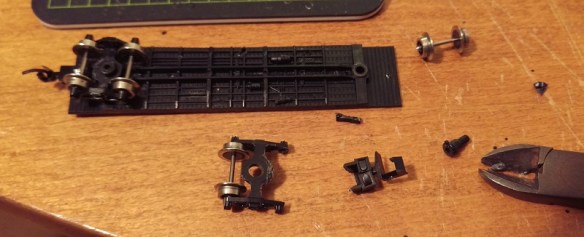
Then using the side cutters snip off the coupler leaving enough material surrounding the bolster pin hole. You won’t be able to do this in one snip as the truck side frames will be in the way. I find five snips normally does the trick. Once finished the top of the truck needs to be flush otherwise it may hit the new coupler. If the area where you sniped is a bit rough you can use the file to smooth it out.
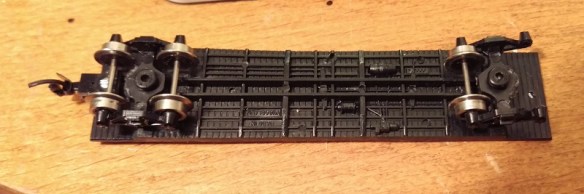
The truck can then be loosely re-fitted, there is no need to push the bolster pin in hard as it will be removed again shortly.
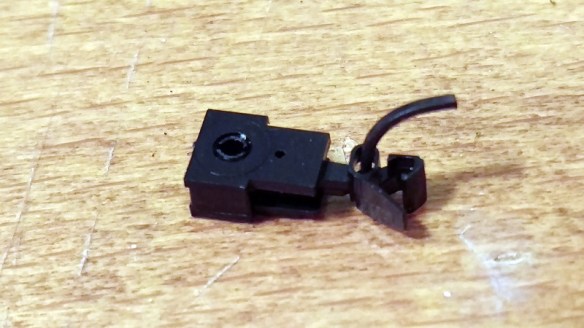
The bulk pack of couplers contains lots of parts but to assemble one coupler you need the five laid out below. They are the coupler hook and catch plate, coupler box and top plus a spacer, screw, spring and drop pin.
Using the craft knife remove the coupler hook and catch plate as well as the coupler box and top from the sprues. The spacer is the flat part on the right and may be required later so put it to one side.
With the parts removed there’s one small thing I like to do before assembling the coupler and that’s to use the file to deburr the top of the drop pin. This simply makes it fit easily without too much force which can break the coupling hook. The end that fits into the coupler hook is the longer leg.
I tend to hold the pin in the tweezers or pliers and run the file on four sides of the pin at 45°.
With the pin still in the tweezers or pliers push the filed end into the small hole in the coupling hook. The pin should be at an angle which is parallel to the side of the hook. The pin only needs to go through the hook so the end is just poking out of the top.
With the pin fitted slide the coupler catch plate over the pin.
With the coupler box on its back place the assembled parts over the tube in the box.
The next part is the most tricky. There are several ways of doing this but for me I like to use a pair of needle nose tweezers and a watchmaker’s screwdriver. The risk is that the spring will ping off and, given how small these are, you usually can never find it. Luckily MT provide several spares in the kit. I find it’s best to get the spring close to the coupler and almost in the same orientation. Then carefully compress the spring with the tweezers and place it over the slot between the coupler box tube and parts. Using the screwdriver push the spring down into place and release the tweezers.
Once in, the spring will stay there, but the assembly is very delicate so don’t knock it or the spring may ping out.
Using the tweezers place the box lid on to the box and press down with your finger. It should clip into place. The lid only fits on one way round and the underside has groves to fit onto the box.
Once the lid is clipped on the coupling is fairly robust and can be moved about. Check that the coupling moves in the box and bounces back to the same central position.
Now it is time to fit it to the car chassis. The particular set I am using are medium length, for a 40 foot box car. A short length might have been better but they will work just as well.
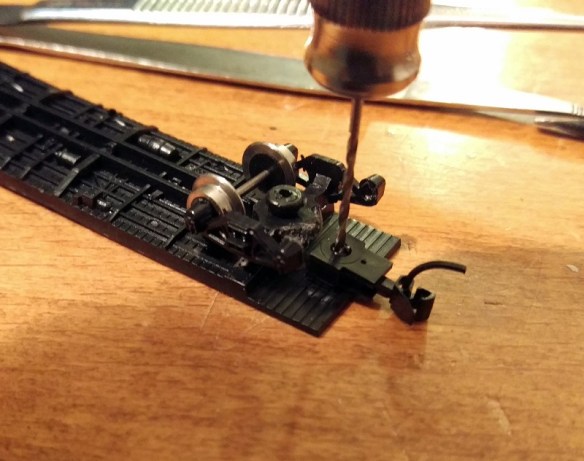
Place the coupling on the underside of the chassis and pass the drill through the box tube. Once the coupling is as far back as you want it, ensure the truck can rotate and the coupling is centered, and use the drill to mark the chassis.
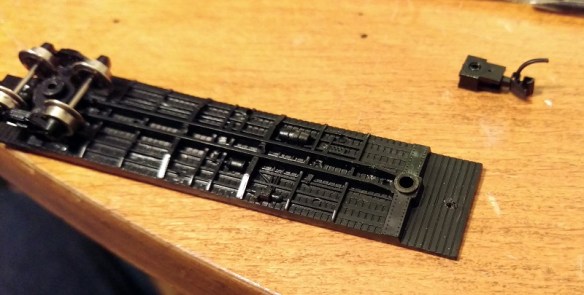
Then remove the coupling and truck so you can easily drill through the chassis. Depending on the make of the car the distance from the edge will vary, but I tend to find the hole needs to be halfway between the third and forth plank counting from the edge. As this car has a plastic chassis the metal screw will cut its own thread. However if the chassis is metal you may want to use the tap that came with the MT tap and drill set to cut a thread in the chassis.
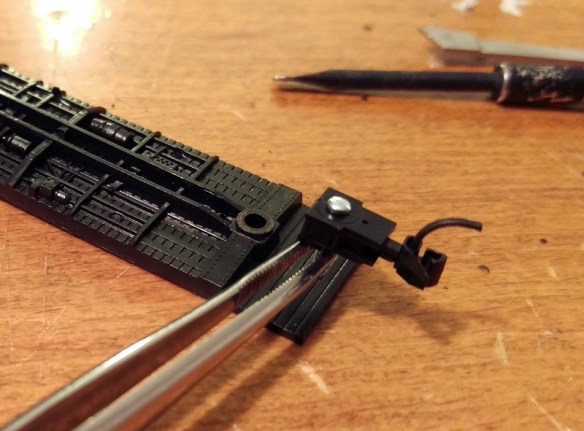
Next push the screw into the coupler box hole from the underside.
I find pushing the screw all the way though and holding it with the needle nose tweezers helps keep the screw straight when you start to tighten it up.
Once the screw is started you can let go with the tweezers and tighten it up. Make sure the coupler is square before you fully tighten it. You will notice that the screw is now sticking through the floor of the chassis. This is not a problem as it will be inside the box car but if your car has a veranda, such as you get on a caboose, or is simply a flat car, you will want to shorten the screw with the side cutters first. Note: you will also need to use a big set of side cutters for this as you may break a modeling pair.
The truck can now be installed. If the truck can rotate freely push the bolster pin in all the way and refit the wheel set.
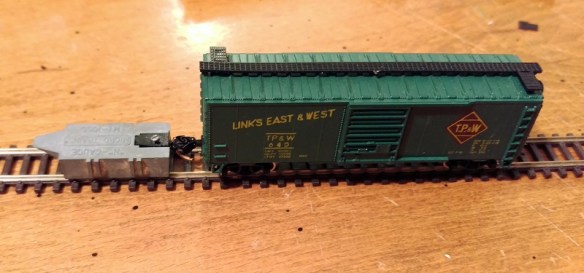
The last thing to do is check the height of the coupler. Using an MT gauge as shown below this is very easy to do.
Simply clip the gauge to the track, shutting off the power first, and test the new coupling with it. Should the coupling be too high simply unscrew the coupling and add the spacer that we put to one side earlier. This will lower the coupling. In the unlikely event that the coupling is too low then remove the trucks and add a washer to each; this will raise the whole box car correcting the coupling height.
The box car is now ready for service.
As I said at the beginning the NMRA (BR) Convention is this weekend at Derby, England and I will be there along with my fellow modelers running the N Scale modular layout ‘Solent Summit’, and my new modules will be there. The convention is open to the public on Sunday and it would be great to meet anyone who is coming along. If you can’t make it I will be giving a full report here in the coming weeks. This week I will leave you with a taster from my new modules, below is a video of a ‘short’ train crossing the Warsash River on the Warsash Wye trestle.
One of challenging things about soldering wires onto switches and components is not having enough hands. Trying to hold the soldering iron, wire, switch and solder can be a bit tricky at times so in this post I will share with you a simple tool I have found to help.
I have used this tool for all sorts of things from Seep point motors to Din plugs. The advantage the tool gives you is it has a firm shell and a soft inner similar to a pin cushion. This allows you to stick or plug the item you need to solder wires to into the tool leaving your hands free to solder on the wires. With items like Din plugs that are small and have lots of wires this is particularly usefully as without the tool the wires you’ve already soldered on will tend to pull the Din plug away from where you need it. The tool will keep the plug in the same place.
This tool is available at just about all local shops, is very inexpensive and comes in a variety of sizes. Although you will have to get a new one on a regular basis I recommend getting a bigger one as the smaller ones tend to roll around too much.
So what is this amazing tool? Well, it’s a potato!
As you can see in the photo below the long bar that is used to throw the points on this Seep point motor has simply been stuck into the potato making it very easy to solder on all the wires. The circular hole patterns are from the Din plugs that were made up earlier. A smiley faced potato is not a necessity but it can brighten your day!
As I said before it is a good idea to regularly change your potato tool, particularly if it turns green!
We are now only two weeks away from the this years NMRA (BR) convention so it’s back to the modelling for me to get my modules finished in time but after the show I will be back to 3D printing and progressing some of the projects.
As I am now nearing the end of my module build I am concentrating on some of the details that make my modules realistic. I have already shared with you how I ballast my track and you can read about it here. In this post I will share with you how I ballast my track up to trestle ends where the ground suddenly drops away.
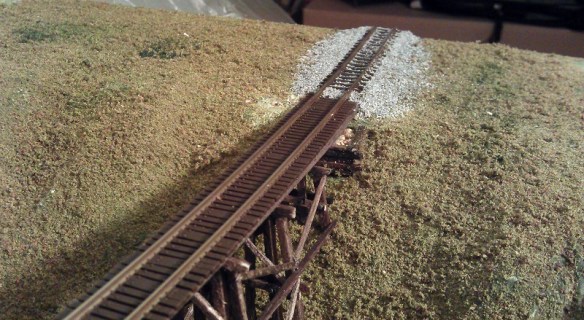
In the model world the ballast is glued down so there is no problem placing ballast right on the edge of a drop as the glue will hold it in place but in the real world wind, rain run off, train vibration and general movement will cause the ballast to fall of the edge creating a weak spot in the trackage. Where the ground gently slopes away, as in the image below, this is less of an issue as the ballast will simply form a shoulder; as it does on the sides of the track.
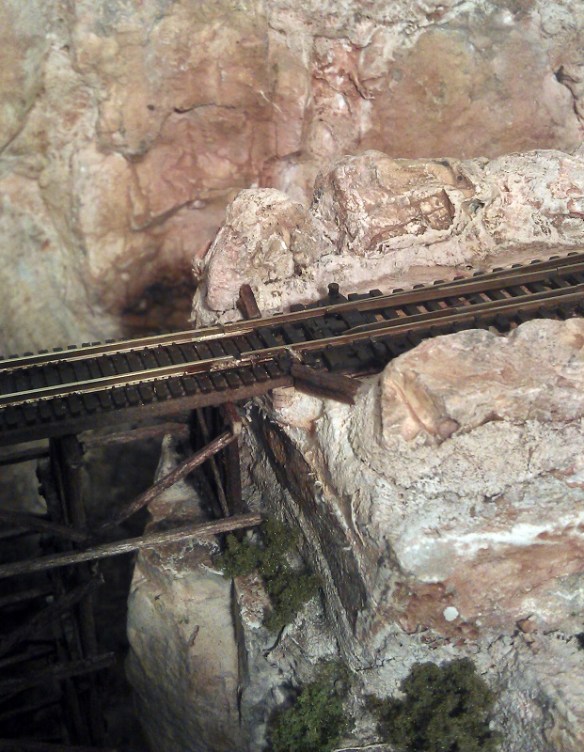
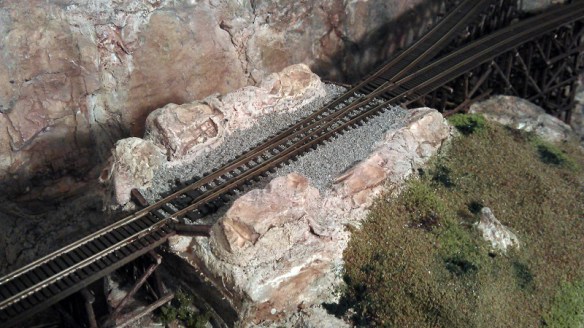
However areas where land drops of steeply or as in my case vertically the ballast needs to be contained. There are all sorts of ways to do this from using concrete to earth banks but as my trestle is made from timber it would make sense that the containing barrier would be made from timber as well. As you can see in the picture below I have created a C shape where the trestle starts.
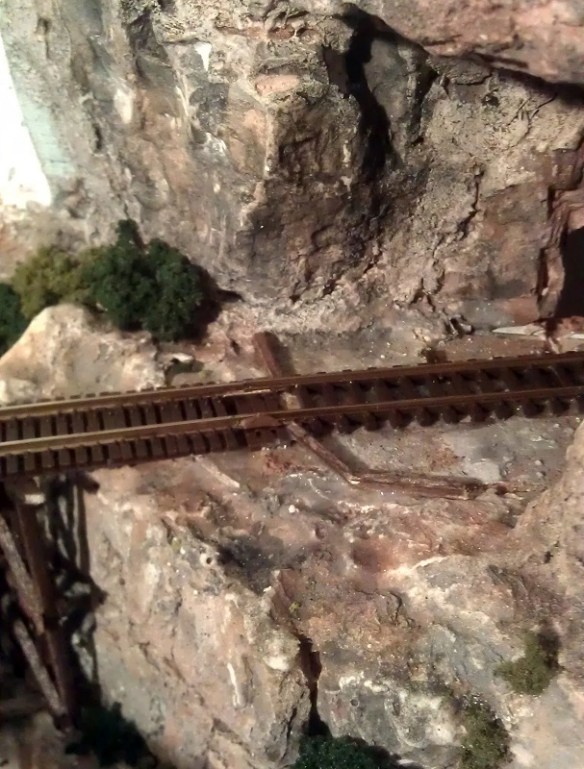
There would be no timber between the rails because the bridge ties will provide the required barrier. I have repeated this at all the trestle ends where the land drops away as you can see in the images below.
The timber has simply been glued to the scenery using white glue. Once the glue had dried it was time to add the ballast and using the same techniques as before I ballasted up to all the barriers.
With the trestle end meeting the land on a gradual slope the ballast simply runs into a shoulder as you can see below. The end of the trestle is founded on a timber frame full of rock and ballast that has been cut into the bank.
The overall effect is a well ballasted track section with clean bridge track.
The final stage to complete the trestles will be to add the check rails and safe refuges which I will cover in a later post.
As you may have read in my previous posts I am currently building a pair of modules to form part of the Gosport American Model Railroad Group’s N Scale Layout. In this post I will share with you a quick and cheap method to make some talus, boulders and general rock debris.
You can buy bags of talus form companies like Woodland Scenics in a variety of sizes but sometimes having a larger variety can be useful. If, like me, you have cast your own rocks from rock molds (you can read more about doing this here) then it’s likely you have lots of bits of plaster left over. I tend to fill up my rubber rock molds and this causes plaster to flow over the flat rubber and mold sides. When I break out the rocks these pieces break off and I collect them in a tray.
Depending on what you want to use your talus or rock debris for will depend on how you color them, but for me I want to simulate fallen rock into my canyon and rock that has been washed down the river in the winter floods. From reference materiel I have noticed that there is often less difference in the color range of the talus than in the actual rock faces. This might be because only certain parts of the rock face are crumbling due to the different rock composition so only the softer rock will be in the bottom of the canyon. Given that my dominant rock colors in the canyon are yellow ocher and burnt umber my talus will be a blend of these two colors. You can read about my rock painting process here.
So here is my recipe for rock soup! I start with a tray of plaster bits and crunch them up with my hands until they are roughly the right size. Then I pour on a bit of burnt umber that has been mixed with water at a ratio of 1 part pigment to 16 parts water. I give the mixture a stir to move the parts around.
The pigment soaks right into the dry plaster parts as you can see in the above photo. Because I didn’t add a lot of pigment it only soaked into certain faces in a similar way to the leopard spotting I used on my rocks. Next I add yellow ocher mixed at the same ratio 1 part pigment to 16 parts water. This time I added a lot more pigment so all the bits get a good soaking, hence the term ‘rock soup’.
The rocks in the tray are stirred and shaken up so all surfaces get a good coating and the mixture is left for an hour or so to ensure the rocks get thoroughly saturated. That way if they are chipped or broken they won’t show through brilliant white. Once I am happy with the amount of saturation I drain off any excess liquid and leave the rock parts to dry. This may take a day or so and it is a good idea to give them a stir now and again which will bring the wetter bits to the surface helping them to dry faster. This processes will also work on Woodland Scenics’ talus as you can see below. The lower tray is all the plaster debris and is a lighter color because it is a more porous material than the Woodland Scenics’ talus. However the two will mix together well.
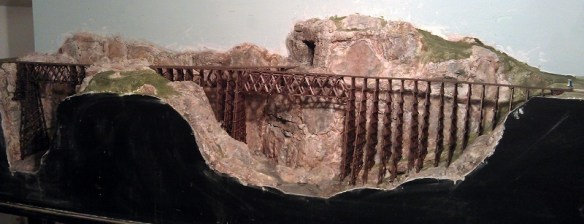
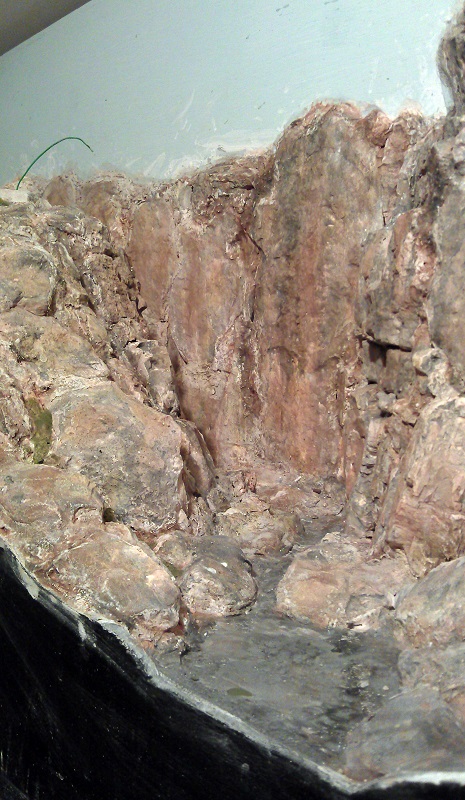
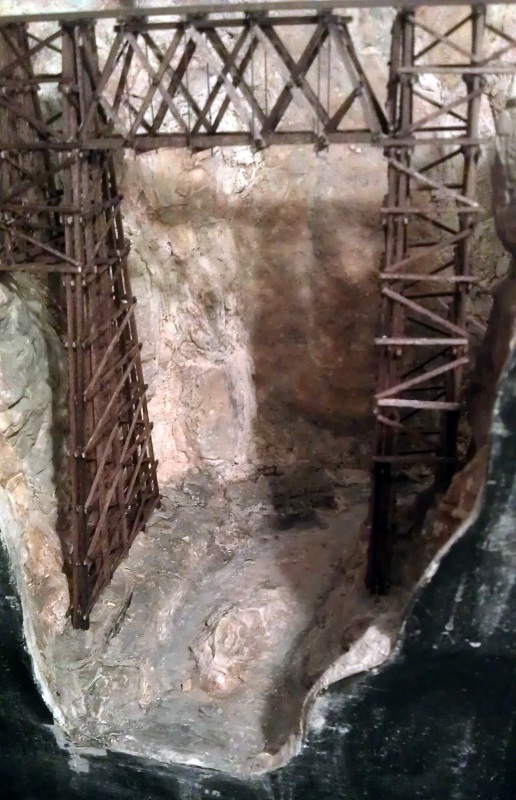
The area I am going to be using this on is the bottom of my canyon which you can see in the pictures below.
The river bed has been painted and is ready for some debris. I start by dropping some of the mixture down the rock faces to see where it lands, also I add clumps in areas that would have caught rocks when the water was flowing at full strength in the winter months. All the modules on the GAMRG’s layout are set in late summer so the water level will be low.
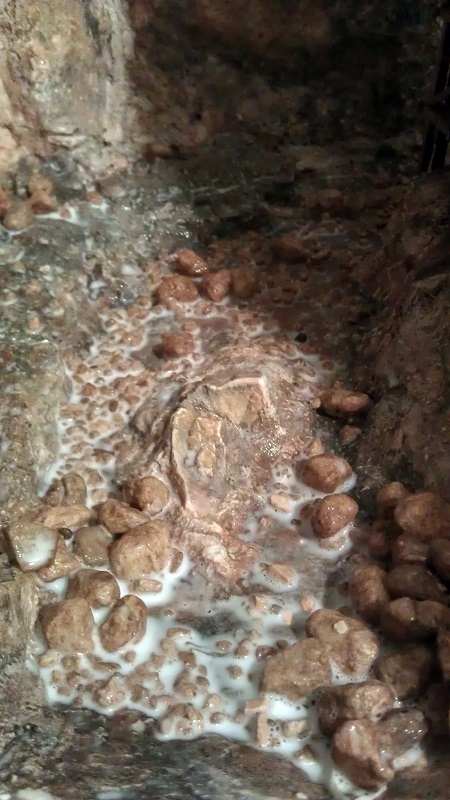
Next I use a watered down PVA glue in a spray or mister. Again Woodland Scenics sell the right glue for this called Scenic Cement but you can make your own. They also sell the spray bottle but I tend to use a basic one with a removable nozzle purchased from a garden center designed for misting plants. It is a good idea to have a bowl of water close by so you can put the nozzle in to soak between spraying as it will start to clog up. Because the mister gently soaks the areas it doesn’t move the rocks about. I tend to place the talus is several stages giving the area a good soaking of scenic cement between each layer.
As you can see below I do mean a good soaking. The talus is heavier than scenic scatter material and you don’t want it coming off the layout, especially a modular one that will get bumped around between shows.
You don’t have to wait for the first layer to dry before adding the next, in fact it is best not to as the new layer will sink into the wet glue adding to the strength.
Once you are happy with the amount and overall look give the whole area another good soak with glue and leave it overnight to dry. Don’t be tempted to touch it until it’s dry as the talus will be very easy to dislodge until the glue has totally set.
Once all the glue has dried it will become clear and leave you with a solid scene that you can add water to or simply leave as is.
I still need to add some more vegetation at the river edge and add the water itself which I will share with you in another post.
This coming weekend, the 3rd and 4 th of October 2015 I will be at the Fareham RailEX model railway show with part of the GAMRG’s N Scale layout. The exhibition will be at the Fareham Leisure Centre, Park Ln, Fareham, Hampshire PO16 7JU, UK and you can read more about the show here.
My new modules that I am working on will not be in this show as they still need a bit of work but it would still be nice to see if you are in the area.




 Once it has dried a little I put a bit more glue over the top to ensure everything makes contact.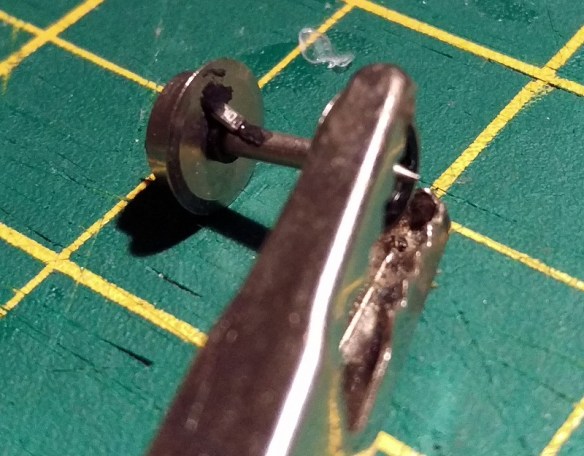




















 James' Train Parts
You must be logged in to post a comment.