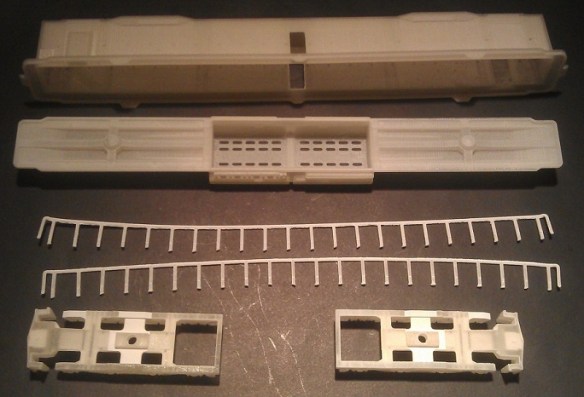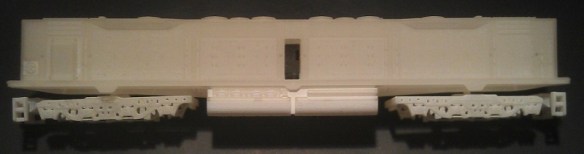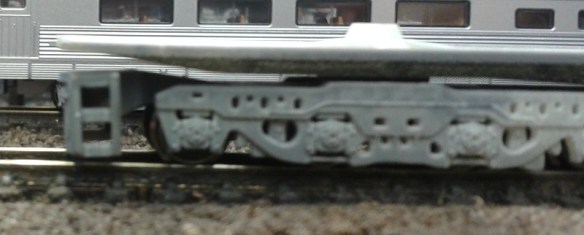
Painting and Finishing the UP Water Tenders

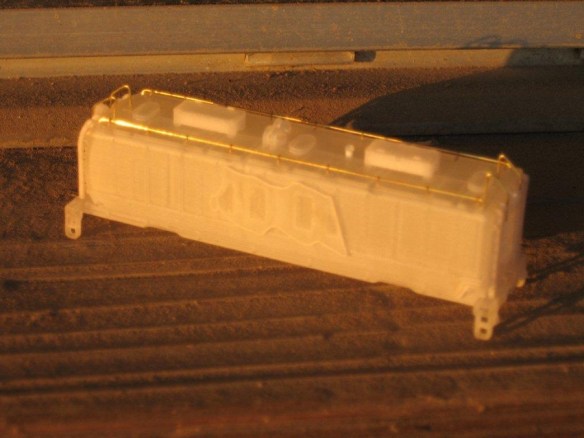
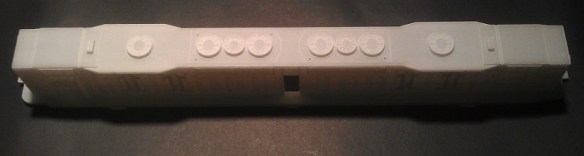
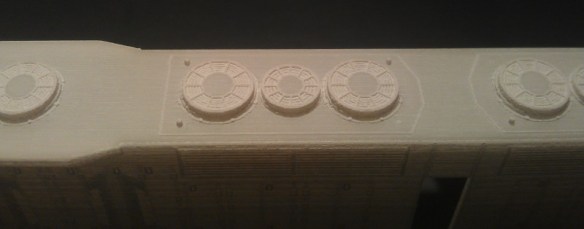
Now all the model errors have been sorted out and I have a successful test print of the UP’s rebuilt water tenders it was time to paint and decal them in order to finish the model.

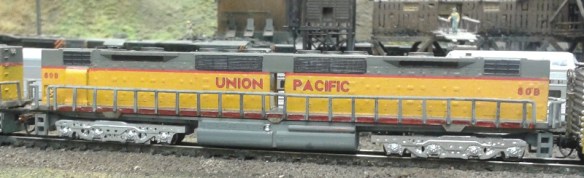
For this I handed the model over to Bob Norris who also painted the DD35 models.  He first washed all the parts again in warm soapy water to remove any oils that may have built up on the surfaces due to people handling the model.  Once dry, he glued on the headlights and tool boxes; these can be glued on at later stage but as they are going to be the same color as the top of the body it makes sense to do it now.

Once all the glue had dried, the main body, chassis and ladders where sprayed with Humbrol’s Acrylic Sea Grey from a can.  As well as being a good primer this is also a great match for UP’s Harbor Mist Gray.

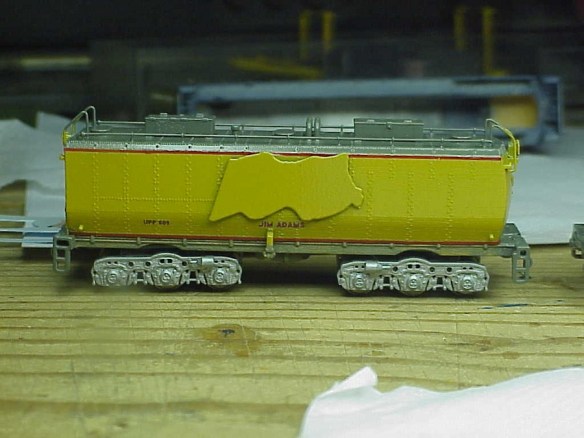
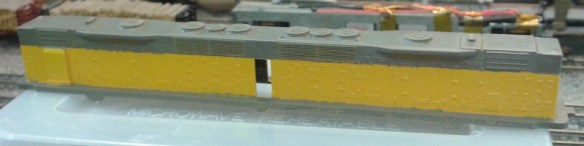
Next comes the yellow on the main body and Bob brush-painted this using Badger’s UP Armor Yellow. This paint is very thin and three coats were required to cover the primer with an even color.  For the forth and final coat Bob added a drop of PollyScale’s Signal Red into the UP Armor Yellow, this darkened the yellow to make it a perfect match to the yellow of the Kato City Of Los Angeles passenger cars.

Once the paint had dried he sprayed the whole body with Testors Glosscote; this sealed the paint and gave a nice finish.  The red lining between the gray and yellow is a red strip decal.  The other decals came from Circus City Decals & Graphics who provide a set especially for this model and can be found here.  Once the decals had been applied and set, the ladders were glued on.  The final stage was to spray the body with Testors Dullcote which removes any areas of the decals that show up shiny against the body and forms a coating to protect them.

Bob then painted the trucks with Humbrol’s Silver.  He also used a dab of this to paint the light lenses in the headlights, after which he put a drop of CA glue over the silver paint to form the actual lenses.

And here is the result

UP Water Tenders 1Several others who have purchased the kits have also sent me some pictures of the finished models and work-in-progress.

Here are Jim Reising’s UP water tenders.

Jim Reising - Water Tenders

Jim used spare handrails from a Kato Dash 9 diesel locomotive to replicate the grab rails on top.

Brian Stewart also sent some work-in-progress shots of his water tenders.
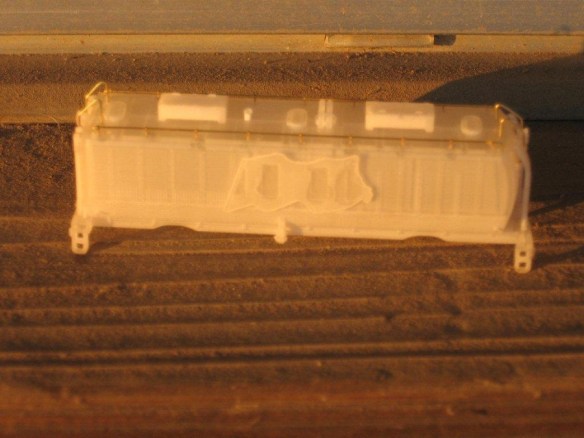
UP Water Tender 4 (Brian Stewart) UP Water Tender 3 (Brian Stewart)

Brian used brass wire to make his grab rails.
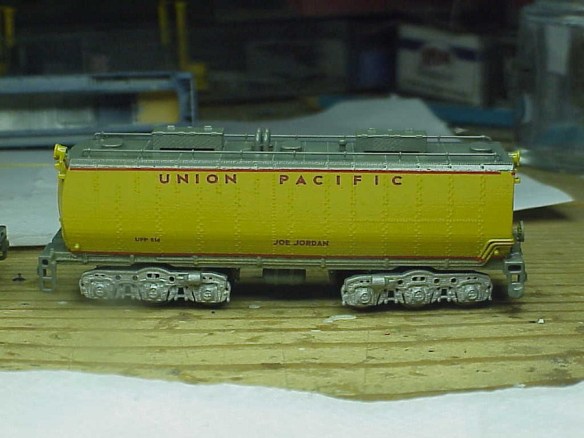
UP Water Tender 8 (Brian Stewart) UP Water Tender 7 (Brian Stewart) UP Water Tender 6 (Brian Stewart) Mark Peterson, who was also the inspiration for this project after suggesting someone make these water tenders available, used Evergreen .020″ styrene rod for his grab rails.
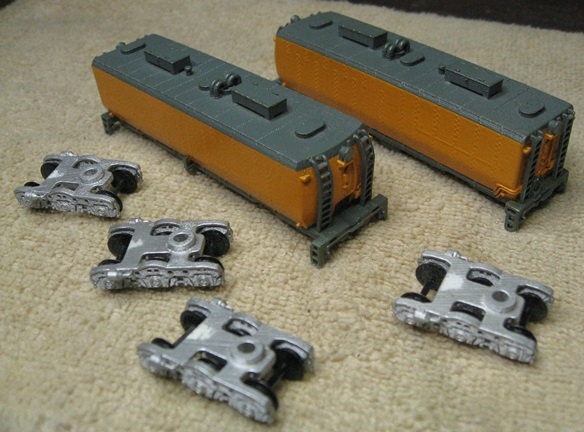
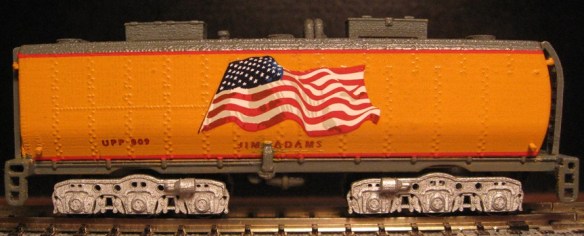
UP Water Tender 1 (Mark Peterson)

UP Water Tender 3 (Mark Peterson) UP Water Tender 2 (Mark Peterson)

UP Water Tender 4 (Mark Peterson)

Mark also has a video of his excursion train, complete with water tenders roiling through Hope, MN.

You can read more about Marks layout, ‘A Season In Hope’ and his adventures with the water tenders on his website here.

Mark’s original request however was for the UP water tenders as they appeared before they where rebuilt in 2007, so here is a sneak preview of what is coming next.

UP Water Tender (Turbine) Type 2

The test print for this car is in the post as I type and I’ll share with you what it looks like in a future post.

Completing the DD35 Set

Happy New Year!

With all the New Year festivities I haven’t gotten round to painting the new log cars, so for this post I will show you the new DD35 dummy unit which was made available just before Christmas.

When I set out to design and make the DD35 I always intended to have two, as with EMD’s original concept, top and tailed by a GP35 or something similar.  However, as is often the case with model railroading, having all the locos powered in a 4 loco lash-up is overkill, not to mention expensive.  So my second DD35 is to be a dummy unit.

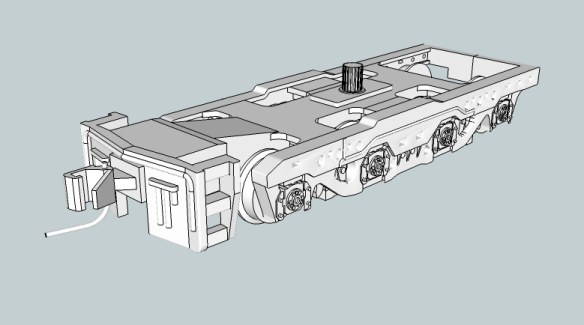
The shell for the powered DD35 was designed to fit over the Bachmann DD40AX chassis so I wanted to design a printable chassis that could be used with the same shell.  This chassis would also incorporate the fuel tank, which was separate on the powered unit, giving it rigidity.

DD35 Chassis 1

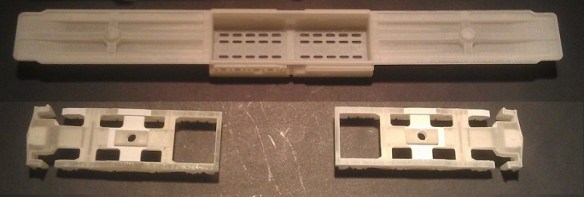
It would have been easy to draw a large flat plate  which would have made it incredibly strong, but also very expensive due to the large amount of material it would need to print it. The challenge was to design the chassis so that it is strong but also economical on material as I intended to print it in the FUD material along with a shell and trucks.

DD35 Chassis 2

I decided to draw the trucks in the style used on the DD35 rather than copying the DD40AX.  Although this would mean the trucks would look different from the ones on my powered unit I decided it would be worth it because it would be easy to change the truck sides on the powered unit at a later stage.  I originally intended to use Micro Trains plastic wheels with this unit but on reflection I decided to go with Fox Vally 36″ metal wheels; this was because I wanted to add plenty of weight to the unit to withstand locomotives pulling at one end and pushing at the other and figured that metal wheels would run a lot better with this.

DD35 Truck 1

As with Bachmann’s DD40AX the steps and couplings are part of the truck, totally non prototypical, but as that was the power chassis I have used, the dummy would have to be the same to look right.  The coupler will be a Micro Trains body mount coupler and a pocket will be provided along with a pilot hole for the screw.  The bolster pin will also be printed and is based on a typical freight car pin.

DD35 chassis 3

With the chassis and trucks ready it was time to order the print.  The chassis came out very well and was very strong, and incorporating the fuel tank definitely added to the strength.

EMD DD35 Chassis Kit

The shell which was printed with the chassis is exactly the same as a powered unit. Here you can see it after I had cut out the handrails.

EMD DD35 Dummy Kit

All the parts fitted together perfectly. Next it was time to paint them.

EMD DD35 Dummy

The painting was done by Bob Norris and went very well, the only issue he had was with the trucks.  Due to the FUD material being a bit thin around the neck, which supports the coupling, the end of the truck with the ladders drooped.

DD35 Truck 2

This was remedied by installing a strip of metal under the neck of the truck thereby strengthening it.

DD35 Truck 3

This has now also been corrected in the 3D model by adding a lot more material in that area, removing the need for a metal plate.  With the correction made it was time for testing and the unit ran very well. After a lap of the layout the FW wheels freed up and spun freely. I think there was still some wax residue it the wheel pocket.

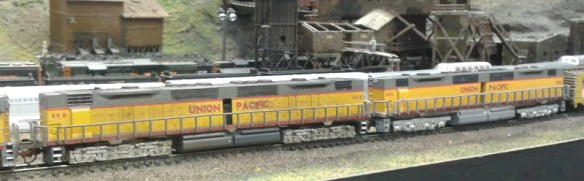
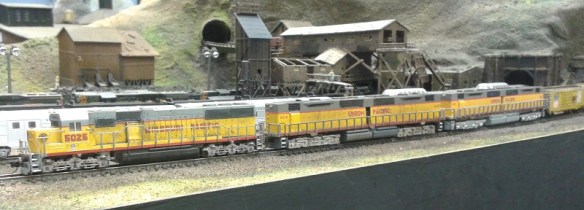
Here is the painted DD35 dummy unit. DD35 Dummy

And again with the powered unit, the dummy still needs to be weathered.

DD35s 1

And with a cab unit.

DD35s 2

And finally in a 4 loco lash-up headed by a U50.

DD35s and U50

These units will be going to the NMRA model show this weekend at Benson, in the UK, working hard pulling trains on the GAMRG club layout. If you’re in the area drop in and come and have a chat.

Fixing bowing problems in 3D FUD printed models

Now the prints have arrived it’s time to clean them up and get them ready for painting. Actually I’ve had 3 versions of the log car printed so far with each being an improvement on the last.  The first was very short on detail, due to some modeling errors which have now all been fixed.  The second came out very well although I was unhappy with the deck planks all being exactly the same length; this caused the plank detail to disappear and the model looked too square and a little unrealistic.  The third and current version looks fantastic, although when I opened the box from Shapeways I could see there was a problem.  There was a bow in the main deck of the car.  I have had this before with other prints and it has resolved itself during the cleaning process. (please see my FAQs for more information on the cleaning process).

All the parts where put into a jar containing Goo Gone to remove the wax residue as normal.  I was hoping this might help soften the FUD material and fix the problem but unfortunately this time it increased it.  Here is the car after the cleaning process was complete.Log car with bow

So why does this happen?  Well the FUD material is printed along with a wax that supports the delicate parts as the print is developed layer by layer.  Once the print run is complete the parts are put into an oven to melt away the wax.  When the parts are removed and left to cool, one side will cool quicker than the other, and because this car is long and thin it will cause it to curl, very similar to the effect caused by heating and cooling a Bimetallic strip.

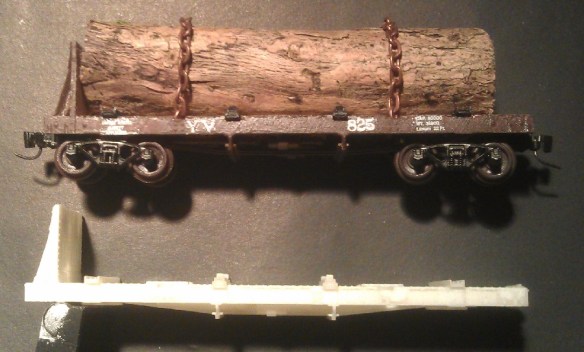
Although the Goo Gone softened the FUD material it was not enough to undo this effect, and leaving it to dry again caused the bow to increase.  However this can be removed from the model by using hot water.  Water at 150F (66°) will bring the model back to the temperature of the oven and the bend can be reshaped and as it cools it will hold the new shape.  For this log car, after making a cup of tea and letting the water in the kettle cool for a few minutes, I poured a small amount of the hot water over the middle of the car.  Almost at once it became softer and flexible, the bend straightened without any effort and I held the car in my fingers as it cooled and became ridged again.  In the photo below, the lower car is the one that had the bow in it.

Log car without bowI had to be careful as it cooled not to let the effect make the car bow the other way, if this did happen I could simply pour on a bit more hot water.  I will now leave the car to totally dry overnight, checking that the bow does not come back.

In the next post we will look at painting and decaling the car.

Fitting and finishing a DD35 shell

Now the DD35 chassis has been completed and the shell has been printed it is time to put them together.  The prints arrived, along with some other parts I have been working on, in the usual big box from Shapeways.  They were all in plastic bags and covered in the waxy residue left over from the 3D printing process which gave them a slimy feeling.  Washing them in warm soapy water is the best way to remove the bulk of this residue but be careful not to have it too hot as there is a chance the plastic may warp.  I also put the larger pieces directly under the tap, this seemed to blast a lot of it off.  Once that was done the sliminess had gone from the parts which made them much nicer to handle.  The next step was to cut the handrails from inside the shell without damaging either, this with done with a sharp craft knife.  The blade ran along the inside of the shell and one by one the handrail posts popped off.  Here are all the parts laid out ready to be test fitted.

DD35 Shell & Chassis

The shell fitted perfectly sliding over the chassis and seated on the metal shelf.  The lip all round the bottom of the shell overlapped the shelf concealing the shelf on the chassis, just as the DD40AX shell had done.  There was a bit of tolerance allowing the shell to be positioned centrally on the chassis.  The fuel tank then clipped into place with a positive click.

New DD35 Shell

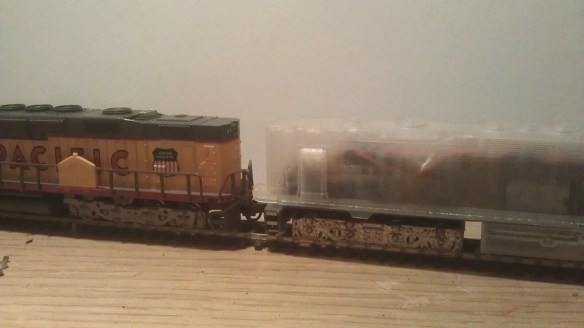
Comparing the DD35 next to a DD40AX, the walkways lined up perfectly. as did the height of the two shells.

New DD35 Shell & DD40AX

After test fitting the shell on the chassis it was time to prepare the shell for painting.  The parts, although having been cleaned in warm soapy water, still had a lot of the waxy residue in the grooves and details.  If this residue is left on the model no paint will take to the plastic so it needs to be totally removed.  A rubber cement solvent is a good way to do this but you have to be careful to find one that has no chemicals in it that will melt the FUD material.  One suitable product is Bestine, which contains Heptane.  Although this product cleans up FUD very well it is flammable and only seems to be available in the US.  I prefer to use a product called Goo Gone; this is also a US product but it is not flammable or toxic and can be ordered online and shipped just about anywhere. (It is also great for cleaning wheels).

All the parts where put into a jar containing Goo Gone and left for 24 hours.  A jar with a lid is best as the Goo Gone evaporates fast and you will want to keep the parts submerged for the process to work, and you can keep the Goo Gone in the jar to re-use the next time.  On removal the parts were washed again in warm soapy water and lightly scrubbed with an old toothbrush to wash away all the remnants of the waxy material that the Goo Gone lifted off the parts.  The parts will feel soft and flexible and they should begin to turn opaque with a yellow tint.  It is not recommended to leave them submerged any longer than 24 hours as they will continue to get softer and may start to deteriorate.  Once removed they will then need to be left to dry on paper towel for at least 24 hours.   After this they should have turned totally white and become rigid and hard once again.  The very last of the waxy residue will now have had a chemical reaction with the Goo Gone causing it to turn into powdery fuzz.  This can be scraped off with a dry toothbrush.  The main shell now looked like this.DD35 Clean Print 1

The fans still had some fuzz left in them which was a little harder to get out and took a little more persistent scrubbing with the dry toothbrush..  This was also the first time I could see all the detail and I noticed things like some missing bolt detail which was traced back to an error in the 3D model.DD35 Clean Print 2

DD35 Clean Print 3

There was also some rough patches on some of the doors which was also traced back to model errors.

DD35 Clean Print 4

DD35 Clean Print 5

Apart from the few small errors mentioned above, the first print was very good, and I was very impressed with the level of detail that came out. However, I have gone back to the original 3D drawing and ensured that future prints will not have these errors.

The shell was test fitted again just to ensure everything is okay, and it fitted just as well as before.

DD35 Clean Print 6

The shell and chassis was then handed back to Bob Norris for painting.  The shell was sprayed with UP Harbor Mist Gray and UP Armor Yellow paints from Badger paints.  The yellow was very thin and ended up being brush painted. In all this took five coats, but the detail showed up very well through the paint. The inside was also painted black to make the yellow color bolder.

DD35 First Paint

The next step, once the paint had dried, was to add the decals for the red lining, numbers and lettering.  Wet slide decals where used and these were then sealed with a coat of Testors Dullcoat (a clear matte overcoat) which stops the decals lifting off and removes any shininess from the decals and model.   The last step was to add the handrails which had also been sprayed with UP Harbor Mist Gray.  They were test fitted then super-glued into place.

2013-11-13 20.54.09

And here it is. A DD35 in N Scale, it runs perfectly and pulls like a DD35!  But as with all model railroads there is always more to do.  To weather it Bob added some grime and dirt to make the loco look like it had been working hard so he could run it with his GE U50.

EMD DD35-3

DD35 & U50

The time it took from receiving the first print from Shapeways to the finished product you see in the photo above was about a week. I have to thank Bob as his experience in painting and working on a different material whilst still achieving his usual high standard of finish meant we turned this project around a lot more quickly than if I had taken on this venture on my own. I’m very happy with the quality of the first model we’ve produced, and the next collaboration should be even better!