
Now the model of the current UP excursion train water tenders is all finished in N scale, I turned my attention to the Pre-Rebuilt version.
My original thoughts were that this would be an easy design, as I had already drawn the main components, all that I would need to do is remove the embellishments, adjust the shape and print. I was very wrong. Although the two designs were built from the same tender they went through a lot of changes to get from old to new.
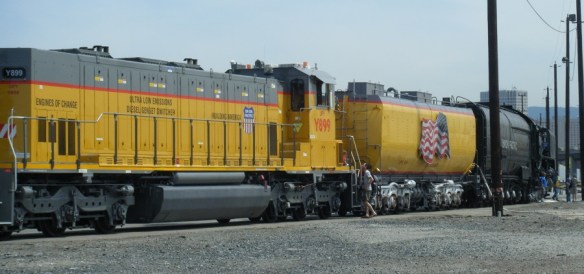
Here are two of the tenders in their 1955-2007 configuration.
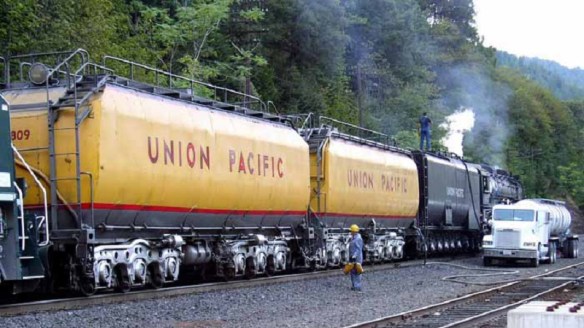
(Photo by Richard Wrede: UP 3985 In Dunsmuir,Ca. taken in 2005)
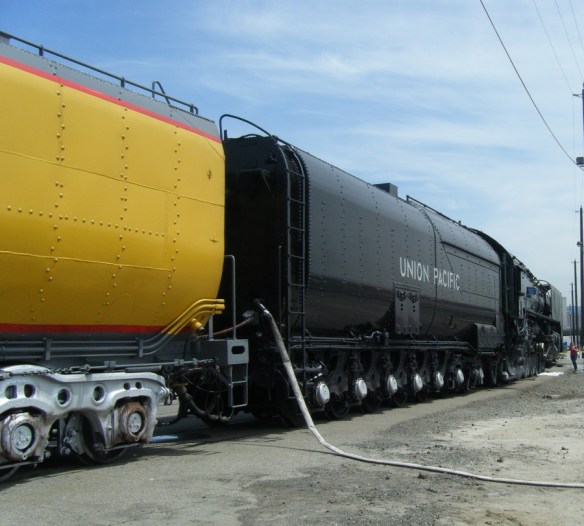
And here is one in it’s 2007-present configuration, and yes they are the same type of tender.

The obvious details that where different from the new 2007-present tender such as the grab rail on the top and the chamfered ends would be fairly easy to do. The main challenge I encountered was the actual shape if the tender body. The Pre-Rebuilt body is wider, and longer. Not because it is bigger inside but because the whole tender was insulated and clad with a second metal skin. These tenders were ‘hand me downs’ form the large 8500 class Gas Turbines, this cladding covered the heating equipment and insulation which was used to heat the Bunker C fuel oil. Remembering we are working in N scale at 1:160 I pondered about not changing the body width, that would mean all I had to do was remove the rivet detail from the sides. But I just could not bring myself to do it so I widened and lengthened the bodies. This in turn meant both ends had to be remodeled as the radius intersections where the curved areas meet the sides all moved.
With new body modeled in, I could then start adding the detail. Service holes on the sides are shown below.
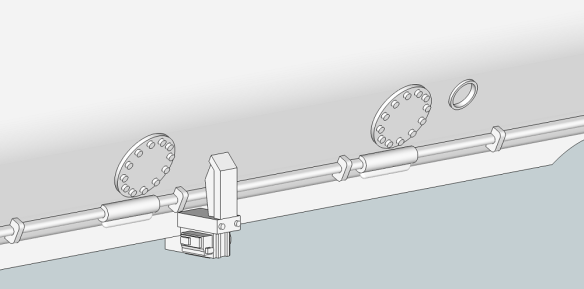
End pipe work and electrical ports.
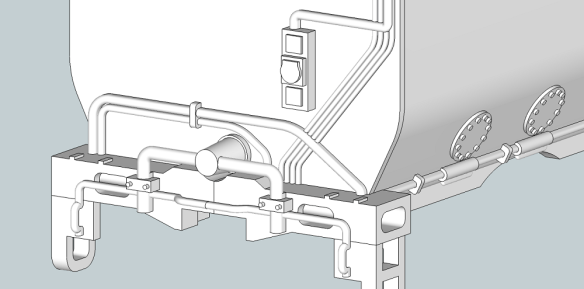

And side piping.

This cars had a lot of piping and from the reference material I could find, it varied from car to car. The two most common differences I could find, mainly with the pair UP have been using with the heritage fleet, was one had piping running over the top to the service hatch and one did not. Here is the pipe work going to the hatch.

Using the reference material I was able to mostly work out where the pipes went, some just seemed to go nowhere. Putting them in over the curved end was the trickiest part as this surface curves in two directions and the pipes don’t run in a straight line. The piping on the model is not actually round, to give it strength it is curved on top and squared down to the body, making it into an elevated detail rather than a separate object. This is almost impossible to see in N scale and gives the look of piping running over the body, plus it makes it strong.
Next came the top area, and this car it is covered with an open grill mesh. This is very hard to do, not that it can’t be printed but because it would either look way too chunky or be so fragile it is unlikely to survive the cleaning and handling process. To overcome this, the piping which runs along the side of the body between the grill mesh and the top of the body has been closed off as shown below forming a solid object.

The grill has then been drawn as a recessed detail which now forms the top of the car.
The end ladders are also different on this tender, plus they had steps made from the same grill mesh. This made them fairly quick to model, plus this time all four are the same.

As for the grab rails along the top, once again they would either look way too chunky or be too fragile so I have not included them in the print, however we will cover them in a later post.
The final details to add such as the tool box came last. The trucks and chassis where used from the previous water tender model, although I couldn’t help my self and did some improvements on those too.
And here is the finished 3D model.

And you can get them here.
So not the quick turnaround I first considered, but I think well worth the extra effort. The model is sized correctly and I think it will look fantastic. In a later post I will show how it came out.
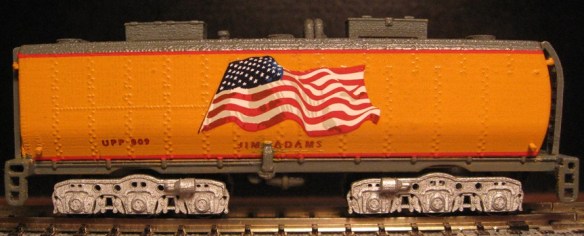
 Several others who have purchased the kits have also sent me some pictures of the finished models and work-in-progress.
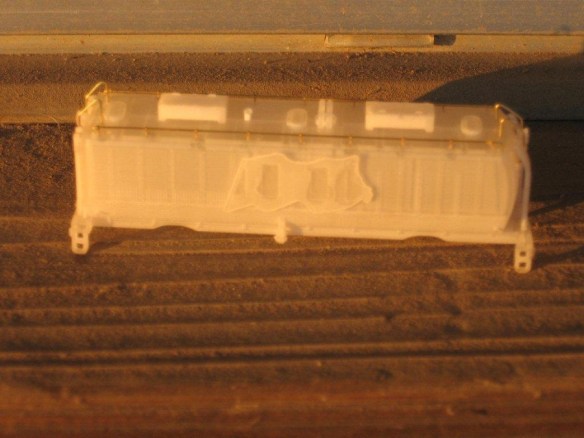
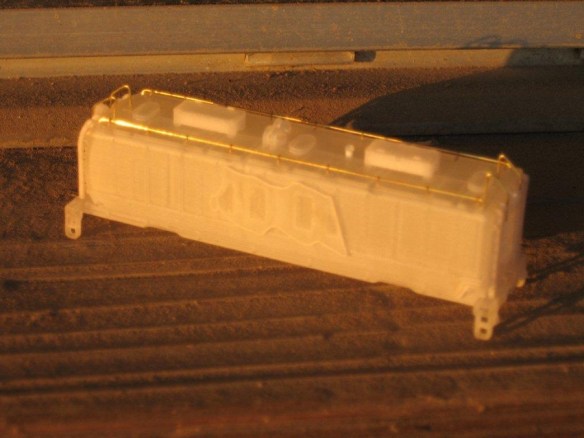
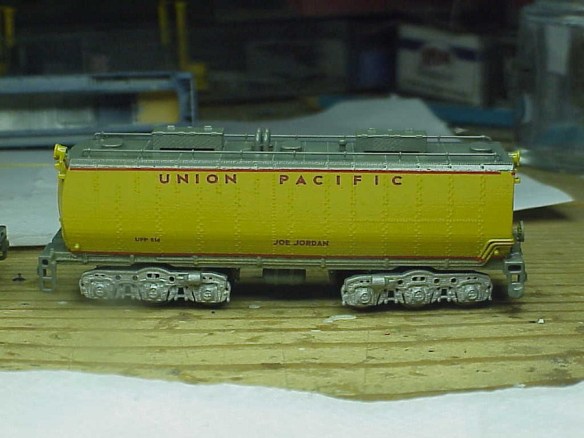
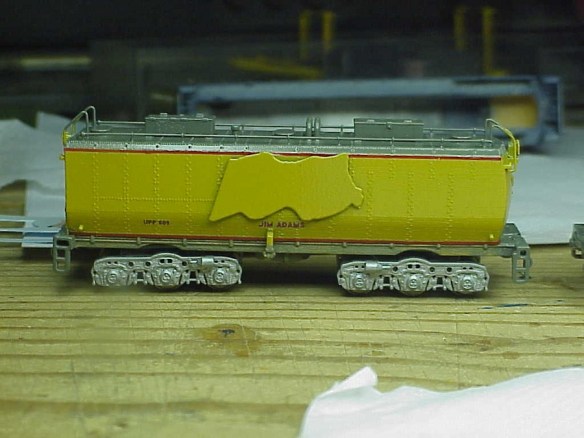
 Mark Peterson, who was also the inspiration for this project after suggesting someone make these water tenders available, used Evergreen .020″ styrene rod for his grab rails.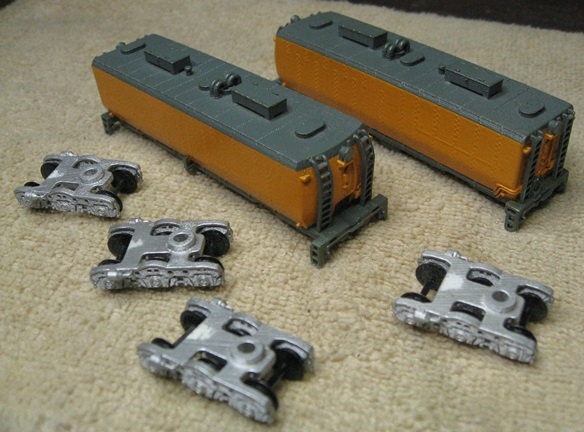


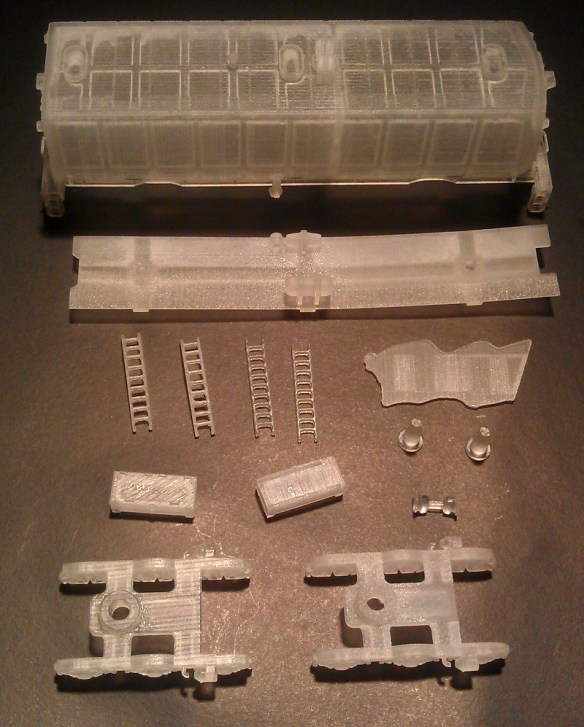 The water removed a lot of the residue but it would still need to be soaked in Goo Gone for 24 hours to totally eradicate it. At this stage the detailed parts start to become easier to see as well as the few areas which had not printed correctly. For example, on the trucks at the bottom of the photo you can see the air cylinders and the pipes running back into the trucks; there is a gap between them that should not be there. Looking back at the 3D model it became apparent there was an error which did not show up easily. This was fixed before releasing the model. There were also some other minor issues with the piping, once again all traced back to the 3D model; these were also fixed. One of the most noticeable things in this photo is the chassis which has a bow in it. This chassis is very thin to help keep the cost of printing the model down, however is not a concern as this particular model is designed so the strength comes from the main body, which is very strong due to the multi-curved surfaces. The chassis straightens out when put into place. Once the model is cleaned, painted and the trucks have been attached, the chassis is designed to be glued in place making a very strong, complete body. For reference, should you receive a chassis, or any other part, that is bowed more than is shown in this picture, it can be easily be corrected using hot water as described n this previous




 James' Train Parts
You must be logged in to post a comment.